

The next AI job is not just coding: Meet the engineers who solve people problems

AI is changing what companies expect from engineers. Forward Deployed Engineers, or FDEs, combine coding with business understanding, communication and problem-solving. As companies move from AI demos to real-world deployment, experts explain why engineers who can work with customers and navigate messy business problems may become increasingly valuable.

Forward Deployed Engineers, or FDEs, combine coding with business understanding, communication and problem-solving. (AI-generated image)

New Delhi,UPDATED: Sep 16, 2026 14:52 IST
A company wants to automate billing. The software works in a demonstration. The client likes it. Then someone asks a simple question: Will it work with our legacy systems, incomplete data, security rules and the way employees actually process payments?
That is where many AI projects get complicated.
A business manager may not know exactly what AI can realistically solve. Employees may have workflows that do not fit a neat software specification. A client may change priorities halfway through a project. Technical teams and business teams may describe the same problem differently.
And sometimes, a solution that looks impressive in a demo simply does not work in daily use.
This is driving interest in a new kind of engineering role: the Forward Deployed Engineer, or FDE.
An FDE is an engineer who works directly with customers to understand a problem, decide what should be built, and take the solution into production. Pioneered by Palantir, the role combines engineering with problem discovery, stakeholder management and business understanding.
The FDE Academy's September 2026 report, The Forward Deployed Engineer Talent Landscape in India, treats FDE as more than a job title. It identifies six capabilities at its core: engineering, enterprise architecture, product thinking, consulting and stakeholder management, domain expertise, and end-to-end deployment ownership.
FROM WRITING CODE TO SOLVING THE RIGHT PROBLEM
"Forward Deployed Engineers signal a fundamental shift: from engineers who write code to engineers who solve business problems with code," says Amit Gajwani, Chief Operating Officer at Mastek.
Here is a simplified comparison:
Traditional engineering approach | FDE approach |
|---|---|
Starts with a defined technical brief | Starts by understanding the actual business problem |
Builds against requirements | Helps discover and refine requirements |
May work through separate delivery teams | Works directly with clients and business teams |
Focuses on whether the software works | Also focuses on whether the solution creates business value |
Chetan Mangalwedhe, Founder and CEO of TalentiFi-X, says CS degrees, coding, Python, cloud and AI projects can still open doors to core engineering roles. But client-facing roles increasingly demand evidence that candidates can take a solution beyond the technical environment.
"What they look for now is evidence of real deployments, not just pedigree," he says. "Have you sat with a business team, mapped the actual process, and shipped something that stayed in production?"
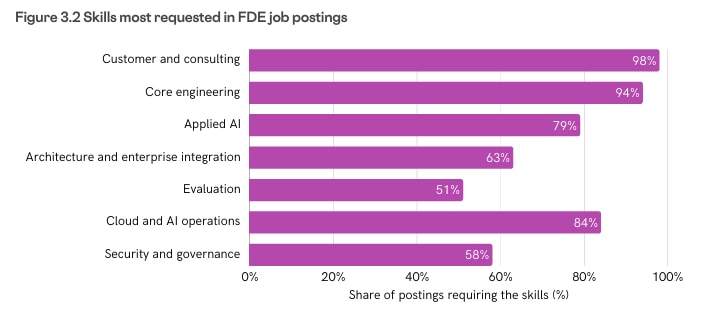
In practice, that means customer discovery, domain knowledge, problem-solving under constraints, communication, AI judgment and ownership of the outcome.
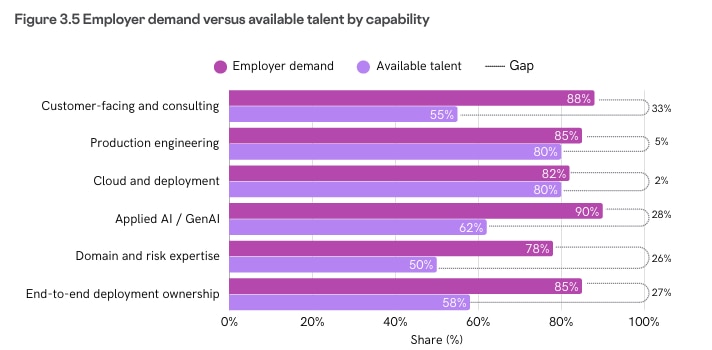
The FDE Academy's employer survey found that employer demand for forward-deployed AI builders stood at 95%, compared with an available talent supply of 45%, pointing to a 50-percentage-point gap.
Within the role, the widest capability gap was in customer-facing and consulting skills, which 88% of employers sought against availability among 55% of the talent pool. Production engineering, by comparison, showed a narrower five-point gap, with demand at 85% and talent availability at 80%.
It also found gaps in applied AI/GenAI, domain and risk expertise, and end-to-end deployment ownership.
"AI can write a lot of the code now. It cannot earn trust in a client meeting or decide which problem is worth solving first," Mangalwedhe says.
WHAT AN FDE LOOKS LIKE IN THE REAL WORLD
FDE applications span industries, from fraud detection and credit assessment in BFSI to clinical documentation, predictive maintenance, demand forecasting and IT workflow automation. The common thread is fitting AI into an existing business process rather than building it in isolation.

At Tredence, the shift is already being tested through client projects.
Pavan Nanjundaiah, Head of AI Transformation at Tredence, described a five-day workshop for a global consumer packaged goods company that wanted to automate its billing and payment process.
In the conventional model, consultants might spend weeks gathering requirements before handing a detailed document to an offshore development team. The final product could take months to arrive, by which time the client's needs may have changed.
Tredence instead sent two FDEs to the client's office.
"By the end of day one, they deeply understood how the business worked," Nanjundaiah says. "That same evening, using cloud systems and AI coding assistants, they built a live, clickable prototype."
The client could see the solution early, respond to it and suggest changes. The prototype evolved through the week, and by day five, the company had signed off on a working model.
According to Tredence, the project was completed in four months instead of the original six-month timeline, partly because the engineering team received a live prototype rather than a lengthy requirements document.
The example captures the FDE difference: discovering the problem, testing the solution and shortening the distance between business need and technology.

WHY TRAINING IS CHANGING
The FDE role also challenges how engineers are traditionally trained.
Amar Srivastava, CEO-Online and Group CPO at Scaler, says a conventional software engineer is often given a defined technical problem, while an FDE must understand the client's systems, constraints and business context before taking a solution to production.
"All of this requires technical depth combined with equally strong judgement, problem discovery, communication skills, stakeholder management and comfort with ambiguity," he says.
Scaler's FDE curriculum covers messy data, legacy systems, security constraints, AI application engineering, evaluation, observability and deployment, with communication embedded throughout.
Its FDE Judge simulator puts learners through client scenarios involving imperfect data, competing requirements and time constraints, requiring them to scope problems, design solutions and defend decisions to a simulated CTO.
"The first instinct of an FDE should not be to start building, it should be to unpack the problem, understand the constraints, and identify how technology can help," Srivastava says. "Sometimes that may mean AI, and sometimes it may not."
Scaler projects more than 50,000 FDE and FDE-adjacent roles by 2027, while the FDE Academy’s September 2026 report says demand for FDE talent is expected to outpace available supply through 2027–28.
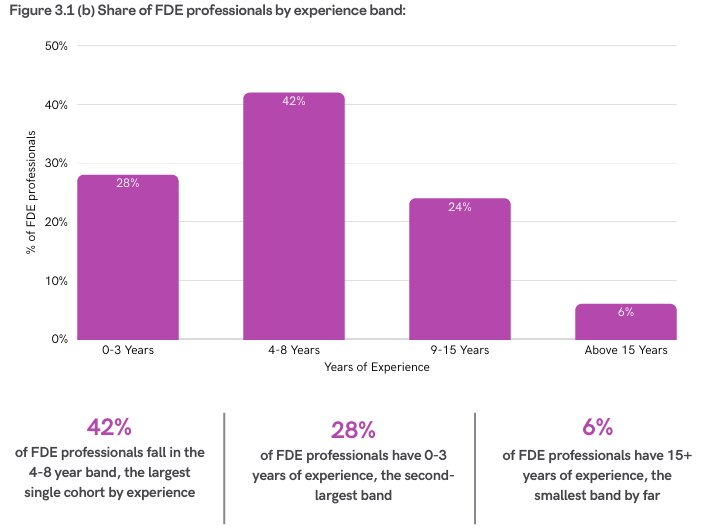
The role may also be more accessible to mid-career engineers than its frontier-AI image suggests. The FDE Academy report found that 70% of the FDE professionals in its analysis had eight years of experience or less, including 28% with up to three years of experience and 42% with four to eight years.
Coursera data points to a similar shift in learner interest: demand for AI application skills among Indian learners grew 80% year-on-year, suggesting growing interest in skills that take AI from concepts to practical use.
Scaler says its FDE programme had crossed 100 enrolments within about six weeks of launch. An Indeed report also shows a 1,807% rise in FDE job postings in India between June 2025 and June 2026.
Tredence, meanwhile, says it has around 60 FDEs actively deployed and is working towards a team of 200 FDEs by the end of next year.
THE BIGGER SHIFT: AI-FLUENT, BUSINESS-READY TALENT
The FDE is one visible example of a wider change in the workforce.
Jaspreet Bindra, Co-founder and CEO of AI & Beyond, says the move from AI experimentation to deployment is changing what companies expect from engineers.
"It is no longer enough to build a technically impressive model or application; the bigger question is whether it solves a meaningful business problem and can work reliably within an organisation’s processes," he says.

Mastek's Gajwani similarly says the company is investing in consulting-style communication, domain immersion and problem-framing alongside technical certification.
"An engineer who can only code has become the easy part to replace or automate," he says. "An engineer who can think critically, translate business needs into practical solutions and deliver measurable outcomes will remain indispensable."
The role of an FDE is moving beyond the AI startups that helped popularise it. The FDE Academy report found that 38% of FDE professionals in its analysis worked at Big Tech firms, while IT services and consulting firms and product companies accounted for 24% each. AI-first startups accounted for 14%.
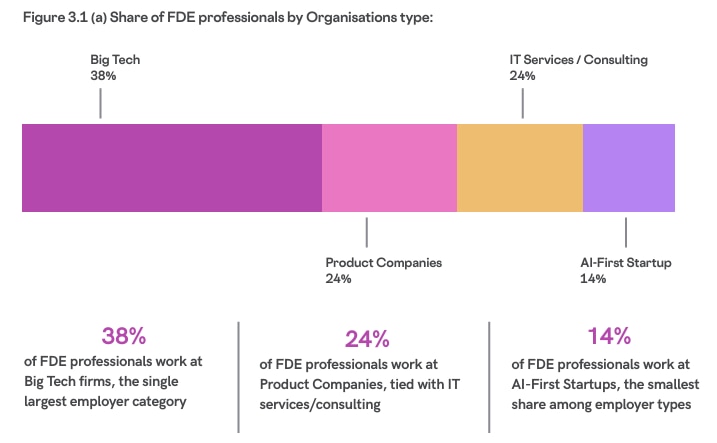
The data suggests FDE-type work is spreading beyond AI-first startups into Big Tech, services and product companies.
Coding is not becoming irrelevant. FDEs still need to ship production-grade software. But, as Mangalwedhe put it, "What has changed is what sits next to the code."
For engineers, that means learning to ask better questions, understand business workflows, communicate with customers and judge whether a technical solution is worth deploying.
- Ends