


India's Best Colleges 2026
ADVERTISEMENT
Engineering (Government) | Cutting edge of innovation | Indian Institute of Technology (IIT) Delhi
AI is not just a standalone specialisation at IIT Delhi but a foundational skill, driving a broader transformation in how students learn, collaborate and innovate
-
- Shelly Anand
As artificial intelligence reshapes industries, careers and classrooms, IIT Delhi is undertaking one of the most significant academic overhauls in its history. The institute’s vision for 2026 is not about adding more programmes but about rethinking what students learn, how they learn and how they prepare for a rapidly changing world.
At the heart of this transformation is a stronger emphasis on interdisciplinary education. A new MSc programme in Cognitive Sciences brings together expertise from the School of Humanities and Social Sciences, the School of Artificial Intelligence and the institute’s biological sciences ecosystem. By combining philosophy, logic, neuroscience and AI, the programme reflects IIT Delhi’s belief that tomorrow’s challenges will require knowledge that cuts across traditional disciplinary boundaries.

That philosophy is increasingly shaping the institute’s broader academic framework. Undergraduate students now enjoy greater flexibility to take cross-disciplinary electives, pursue customised minors and switch majors more easily. The goal is to move beyond rigid academic silos and enable students to shape their own educational journeys, much like at leading global universities.
AI is central to this shift, with IIT Delhi integrating it across disciplines. A Rs 100-crore philanthropic contribution from alumnus Anant Yardi, a pioneer in the use of AI in the real estate sector, has further bolstered these efforts through the Yardi School of Artificial Intelligence. Yet, as Dean (Planning) Prof. Somnath Baidya Roy points out, AI is being treated not as a standalone specialisation but as a foundational skill for all students.
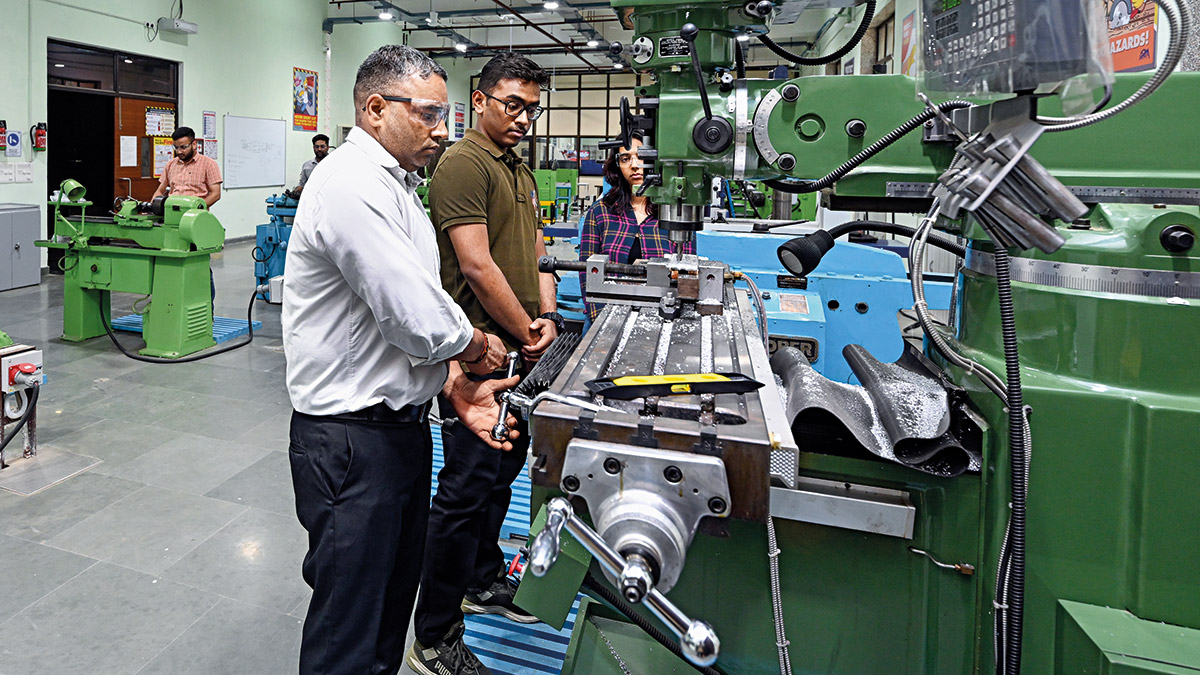
Beyond academics, IIT Delhi is placing greater emphasis on experiential learning. Summer internships have become mandatory for both undergraduate and MTech students, while doctoral scholars are being encouraged to engage more closely with industry. The objective is to expose students to the realities of professional life—working in teams, managing deadlines and solving real-world problems. Students are also being encouraged to think beyond conventional career paths. Prof. Roy, for instance, urges them to pursue a “side project” from their first year itself—be it a startup, research initiative, creative venture or social enterprise—to cultivate entrepreneurial thinking and resilience in a rapidly evolving technological landscape.


ADVERTISEMENT