
A deep dive into Indian dance | Justin McCarthy's 'From The Corner Of Her Eye'

Justin McCarthy's 'From the Corner of Her Eye' offers a richly researched exploration of Bharatanatyam's history and the sociopolitical forces that shaped the dance form
 Last UpdatedNov 24, 2026 19:44 IST
 Published by
Justin McCarthy’s From the Corner of Her Eye: The Many Histories of Bharatanatyam is a grand tour of the landscape, ecosystems, political realities and financial struggles of many Bharatanatyam dancers of yore. McCarthy is a first-rate researcher and raconteur. Being also a fine pianist, he delights in the portions that are about music. He tells many imagined tales and adds to our knowledge bank. In that, this book is a must-read for any practitioner of Bharatanatyam or Indian dance. Though one wonders why the form is spelt with a small ‘b’ in most places and with a capital ‘B’ in some. Western dictionaries often don’t state Indian dance forms with capitals. However, Salsa and Flamenco are capitalised.
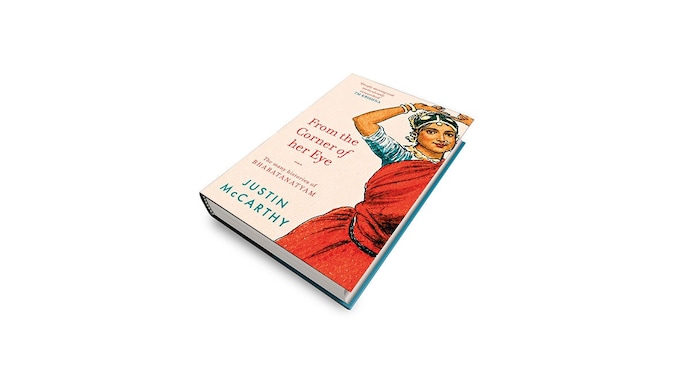
Indian dance is a rich visual art and a dance book is often a visual delight, driven by the colours and costumes of Indian dances. This book, with less than a dozen insipid black and white photos—one is even AI generated—lacks visual appeal, making the textually rich book a laboured tome. However, the cover by Bhavi Mehta is fetching, as are each chapter’s head sketches.
McCarthy connects the dots well on karnas (page 17), kritis (page 95) and kuravanjis (page 113). The patronage of the merchant class—the Chettiars and Mudaliars—rarely touched upon in other books on Bharatanatyam, is platformed well, and he deserves credit for that. The polarisation between Devadasi and Brahmin Bharatanatyam is, commendably, taken up too. McCarthy is often more a sociologist than a historian by disposition (Balamani, page 188, etc). The political battle over an art form is well captured (page 239 onwards). McCarthy has the eye of a sympathetic practitioner for the marginalised dancers of the past but has crammed in so much ancillary information that there’s a lack of the process of writing history. All footnotes are accessed through a QR code in the end section. That is very cumbersome.
Who is this book primarily for? Is it to serve as a teaching tool in universities here in India, or is it meant for markets abroad? Most Indian dancers, often being self-absorbed brahmagyaanis, rarely buy books or read anything unless it’s about themselves! Still, keep it coming, Justin.
—Ashish Khokar is an authority on dance as a historian, archivist, author and critic