

FIFA World Cup 2026 | Why India is missing

As smaller nations light up the World Cup, Indian football languishes in neglect and indecision
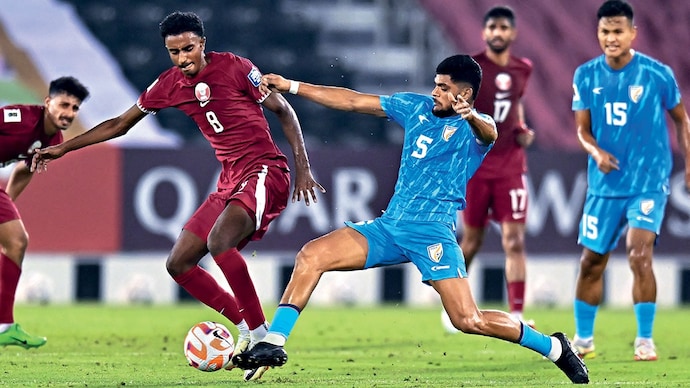
CREATING A CHANCE: India's Mehtab Singh (second from right) in action against Qatar at the AFC second round of qualifications for the 2026 World Cup, Jun. 2024 (Photo: AFP)
ISSUE DATE: Jul 20, 2026 | Jul 10, 2026 19:24 IST Last UpdatedJul 10, 2026 19:24 IST
 Published by
Last UpdatedJul 10, 2026 19:24 IST Published byMansi
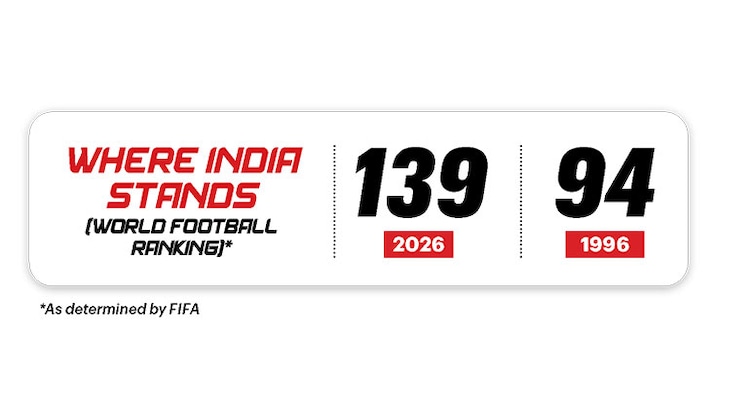
Jul 10, 2026 19:24 ISTAs millions stayed awake through the night in early July to watch Cabo Verde’s spirited performance against defending champions Argentina at the 2026 FIFA World Cup, football fans in India wondered how a tiny archipelago off the coast of Africa, only slightly bigger than Goa, is squaring up against footballing giants, while even qualifying for the tournament remains a distant dream for India. The sorry state of Indian football showed when India was forced to withdraw from the 2026 Asian Games because the men’s team failed to satisfy the Union sports ministry’s criterion of being among Asia’s top eight. India ranks 24 among the 46 members of the Asian Football Confederation (AFC) and the team failed to qualify yet again for the AFC Asian Cup 2027, the foremost competition in the continent. India’s quest to make history collapsed in 2024 itself in the second round of the AFC qualifiers. Competing in Group A alongside Qatar, Kuwait and Afghanistan, it failed to secure a top two finish needed to progress in the World Cup qualifiers. The Blue Tigers managed just one win—against Kuwait—their first away win in 22 years.
Arkamoy Datta Majumdar is an Assistant Editor with India Today magazine, based in Kolkata. He writes about politics, international relationship, football, and society, with a particular focus on eastern India and the political transformation of West Bengal. He oversees the editorial operations in the eastern states of West Bengal, Odisha and Sikkim.
His reporting sits at the intersection of politics and everyday life. He covers elections and political parties, governance and public policy, political movements, identity and cultural politics, federalism, border issues and the changing relationship between the state and its citizens. In West Bengal, his work has closely followed the rise of the BJP, the evolution of the Trinamool Congress, the Left and Congress, electoral politics, voter-list and citizenship questions, welfare politics and the ways in which political competition increasingly plays out through culture, religion, education and public institutions. He has covered the crucial Bangladesh elections of 2026 from Dhaka.
He also follows the wider politics of the eastern region, particularly where questions of borders, migration, regional identity, security and diplomacy intersect with domestic politics.
For Arkamoy, political journalism is as much about understanding people and places as it is about following politicians. He is interested in what happens between an announcement and its implementation, between a political slogan and its impact on the ground, and in the quieter social and cultural shifts that often reveal where politics is heading.
READ MORE
Suhani Singh is a Deputy Editor at India Today magazine, where she writes on entertainment, sports and culture. Based in Mumbai, she has been a part of the India Today Group since 2013. She began her journalistic career covering dance and film beats for Time Out Mumbai magazine. She is also a member of the Film Critics Guild.
READ MORE