
Breaking down box office maths: Popcorn or tickets, what pays theatre bills?
Ever wondered where your movie ticket money actually goes? In today's piece, we decode the business behind the big screen – from ticket splits and popcorn profits to why multiplexes and single-screen theatres play by different rules.

Who actually pays cinema halls? (Photo: Author)

New Delhi,UPDATED: Jun 28, 2026 12:30 IST
Imagine you’re a little kid, clutching your mum’s hand, eyes wide as you step into a cool, dark cinema hall. The lights dim, the screen lights up with your favourite hero, and suddenly you’re in another world.
But behind the magic, there’s a clever money story happening – one that keeps the popcorn popping and the lights on. Today, let’s pull back the curtain, nice and simple, like chatting over ice cream. How do cinema halls really make their money?
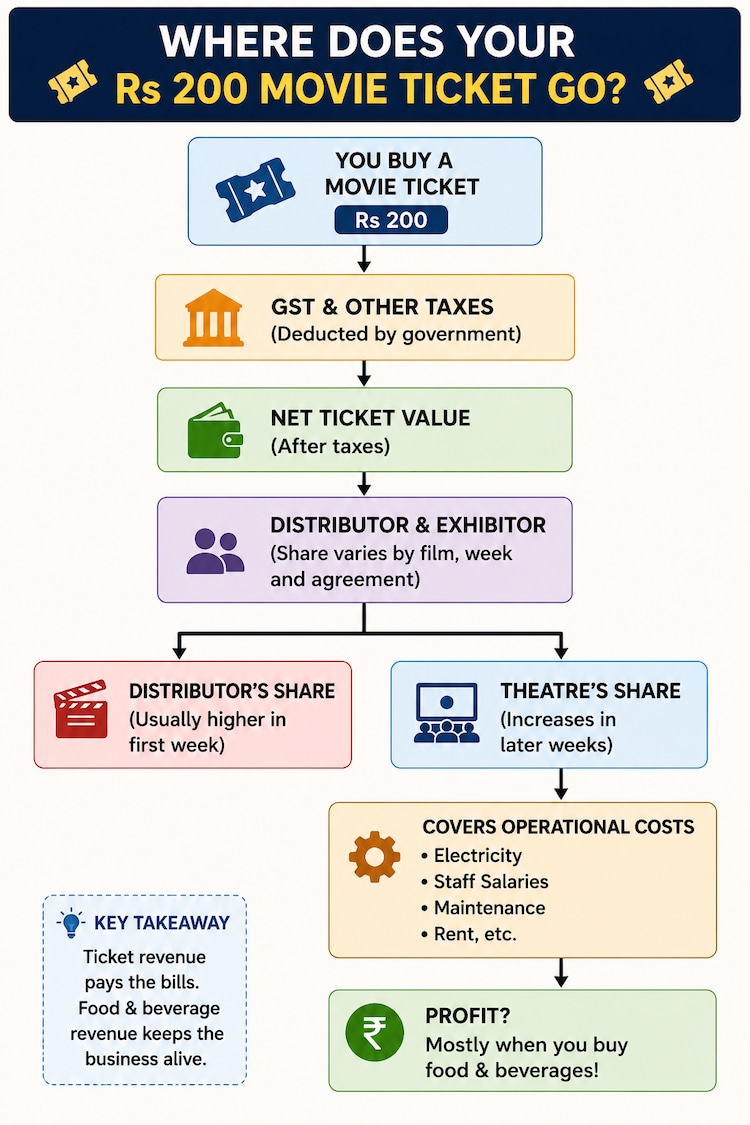
The ticket magic: Where does your Rs 200 go?
You hand over 200 (or more) for a ticket at a shiny multiplex like PVR or INOX. It feels like a lot, right?
But not all of it stays with the theatre. First, the government takes its share – think of it as pocket money tax, usually around 18 per cent GST on tickets above a certain price. What’s left is the “net” collection.
Then comes the big split.
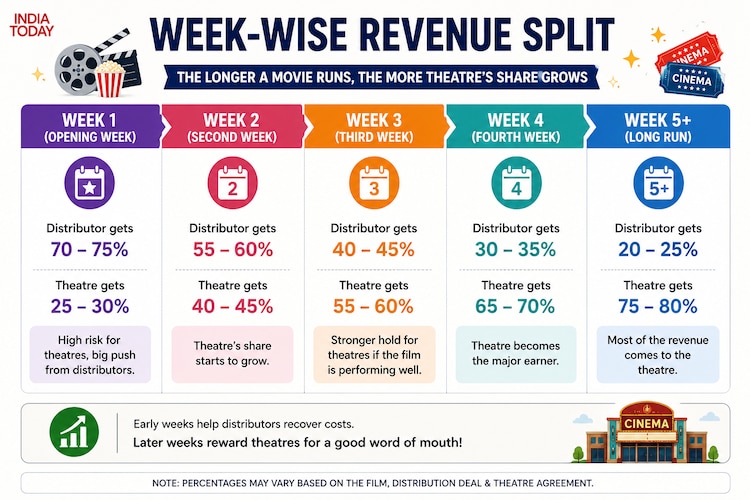
In the first week of a big film, it’s often roughly 50–50 between the theatre (exhibitor) and the distributor (who represents the producer). As weeks go by, the theatre’s share grows because they’re taking the risk of keeping seats warm if the movie slows down. For a hit film, producers might negotiate a slightly better deal.
That's one of the biggest misconceptions about the exhibition business, says Ruban Madhivanan, who runs the massive chain of GK Cinemas in Chennai, in an exclusive conversation with India Today.
"When someone buys a ticket, taxes are deducted first. The remaining amount is shared with the distributor, and for big-star films, distributors can take as much as 70 per cent. Ticket sales largely help us recover operating costs."
Here’s a simple table for a Rs 200 ticket (rough numbers for understanding – real splits vary by film, week, and deal):
Over the run, the theatre might end up with 45–55 per cent or more of the net. For big Hindi or South blockbusters, multiplexes often do well because tickets cost more (150–500+ depending on city, time, and screen).
Hit, superhit or blockbuster? What these labels really mean
Let's understand this first: Every Friday, trade analysts begin tracking a film's box-office journey. But a movie isn't judged by its collection alone. In the film business, the first question is always: Did the film recover what it cost to make?
That milestone is called the break-even point – when a film has earned enough to recover its production and marketing costs, along with the investments made by distributors. Once a movie crosses that mark, it begins generating profits.
From there, the trade assigns verdicts based on return on investment (ROI) rather than headline collections. A film that earns healthy profits is generally considered a hit. If it significantly exceeds expectations and delivers exceptional returns, it becomes a superhit. Films that multiply their investment several times over and dominate the box office earn the coveted blockbuster tag, while an all-time blockbuster is reserved for the rare few that shatter records, generate extraordinary profits and leave a lasting cultural impact.
This is why box-office numbers can sometimes be misleading.
A film made on a Rs 60 crore budget that earns Rs 250 crore could be a far bigger commercial success than a Rs 500 crore spectacle collecting Rs 600 crore. In cinema, it's not just about how much a film earns – it's about how much it earns compared to what it cost.
Now, why have budgets become Bollywood's biggest talking point?
That brings us to one of the biggest conversations in the film industry today: budget discipline.
Today, producers are increasingly focused on keeping budgets under control because every additional crore spent pushes the break-even point even higher.
It's no longer just the cost of making the film. Star remuneration, entourages, vanity vans, luxury travel, elaborate sets, extended shooting schedules, visual effects and massive marketing campaigns all add to the final bill. If a film's budget balloons to Rs 500 crore, it needs to earn substantially more than that before it can be called a genuine commercial success.
That's why producers are becoming more cautious. Reports around Don 3, for instance, suggest that discussions over the project's escalating budget have been one of the factors delaying production.
The single screen vs PVR debate
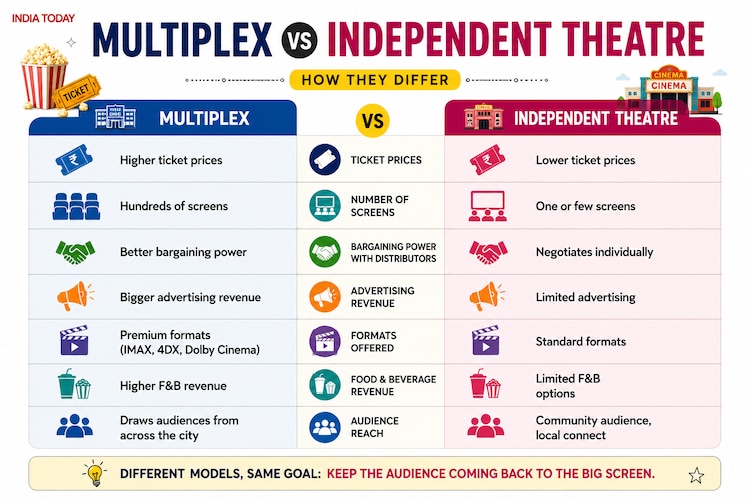
Single-screen theatres play by different rules. Tickets are cheaper (often 50–150), crowds are bigger in smaller towns, but their share can be lower or based on minimum guarantees. They survive on volume and loyal local audiences, especially for mass entertainers.
The difference isn't just about ticket prices, it's also about bargaining power.
Large multiplex chains such as PVR INOX negotiate for hundreds of screens at once, giving them stronger leverage while signing distribution deals. Independent exhibitors, on the other hand, negotiate film by film, often relying on long-standing relationships with distributors.
Ruban explains, "For distributors, dealing with one national chain is much easier than negotiating individually with hundreds of independent theatres. Because of their scale, multiplexes often receive better revenue-sharing agreements than standalone exhibitors."
In simple terms, a multiplex and a neighbourhood theatre may both be showing the same film, but they aren't always playing by the same commercial rulebook.
Comparison between multiplex and single screen:
Popcorn: The real hero that pays the bills
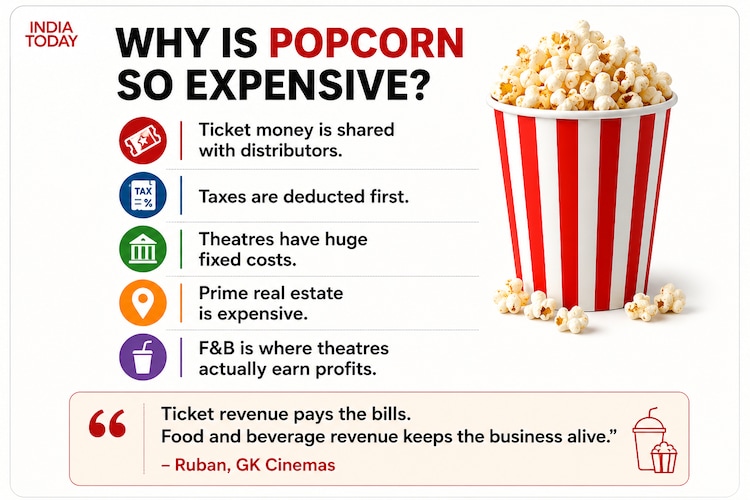
Now for the fun part – the bit that makes theatre bosses smile widest. Tickets bring people in, but popcorn, cold drinks, nachos, and snacks are where the real profit lives. Why? Because a tub of popcorn that costs the theatre Rs 30–40 to make can sell for Rs 150–400! That’s a huge margin.
As Ruban puts it, "Ticket revenue pays the bills. Food and beverage revenue keeps the business alive."
You, I and every other moviegoer has one million dollar question here: Why doesn't a theatre simply lower popcorn prices and rely on ticket sales?
Because the maths doesn't add up. By the time taxes are deducted, and the remaining ticket revenue is shared with distributors, exhibitors are left with only a fraction of the ticket price. Snacks, beverages and other in-cinema purchases are what allow theatres to invest in better projection, cleaner auditoriums and a comfortable movie-going experience.
For chains like PVR INOX, food and beverages (F&B) can make up 25–30 per cent of total revenue, with super-healthy profits after costs.
Tickets might be 50–60 per cent of revenue, but after paying distributors, the leftover profit often comes more from that fizzy cola and cheesy fries. Add advertising on screen, in the foyer, or branded tie-ups, and you’ve got a solid business.
Think about it like this: the film is the exciting story that gets you through the door. The snacks are the pocket money the theatre keeps almost entirely. No wonder they tempt you with those glowing counters!
There's another reason snack counters matter so much. Cinema halls usually occupy prime real estate, whether it's a bustling high street or a mall. Recovering those investments through ticket sales alone is almost impossible. Food and beverage sales help offset those costs while supporting everything from electricity bills to staffing and maintenance.
What about the North vs South debate?
Actually, every theatre has its own winning formula.
Not every cinema hall earns money the same way. A theatre in Chennai may rely heavily on Telugu releases (yes, you read that right! A Telugu release) because of its local audience, while one in Mumbai could see bigger crowds for Hindi blockbusters. The formula changes with geography, language preferences and even the kind of audience walking through the doors.
Ruban says his theatres screen films across languages, but Telugu films perform particularly well because of the area's large Telugu-speaking population. "We screen almost every language film, but Telugu films do very well at our centres," he says.
Interestingly, he says, re-releases have also become a profitable business. "Re-releases are like a gold mine because the revenue commitment is much lower for exhibitors. But now that trend is slowly getting saturated because many popular films have already returned to cinemas multiple times," he tells India Today.
And naturally, with that, audience behaviour changes too. He explains, "One thing I've noticed after COVID-19 is that food and beverage sales for Hollywood films have come down drastically. People who come for Hollywood films are usually happy just watching the movie. At most, they'll buy a bottle of water or a soft drink."
The full picture: A day in the life of a cinema hall
A multiplex isn’t just showing movies – it’s running an experience business. Air-conditioning, comfy recliners, fancy sound, and clean halls cost money. Single screens might be simpler and cheaper to run, but they face tougher times with rising costs and competition.
Behind every screening is a long list of expenses that audiences rarely think about. Electricity, projection systems, maintenance and staff salaries continue whether a show is packed or nearly empty. Ticket revenue helps cover those fixed costs, while food and beverage sales often determine whether the business actually turns a profit.
Ruban explains it best: “Footfalls from tickets are oxygen, but F&B and ads are the nutrition. However, if audiences don't buy food or beverages, it's not necessarily a loss – it's a loss of potential profit.
A slow movie hurts everyone, but a hit like Dhurandhar or a South sensation like Pushpa lifts the whole chain.
Here's a week-wise understanding of revenue split:
The OTT race
Having said that, one cannot miss talking about industry's biggest challenges right now. Streaming platforms have changed not just how we watch films, but how long they stay in theatres. Many exhibitors argue that shorter theatrical windows hurt films that depend on word of mouth rather than blockbuster openings.
Citing Karuppu's OTT debut as an example, Ruban believes extending the gap between theatrical and OTT releases could particularly benefit smaller films. He said, "If the theatrical window were extended from four weeks to eight weeks, many films would continue earning in cinemas for much longer. Several films lose potential theatrical revenue simply because they arrive on OTT too quickly."
The Suriya film, irrespective of its brilliant box office run, was made available on OTT within a month of its release.
"Karuppu was a very big hit. It did phenomenal business at the box office. But if the OTT window had been eight weeks instead of four, it could have performed much better in theatres during those last couple of weeks," he says.
So, the next time you settle into that plush red seat with a tub of popcorn in hand, remember: every ticket, every snack and every sold-out show is part of a carefully balanced business that keeps the magic of cinema alive. Lights, camera and a whole lot of smart business!
- Ends