
DRDO tests hack-free quantum communication to protect sensitive military data

DRDO tested a quantum-secured communication platform on a live weapons trial network in Chandipur. The exercise moves indigenous quantum security closer to practical use in defence testing.

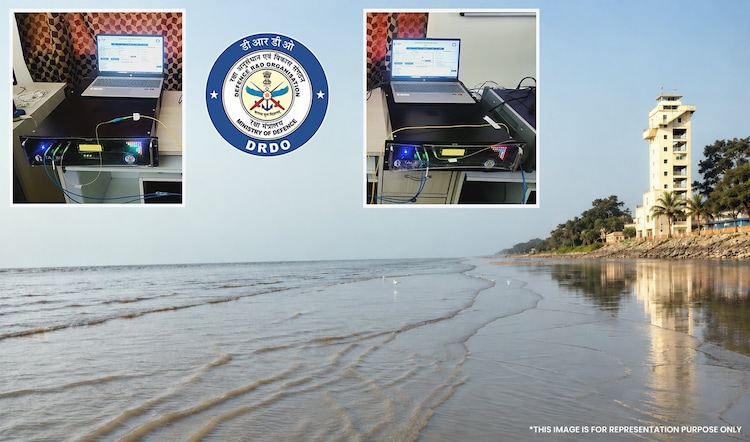
DRDO said the platform is designed to provide unconditional security for key distribution while incorporating eavesdropping detection. (Photo: Generative AI by India Today)
New Delhi,Oct 14, 2026 13:31 IST Last UpdatedOct 14, 2026 13:31 IST
 Published by
Last UpdatedOct 14, 2026 13:31 IST Published bySibu Kumar Tripathi
Oct 14, 2026 13:31 ISTThe Defence Research and Development Organisation (DRDO) has successfully tested a quantum-secured communication system on a live network used for India's artillery and armoured weapons testing, marking a step towards strengthening the security of sensitive military information.
The Quantum Key Distribution (QKD) platform was configured and tested on the live network of the dynamic test ranges at the Proof and Experimental Establishment (PXE) in Chandipur, Odisha, DRDO said.
The technology is designed to protect critical information, including real-time observations and telemetry collected during artillery and armoured weapon trials. Telemetry refers to data automatically collected and transmitted from equipment during testing, helping scientists and engineers monitor its performance.
Such information is vital during weapons evaluations, where secure and reliable communication is essential. Protecting these data streams from interception or unauthorised access can help safeguard sensitive defence information.
HOW QUANTUM TECHNOLOGY PROTECTS MILITARY COMMUNICATIONS
Unlike conventional encryption systems, which rely on mathematical techniques to protect information, Quantum Key Distribution uses the principles of quantum physics to help two parties securely establish encryption keys.
These keys are then used to encrypt and decrypt messages. A key feature of QKD is its ability to detect attempts to intercept the quantum signals used during the key exchange.
This means that if an eavesdropper attempts to monitor the exchange, the disturbance can reveal the intrusion, allowing the communicating parties to take appropriate action.
DRDO said the platform is designed to provide unconditional security for key distribution while incorporating eavesdropping detection. However, the security of the complete communication system also depends on its implementation and the protection of the devices and networks connected to it.
The successful test demonstrates a potential application of quantum-secured communication in defence testing environments, where sensitive measurements and operational data must be transmitted securely in real time.
DRDO DEVELOPS PLATFORM WITH INDUSTRY PARTNER
The QKD platform was designed and developed under DRDO's Microelectronic Devices, Computational Systems and Cyber Security (MCC) cluster, in collaboration with its production partner, Taqbit Labs.
The development is part of India's broader efforts to build indigenous capabilities in advanced technologies and strengthen cybersecurity for strategic applications.
Quantum technologies are attracting growing interest worldwide because they could help protect communications against increasingly sophisticated cyber threats.
For India, applying these technologies to defence networks could provide an additional layer of protection for sensitive military operations and weapons evaluation.
The Chandipur test highlights how quantum-secured communications could move beyond laboratory demonstrations towards practical use in defence-related networks.
- Ends