
Anyone can play weatherman with this IIT Madras professor's free rain forecast

Built as a passion project, this rainfall forecasting platform started on an ordinary desktop and now runs itself in the cloud. Its forecasts are free, so anyone can play weatherman on a laptop.
 Last UpdatedNov 25, 2026 16:09 IST
 Published by
Every monsoon, India conducts the same small, quarrelsome ritual. A cloud darkens the edge of the sky, the washing comes in off the lines, and somebody on a balcony sniffs the wind and declares that it will pour by evening. Somebody else swears it will not. The sky has always been a conversation, and the forecast, the one expert voice in it, has mostly been spoken in a language the rest of us cannot read.
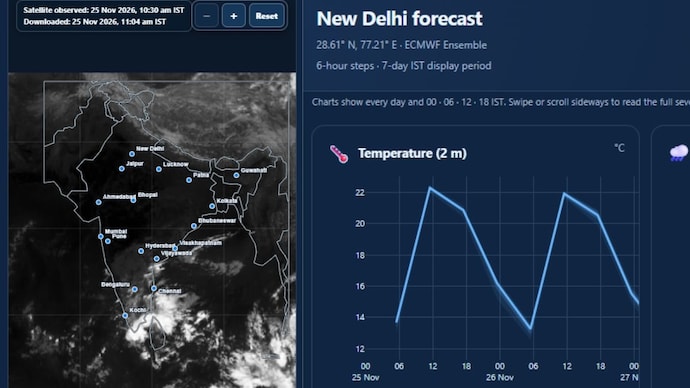
On a desktop screen at IIT Madras, that language has been turned into something anyone can follow. A belt of rain settles along the west coast and stays, hour after hour, as if the monsoon had decided to linger. Further south, over Chennai, it thins to a few doubtful millimetres, a drizzle that may or may not come, and then to nothing at all. In a few quiet seconds, a week of weather drifts past, each day a little wetter in the west and a little clearer in the south, as unhurried as the clouds themselves.
It has the look of something made behind glass in a national weather centre, in the cold hum of a supercomputer. It began on an ordinary desktop computer, in the quiet hours after its owner had gone home. Today it draws itself, in the cloud, with no one at the keyboard.
That owner builds cooling systems for a living. He made the forecast as a passion project and gives it away. It lives on the weather page of his laboratory’s website, which links to a platform called India Ensemble Weather. Anyone with a laptop can open it, see the forecast for the week ahead for the major cities of India and check it against the sky outside. The public, in other words, can now play weatherman. It forecasts the air as well as the rain, and the air in the north looks very different from the air in the south.
These days he does not even have to type a command. Three times a week, at 10 am on Monday, Wednesday and Saturday, a Google scheduler wakes a programme on Google Cloud Run. It downloads the latest global forecast, processes it and sends it straight to his webpage. “So I don’t have to run anything,” he said in an update after the interview. “This is done out of passion,” Professor Arvind Pattamatta, of the Department of Mechanical Engineering, told India Today Digital in an exclusive interview at the IIT Madras campus.
WHY WOULD A COOLING EXPERT WATCH THE SKY?
His day job explains it better than he does.
Heat is his working life. His labs test spray cooling, vapour chambers and immersion cooling for phones, EV batteries and spacecraft electronics, with projects for ISRO and DRDO. The weather, to him, is the same subject at a planetary scale. "The atmosphere is the biggest engine," he said, driven by the warm ocean beneath it and powering the entire rainfall cycle. Heat and fluids are his craft. The sky is simply the largest example he could find.
HOW DID A DESKTOP FORECAST THE RAIN?
By borrowing the hard part.
Large agencies already run global weather models on supercomputers, but only coarsely, the way a world map shows a country as a smudge. His desktop took that output and zoomed into one region. When he began, the tool was the Weather Research and Forecasting model, called WRF, an open-source code developed mainly at the US National Center for Atmospheric Research and free for anyone to download.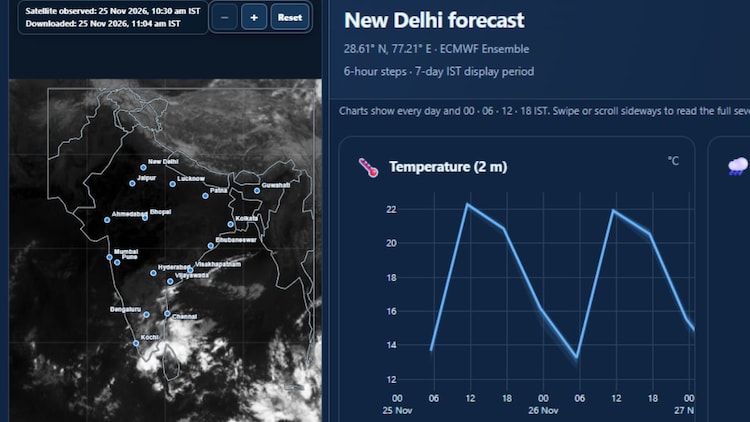
WRF divides the atmosphere into a three-dimensional grid of boxes of air. His boxes were 8 km wide, and the grid rose about 11 km into the sky. A finer view is possible by nesting a smaller grid inside a bigger one, a trick forecasters use for cyclones to see where a storm will make landfall. “I can do one pixel for the entire IIT campus,” he said, at roughly 2 to 3 km.
A run for South India took about four hours on his machine. All of India took about eight. That is no longer necessary. The European forecasting centre now gives him data at 9 km, a resolution he finds good enough, so he has stopped running WRF himself.
WHAT RUNS BEHIND THE SCREEN NOW?
Nothing that he has to do himself.
The programme pulls the free forecast from the European Centre for Medium-Range Weather Forecasts (ECMWF), processes it and displays it for all the important major cities of India. The forecast now runs for a week. The data itself has become easier to reach.
In October, ECMWF made a subset of its 9 km forecasts free and open, released two hours after real time. He had expected that move by the end of the year. It has already happened, and he has already switched his page over to it.
CAN AN AI MODEL CHECK A PHYSICS MODEL?
It can, and he lets the public watch it try.
Alongside the ECMWF forecast, his page now carries WeatherNext, Google’s machine-learning forecast. ECMWF’s forecast is deterministic, a single best-estimate run built from the laws of physics. WeatherNext is an AI model that has learned from past weather. Visitors can compare the two for cities across India. The two show good agreement, he said.
HOW DOES HE KNOW IT IS NOT GARBAGE?
He checks it, and he admits when it fails.
He calls his tests sanity checks. During the interview, his model gave Chennai 33 degrees Celsius at 11.30 am, and a weather station website read 32.6. Bengaluru has to be cooler than Chennai, and the west coast cooler still under monsoon cloud. If Bengaluru came out hotter, he said, some input in the model would be wrong.
He also reads rain as a probability. A forecast of heavy rain with only 10 to 20 per cent probability is unreliable, he said. He looks for at least 70 to 80 per cent. Along the west coast, all 60 members of an ensemble, repeated runs from slightly altered starting conditions, showed rain. That told him the southwest monsoon was active. A dry forecast there would have made him suspect the model.
He is plain about misses, too. The day before, his system gave Chennai 89 per cent probability and about 7 mm of rain. Only a light drizzle came.
WHAT ELSE CAN THE PUBLIC SEE?
More than rain, and more each month.
His page now shows satellite images of the clouds, refreshed every three days, and the track of any storm. It also forecasts air quality. Click a city and it shows the expected levels of PM 2.5, the fine particles that harm the lungs. The data comes from CAMS, the Copernicus Atmosphere Monitoring Service, which is part of ECMWF.
The picture it paints is stark. Delhi and other northern cities show PM 2.5 levels of the order of 100 to 150 (micrograms per cubic metre), readings that come from satellites. A satellite sees the particles high in the atmosphere, he explained, so the air at ground level is worse. Weather monitoring stations in Delhi can show PM 2.5 above 300 or 350, almost twice as much. Chennai, Bengaluru, Kerala and parts of Karnataka show much lower levels. The gap between north and south is there on the page for anyone to see.
He has also added a comfort index, which describes how the temperature and the humidity will feel on the human body, not just what the thermometer reads.
WHAT CAN IT NOT DO?
Quite a lot, and he says so himself.
At a grid size of 8 to 9 km, a model cannot see individual clouds. The rain-bearing cumulus clouds are smaller than one box of air, so it estimates their effect, a method called parameterisation. At 1 km, he said, such clouds can be resolved. He cautioned that forecast accuracy falls beyond about 72 hours, so the later days of a week-long forecast deserve more caution. Seasonal monsoon prediction is a far harder problem.
WHY DOES HE GIVE IT AWAY FREE?
Because the best forecasts are hard to read.
The India Meteorological Department (IMD) has supercomputers and publishes its products online, he said, but “it is not user-friendly. It’s not public-friendly.” He points to the app Windy, which runs no model of its own and simply draws open data beautifully. “Like I am also getting the same data, and I am doing it in my way,” he said.
That is why his platform is built for the public rather than for researchers. “Anybody can access it,” he said, and it works on a phone too. His main intention is to make the forecast user-friendly, so that any common person can look at it, understand it and judge for themselves whether to trust it.
He does not mean it as a rival to the weather office. His wish is a simple, authoritative IMD app that farmers and villagers could read. “I am not an official IMD person. This is my personal,” he said in the interview.
Asked whether this deserved a story, he was modest. “You can write, but I don’t think this is something great,” he said. A forecast anyone can read, on a machine anyone could own, may be exactly that.

Radifah Kabir tries to make the universe slightly less mysterious as Senior Sub-Editor at India Today’s Science Desk. A lifelong lover of physics and mathematics, she has spent four years (and counting) translating complex physics papers into English, chasing scientists for interviews, and writing explainers that don’t put readers to sleep. Off-duty, her heart belongs to Lana Del Rey's melodies, Quentin Tarantino's films, poetry, the Star Wars universe, good English movies, series and books, and one very demanding cat.
READ MORE