
 Handcrafted ByOur Editors
 From SaaS to silicon: How Zoho and a team of fresh engineering grads built an indigenous enterprise server

For a nation whose tech narrative has been written almost entirely in lines of code, software giant Zoho is pulling off the ultimate flex.
New Delhi,Jun 14, 2026 18:55 IST Last UpdatedJun 14, 2026 18:55 IST
  Published by
Last UpdatedJun 14, 2026 18:55 IST Published byDivya Bhati
Jun 14, 2026 17:28 ISTWhen Mangesh Sadafale, the Head of Hardware Development at Zoho, went to Sikkim on a family vacation a few years ago, he could not see, or rather he could not cross the iconic Nathu La pass due to bad weather. Years later, he would find himself staring down a different kind of impassable terrain. The road to designing an enterprise-grade, homegrown data centre server from scratch seemed as arduous. Turns out, calling it “Nathu La” was the easiest job.
“I proposed, can we give it the Nathu La pass name? The team said yes,” Sadafale tells India Today Tech. “Then we decided, when ‘La’ and ‘Pass’ mean the same thing, why keep ‘Pass’ there? We will be Indian and keep whatever our local people use. We removed the ‘Pass’.” The rest, as they say, is history.
In a country whose tech narrative has been almost exclusively written in lines of code, a software company may have just pulled off the hardest trick in deep-tech hardware. But the audacity doesn’t end there. The team that has designed the Nathu La server isn’t a room full of Silicon Valley veterans. It is a crew of fresh engineering graduates from the quiet, central city of Nagpur.
Why Nathu La
To be fair, Nathu La wasn’t built in a day. Research and development began five years ago when sanctions on chips and now, on advanced AI models like Claude Fable 5 and Mythos, were few and far between. In a sense, it was foresight. What’s wild is that a SaaS startup thought about it first. Not some heavyweight like TCS or Infosys.
“Inference cost is now a line item and not a rounding error,” explains Ramprakash Ramamoorthy, Director of AI Research at Zoho. “Typically, if you look at a software company's balance sheet, the bigger expense is going to be people. The second thing is going to be operations like travel, office, and all of that. The third thing is your server cost which is your inference cost. Not just AI inference, all inference. But now it (inference cost) is moving up, and eventually, I think next year it will become the first big line item for a software company's expenses.”
Over the past six months alone, the tech industry has watched global component pricing spike to unprecedented heights. Generic servers have seen their market prices surge by four times compared to December 2025, Ramamoorthy reveals. Securing these components, too, is an uphill task as demand is far exceeding the supply. Procurement delays can stretch into multiple quarters. Most big players are relying on public cloud companies or third-party Large Language Model (LLM) providers, handing over massive chunks of their revenue to keep the lights on. When those infrastructure costs go up, the surplus gets pushed downstream. It was clear from the start that Zoho would not pass the burden to its customers.
“Renting (hardware) forever stops making sense because the competition is getting cutthroat, and then we are primarily building on top of the infrastructure that we have underneath,” says Ramamoorthy. "So, if compute becomes foundational, we should own it. We want to be a predictable and a boring company to do business with. That is one of the reasons we invest a lot in the foundation.”
Underneath all the chaos and uncertainty, lurks another big issue, that of national significance.
“If we look at the top three imports what India has done in the last couple of years, electronics and semiconductors stay at the third position, very close to gold with a narrow margin. Now, in compute electronics, for India, electronics is the third trade deficit, whereas if we compare it with China, electronics is the top number one contributor to their trade surplus,” Sadafale points out.
In the last financial year alone, India imported more than $13 billion worth of complete compute systems. In stark contrast, during that exact same timeframe, China exported more than $150 billion of compute hardware. When Indian enterprises purchase servers today, the vast majority of those funds do not stay within the domestic ecosystem. Instead, the capital flows directly to the countries and multinational corporations that own the core intellectual property.
“The country which owns the IP, owns the design, gets the bigger section of the payment, and the country which manufactures it gets the relatively smaller section of the payment,” Sadafale explains. “Now, when we look at it from an India perspective, the IP creation of critical infrastructure like server networks is very important. If we create IP, if we create a design, then only we will be able to sustain that cash flow or stop the outflow of money from India.”
Sadafale cites the example of manufacturing, or rather, assembling of smartphones in India to make his point. “India doesn't have a solid mobile brand which owns the solid mobile IP and mobile design which can be manufactured in India and exported, so India is paying royalty to some other company outside, and the cash flow is going out of India. Deep tech knowledge cannot be licensed. It has to be homegrown. To maximise the value addition in India, the design has to be made in India,” he says candidly.
Inside Nathu La
When Zoho started its hardware initiative, it skipped over the crowded, hyper-competitive tech ecosystems of Bengaluru, Chennai, and Delhi. Instead, it established the hardware team in Nagpur, with the reasoning that it was located in "central" India.
However, Zoho hit an immediate roadblock. In India, the specialised talent pool capable of executing advanced system design or Very Large Scale Integration (VLSI) engineering is notoriously small, heavily concentrated in specific corporate corridors, and highly resistant to relocating to a Tier-2 city.
“The only available talent pool was freshers in and around local colleges,” Sadafale says. “But the freshers, as everyone knows, they are more interested in software or AI. No one is interested in hardware. By default, hardware is hard. No one wants to work on a hard problem. And hardware is a hard problem. Over and above, in the last few years, AI is also creating trouble. It is spoiling the creativity of students.
To counter this, Zoho engineered the SETU program (Student Engagement for Transformative Upskilling), stepping into local government engineering colleges to look for raw, unfiltered curiosity.
“We don't care about CGPA or marks. We just care about curiosity and ability to learn,” Sadafale emphasises. “In SETU, we start interaction with students in the fifth semester itself. We give them a basic problem statement in hardware design. It can be mechanical, electronics, or firmware. As the students move from the sixth and seventh semester, the problem statements become more complicated. And at the end of the semester, based on how the students have performed, we offer them an internship in the eighth semester.”
To date, the SETU program has trained over 300 students. It aligns closely with the Ministry of Electronics and Information Technology's (MeitY) skill development initiatives for the Electronic System Design and Manufacturing (ESDM) sector.
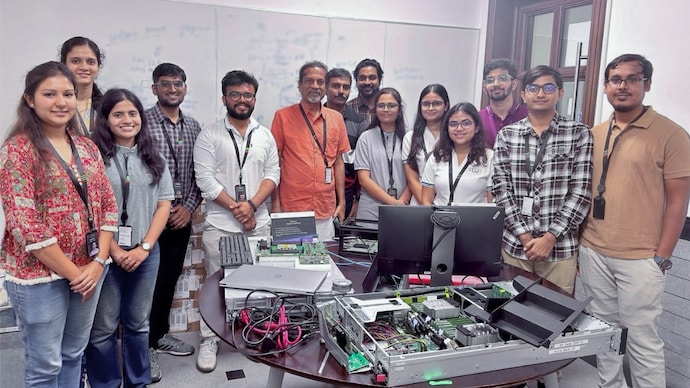
But more importantly, an astonishing 90 percent of the engineering team responsible for creating the Nathu La server platform is composed of these local college graduates who joined the firm over the last five years. Excluding Sadafale's own 25 years of industry expertise, the average professional experience across the entire Nagpur hardware office sits at just three to four years.
Throwing early-career engineers directly into the deep end of advanced enterprise server development may sound like a recipe for disaster, but Sadafale believes their lack of institutional bias is a major competitive advantage.
“Freshers can do magic because they don't know what is complex and what is simple,” he notes. “So, (when) you throw the problem at them, they will figure out the solution. You just have to protect them and help them in a way that it nurtures them, and it works out. It's great. It just works.”
Nathu La is a living example of it. A high-performance enterprise server requires three distinct engineering areas to operate in perfect harmony: mechanical design for structural integrity and cooling, electronics design for high-speed signal distribution, and firmware to bridge the physical circuitry with the operating system. The Nagpur team systematically tackled all three.
At its core, the Nathu La motherboard is built around the Open Compute 'M-DNO' form factor, a highly modular architecture that allows the system to be rapidly reconfigured for vastly different enterprise data centre workloads. Rather than deploying rigid, generic servers that run at subpar efficiency, Zoho can alter the underlying module configurations to precisely match the software application running on top of them.
“Nathu La is a modular design which is workload-optimised,” Sadafale explains. “In Zoho Mail, we normally send text messages. Text is relatively small data information saved in storage to retrieve it when we want to see the mail again. Whereas in a Meeting, it is audio-video information, which is relatively much higher data. It has to be processed more because we are doing screen sharing, recording, background removal, and multiple people are changing their configuration. Meeting needs a different type of compute, a different type of server, whereas Mail needs a different type of compute and server.”
By tailoring the server architecture to the specific data profile of the application, Nathu La can achieve an impressive 12 to 18 percent lower power consumption profile alongside a remarkable 20 to 30 percent reduction in total cost of ownership (TCO), Zoho claims. The platform boasts five distinct patents, the bigger pieces going into cooling.
“Thermal is the number one concern today even if I take an air-cooled system like Nathu La,” says Sadafale. “The future systems will be liquid cooled. But in air-cooled also, our patents, the majority of them are for cooling. How efficiently you cool the systems, what are the small things, how the air flows, that is the actual patent. People will say, ‘What is the big deal?’ But that is a big deal.”
Beyond the physical steel and circuitry lies the critical layer of firmware. Nathu La eliminates the opaque “black box” code supplied by traditional overseas hardware vendors, replacing it with a completely auditable, transparent “white box” software stack based on open-source standards like EDK2 for the BIOS and OpenBMC for the Baseboard Management Controller.
The BMC acts as the operational nervous system of a modern data centre, allowing a single operator to monitor, diagnostic test, and maintain thousands of separate server stacks from a centralised console. By modifying open-source code for their specific needs, Zoho’s infrastructure engineers can know exactly what is happening inside every single data path.
“We took open-source code and then modified it for our needs,” Sadafale explains. “So, we know each and every line of the code that has gone in. We know what signal is going here and there. There is hardware security we have added in so that even if someone takes the server outside (the country) and tries to hack something, that will not happen.”
Beyond Nathu La
The rollout of the Nathu La server platform coincides with a broader conversation regarding the sustainable integration of AI within the enterprise ecosystem. We know – and we have seen – that AI tools like Claude Code can upend the SaaS industry. Whether it can bring the SaaSpocalypse, that remains debatable. But as the initial wave of excitement settles, the market is beginning to demand tangible proof of value, that which OpenAI, Anthropic and even Google, have promised.
“The whole craze for all these memory prices going crazy, all of this is due to the AI mad rush,” Ramamoorthy notes. “But the good thing is I see some of it slowing down, at least in the last couple of weeks. We're hearing a lot more conversations about return on token investment – ‘I spent so much, what is the tangible output that I have received?’”
Across its corporate legal workflows, sales optimisation pipelines, and customer support channels, Zoho is seeing a steady, incremental 20 to 25 percent improvement in overall employee productivity using AI.
“If a human support engineer is solving 10 tickets a day, they will be able to solve 12 tickets a day,” Ramamoorthy states plainly. “And that is the incremental benefit that we have seen so far. The reality is coming back to the table. I hope that contains the mad rush of throwing crazy compute at internet-scale data. It (AI) definitely has changed the way we work personally at an individual level, but in team productivity, we still haven't seen those remarkable multiple productivity improvements, in the order of multiples, we have not seen that (yet).”
This is precisely why Zoho is staying clear of slapping a massive, power-hungry external LLM onto an existing platform as a quick feature fix. Instead, its AI deployment strategy is anchored around the core principle of “right-sizing” models based on the specific context of the task.
Currently, Zoho is using a highly coordinated matrix of 80-plus specialised machine learning models alongside small, medium, and large language models (all in-house) contextually embedded into the workflow to trigger the “next best action” for a user.
“Use a smaller model when you can, use a machine learning model when you can, and use the bigger models only when you do generative work, only when you do creative work,” Ramamoorthy advises. “So, if you look at a typical enterprise workflow in 10 steps, there are only one or two steps where you need that generative or creative capability. The rest of the things are going to be repeatable, retractable, and all of that.”
This disciplined approach to software modeling will now work in sync with the cost savings generated by the Nathu La hardware underneath. Because Zoho isn't bleeding capital to third-party public cloud providers or external LLM API vendors, it doesn’t have to treat intelligence features as a premium add-on for now. Its AI capabilities come pre-bundled inside the standard subscription tier and treated with the same architectural utility as an enterprise search tool, a mobile app, or a single sign-on protocol.
As Nathu La moves into active production, Zoho’s engineering leadership is intentionally playing the long game. While the system is built on Intel's latest 6th Generation Xeon processors in close collaboration with Intel India, the assembly, structural execution, and intellectual design are thoroughly indigenous. The project aligns directly with India's National Supercomputing Mission, its national open-source software mandates, and the overarching Atmanirbhar Bharat Abhiyan.
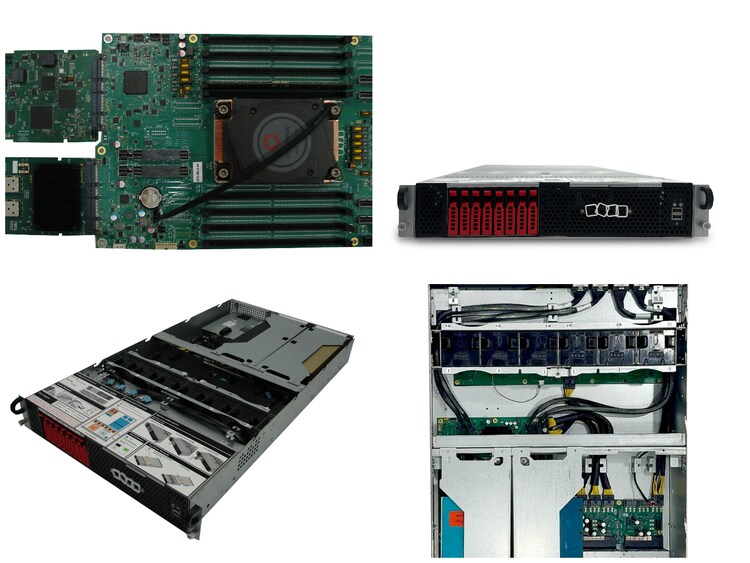
For the immediate future, Zoho is keeping its hardware deployments entirely internal and tightly focused on its India-based data centres, ensuring its engineering support frameworks mature safely before expanding the server infrastructure to its 150+ global hubs. The production pipeline is scaling up quickly. A few hundred server units are currently operating in limited deployment, with a clear roadmap to install 2,000 active Nathu La servers by the close of 2026.
When pressed on whether Zoho will eventually challenge global legacy hardware OEMs by selling these servers directly to external corporate buyers, Sadafale says, “Today we cannot comment on that because these global OEMs have a very strong supply chain support system. It's a massive thing. Designing an enterprise-class system is one thing, getting it working is one thing, getting it into production is one thing, and supporting it in the long term is another thing. We have just crossed the first step. So, there is a long way to go. Right now, it's a local thing. We'll do it locally. But our roadmap is strong. It's not like one product saying, ‘Oh yeah, we are done.’ No, we have a strong roadmap, and we are very well integrated with the semiconductor supplier.”
Ultimately, the creation and execution of Nathu La serves as a powerful reminder of the enduring value of human talent in a world increasingly fascinated by AI automation. It is, for all intents and purposes, a strong counterargument to prophesies about AI wiping out white-collar jobs made by the likes of Anthropic CEO Dario Amodei.
“Definitely, the way we create content, the way we do things has changed, but a lot still comes back to human skills, human empathy,” Ramamoorthy says. “Human capital is still the best thing that a company can have. It is irreplaceable by any LLM. Today it's difficult to build a server from scratch using an LLM. You need a Mangesh with years of experience and wisdom in building things. A lot of things that are undocumented reside in a (human) head, and you need that kind of leadership. And that leadership happens when you start nurturing people from the beginning. Things will come back to normalcy, but this is going to be a slightly new normal. You still can't work the same way you worked in 2022, but then we get to keep our jobs.”
- Ends
Also Read | Rio de Janeiro city releases top AI model, day after US banned Anthropic AI for foreigners
Also Read | Sarvam AI CEO believes US Mythos ban for foreigners is just the beginning, sovereign AI is future
From SaaS to silicon: How Zoho and a team of fresh engineering grads built an indigenous enterprise server