Emperor revisited | Munis D. Faruqui's book on Aurangzeb
Munis D. Faruqui challenges established stereotypes of Aurangzeb and offers a nuanced reassessment of the Mughal emperor

Aurangzeb, the sixth Mughal Emperor, ruled between 1658 and 1707. His full name was Abul Muzaffar Muhiuddin Mohammad Aurangzeb Alamgir. He was born to Shah Jahan and Mumtaz Mahal and ascended to power after defeating his elder brothers in a fierce battle for succession.
India’s medieval history records that he expanded the Mughal Empire more than any other ruler from his dynasty, extending its reach to the Deccan (South India). He was known to be a devout and orthodox Muslim and ordered the demolition of several Hindu temples during his reign. He also re-imposed the controversial Jizya tax and implemented Sharia laws. Due to these actions, he gained a reputation as a fundamentalist and communal ruler. He formed alliances with the Rajputs and fought against Shivaji and his successors. Although he successfully conquered Bijapur and Golconda, he struggled to suppress rebellions by the Marathas and other southern kingdoms.
After he died in 1707, the once-mighty Mughal Empire began to decline, eventually leading to its defeat by the British.
One of the most controversial rulers in Indian history, historians remain divided in their opinions about Aurangzeb. While some view him as a fundamentalist who was intolerant towards other faiths, particularly Hinduism, and accuse him of promoting religious hatred and dividing society, others regard him as an exceptionally capable and disciplined ruler who sought to consolidate and strengthen the Mughal Empire.
On Shri Krishna Janmashtami, Uttar Pradesh Chief Minister Yogi Adityanath announced his government's resolve to develop a grand temple complex in Mathura and Vrindavan on the lines of Ayodhya's Ram Temple and Varanasi's Kashi Vishwanath Dham.
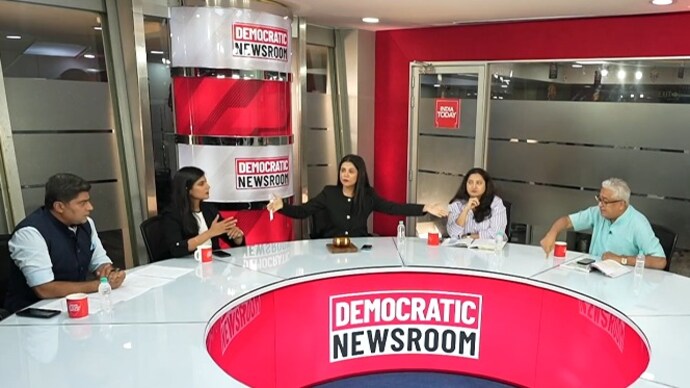
On Shri Krishna Janmashtami, Uttar Pradesh Chief Minister Yogi Adityanath announced his government's resolve to develop a grand temple complex in Mathura and Vrindavan on the lines of Ayodhya's Ram Temple and Varanasi's Kashi Vishwanath Dham. Speaking during celebrations at the birthplace of Lord Krishna, the Chief Minister stated that efforts are underway to create grandiose premises to ensure devotees face no hurdles. The announcement sparked discussions around the 2027 Uttar Pradesh Assembly elections and the long-standing Krishna Janmabhoomi dispute involving 13.37 acres of land. In a debate on India First, petitioner's counsel Advocate Vishnu Shankar Jain detailed the legal maintainability and historical documentary evidence regarding the temple's demolition in 1670. Representatives from the Bharatiya Janata Party, Samajwadi Party, and the All India Imam Association presented contrasting viewpoints on the legal proceedings, civilisational faith, historical records, and the broader political narrative surrounding Mathura.
A television news debate examines the political and civilisational dispute surrounding the Krishna Janmabhoomi in Mathura following remarks made by Uttar Pradesh Chief Minister Yogi Adityanath on Sri Krishna Janmashtami. Bharatiya Janata Party spokesperson Anila Singh asserts that reclaiming the temple site is a constitutional and civilisational right for Sanatanis, declaring, 'The issue of Shri Krishan Janmabhoomi is not an ordinary land dispute but a matter of faith, identity and a resolve of liberation.' Samajwadi Party spokesperson Anurag Bhadouria accuses the ruling party of invoking religious issues near elections to distract the public from core governance topics such as civic infrastructure, schools, employment, and alleged financial mismanagement at temple trusts. Maulana Sajid Rashidi questions the statements made by political leaders ahead of court verdicts, invoking the Places of Worship Act of 1991 and past Supreme Court observations. The debate centers on historical claims regarding Mughal emperor Aurangzeb's 1670 demolition order and ongoing legal adjudication.
In an interview with India Today, Advocate Vishnu Shankar Jain, counsel representing the Hindu petitioner in the Shri Krishna Janmabhoomi case, discussed the legal status of the Mathura title suit. Jain asserted that out-of-court dialogue is untenable, stating, "Dialogue is not possible at all and the only resolution is by a judgement of the Honourable Court." He highlighted that the Allahabad High Court ruled the suits are maintainable and not barred by the Places of Worship Act or the Waqf Act. Jain detailed historical evidence regarding the 13.37-acre disputed land, citing the demolition ordered by Aurangzeb in 1670 as recorded in Maasir-i-Alamgiri, the 1770 Battle of Govardhan, British auction records from 1815, and prior legal rulings. He expressed confidence that a court-appointed Advocate Commission survey will establish that the prison cell of Kansa is located at the site.
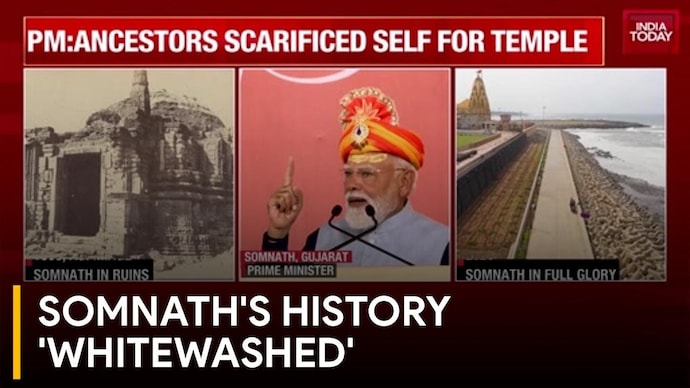
A heated debate unfolds over the history of the Somnath Temple, sparked by the Prime Minister's recent comments. BJP National Spokesperson, Sanju Verma, argues that Jawaharlal Nehru showed 'deep contempt, Nehru showed disdain for Hinduism', citing a 1951 letter to Dr. Rajendra Prasad regarding the temple's inauguration. Countering this, Congress National Spokesperson, Dishant Rawal, defends Nehru's secular approach during a sensitive post-partition era and claims it was Mahatma Gandhi who advised against using government funds for the temple's reconstruction. Adding a scholarly perspective, historian Dr. Ravi Bhatt suggests that Indian history as taught in schools often focuses on disappointments and that there is 'plenty of room to refresh' the narrative by including multiple perspectives, including those of Persian historians, to create a more balanced view.
This India Today bulletin reports on a major political controversy ignited by Prime Minister Narendra Modi's remarks at the 'Somnath Swabhiman' event. The Prime Minister claimed that forces opposing the Somnath temple's reconstruction post-independence are still active today. He asserted that historical attacks on the temple were not for wealth but to 'attack the entire Hindu civilization'. The report details the BJP's accusations against India's first Prime Minister, Jawaharlal Nehru, alleging he had a 'Hindu virodi mindset' and actively opposed the temple's revival, citing letters written by him. In response, the Congress party hit back, stating that the temple was, in fact, rebuilt while Nehru was Prime Minister. The bulletin covers the ongoing political mudslinging over this historical issue.
In a powerful address, an unidentified speaker reflects on the historical significance of the Somnath temple and the resilience of Sanatan Dharma against centuries of invasions. The speaker asserts that the 'real cruel history of hatred, tyranny and terror was hidden from us'. The speech criticises post-independence historians and politicians for allegedly downplaying the religious motivations behind the temple's repeated destruction, framing them merely as acts of loot. The speaker calls for the nation to remember the valour of its ancestors and the sacrifices made to protect the temple, citing historical figures like Veer Hamirji Gohil. The address serves as a call to reclaim and honour a historical narrative of resistance and cultural pride that the speaker claims was deliberately suppressed.
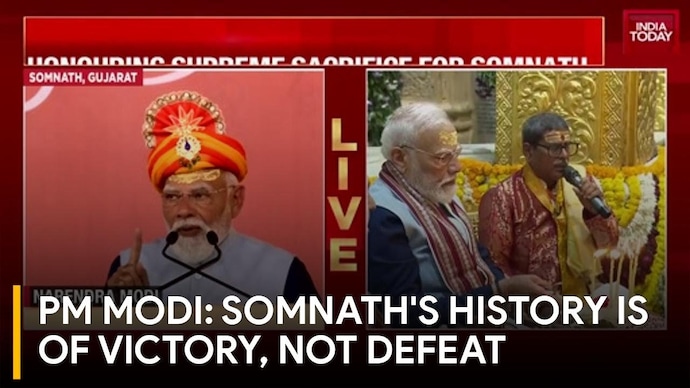
In this special report, Prime Minister Narendra Modi addresses the millennium-long saga of the Somnath temple, coinciding with its 75th reconstruction anniversary. He asserts that the temple's chronicle is one of triumph and resilience against centuries of invasions. PM Modi states, 'Somnath's history is not a history of destruction and defeat. This history, is of victory and reconstruction, of the valour of our ancestors, of their courage and sacrifice.' The speech recounts the initial destruction by Mahmud of Ghazni in 1026, followed by repeated attacks by figures like Alauddin Khilji and Aurangzeb. It also honours the persistent efforts to rebuild the temple by Indian rulers, including Raja Kumar Pal and Ahilyabai Holkar, portraying Somnath as an eternal symbol of India's cultural and spiritual identity.
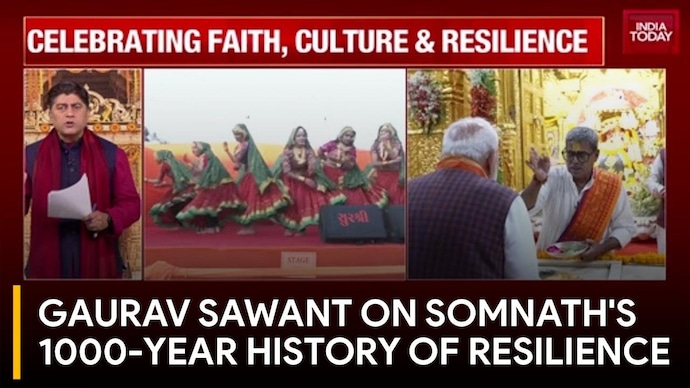
On this special report, India Today's Gaurav C. Sawant details the Somnath Swabhiman Parv, an event commemorating 1,000 years since the first attack on the Somnath temple by Mehmood of Ghazni in 1026. Prime Minister Narendra Modi is set to lead a 'Shoryatra' to honour the thousands who sacrificed their lives defending the temple over centuries. Sawant states, 'The history of Somnath is the history of Indian resilience and resurgence.' The broadcast reflects on the temple's cycle of destruction and reconstruction, highlighting it as a symbol of India's civilisational continuity and unwavering faith. Sawant emphasizes that the ability to follow the Sanatan Dharma today is a direct result of the sacrifices made by ancestors, a legacy the event aims to celebrate and pass on to future generations.
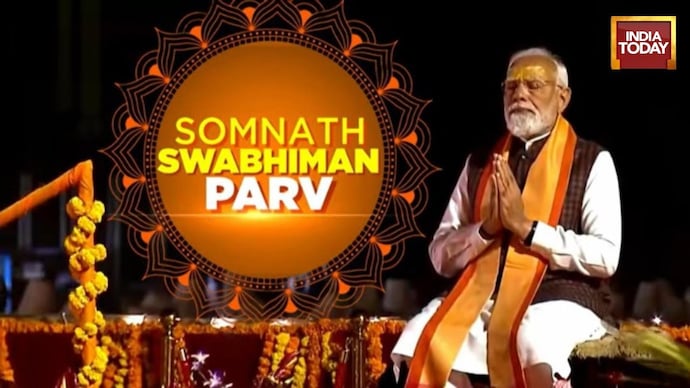
Prime Minister Narendra Modi attended the 'Somnath Swabhiman Parv' in Gujarat, an event marking 1,000 years since the first invasion of the Somnath Temple by Mahmud of Ghazni in 1026. The multi-day program included a 72-hour 'Akhand Omkar Japa' and a drone show. This special report examines the historical significance of the temple, which is the first of the twelve Jyotirlingas, as a symbol of India's cultural heritage. The report details the temple's history of repeated destruction by invaders, including Mahmud of Ghazni and Aurangzeb, and its subsequent reconstructions. It highlights the roles of figures like Ahilyabai Holkar and Sardar Vallabhbhai Patel, who initiated the modern reconstruction after India's independence. The broadcast also notes the context of Patel's efforts proceeding despite objections from then-Prime Minister Jawaharlal Nehru. The event is framed as a tribute to India's resilience and civilizational continuity.
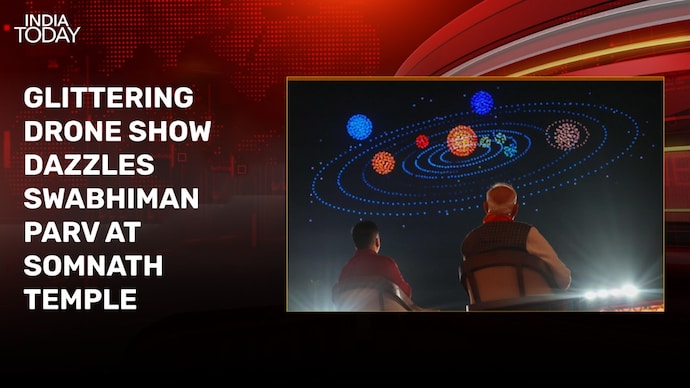
India Today delves into the history of the Somnath Temple, a symbol of India's cultural and spiritual resilience. During the Swabhiman Parv at the grand temple, a glittering drone show dazzled and spellbound the gathering and lifted the mood of the celebrations attended by Prime Minister Narendra Modi.
Prime Minister Narendra Modi addressed the Veer Baal Diwas event on Friday, paying tribute to the Sahibzades. PM Modi reiterated his resolve to free India from the "mentality of slavery" (ghulami ki mansikta) by 2035, marking 200 years of Macaulay's education minute. He highlighted that in the recent Parliament Winter Session, 160 speeches were delivered in Indian languages like Tamil and Marathi, signaling a shift away from colonial legacies.
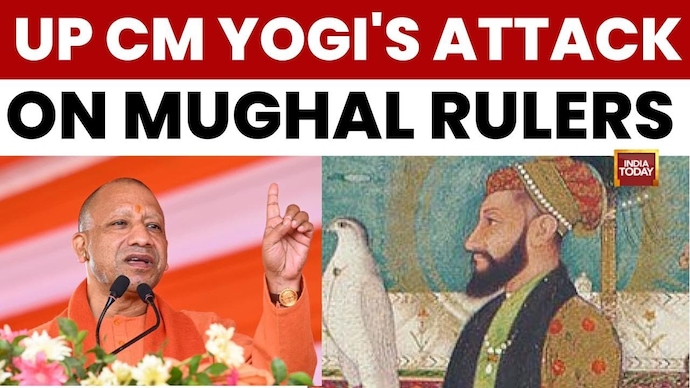
Uttar Pradesh Chief Minister Yogi Adityanath launched an attack on Mughal-era rulers, accusing them of an assault on India's spiritual identity. He specifically named Aurangzeb as a tyrant who attempted to erase Hindu traditions and evoked Sikh history, citing the resistance of Guru Tegh Bahadur, Bhai Mati Das, and Bhai Sati Das as crucial to the survival of Sanatana Dharma. Yogi Adityanath alleged that Aurangzeb 'tried to destroy the temples, suppress traditions and attempted to completely wipe out the Tilak and the Janayu, the two benchmarks of Hindu identity'. The speech highlighted that Sanatana Dharma's survival was due to significant sacrifice and resistance against such rulers.
On this special report, Thuglak Editor S. Gurumurthy discusses the Ayodhya Ram temple as a symbol of India's civilisational rise and the reassertion of its ancient culture. According to S. Gurumurthy, 'It is an announcement to the world that Indian civilization is a living civilization'. He frames the temple's establishment not as an isolated event but as part of a global trend of civilisational revival, citing examples from China and Russia. Gurumurthy also addresses the path forward for disputes in Kashi and Mathura, advocating for dialogue over litigation and blaming 'vote bank politics' for past failures. The report covers his views on Prime Minister Narendra Modi's outreach to the 'Vanchit Samaj', linking it to the inclusive principles symbolised by Lord Ram's life and the foundation stone for the temple being laid by a Dalit.
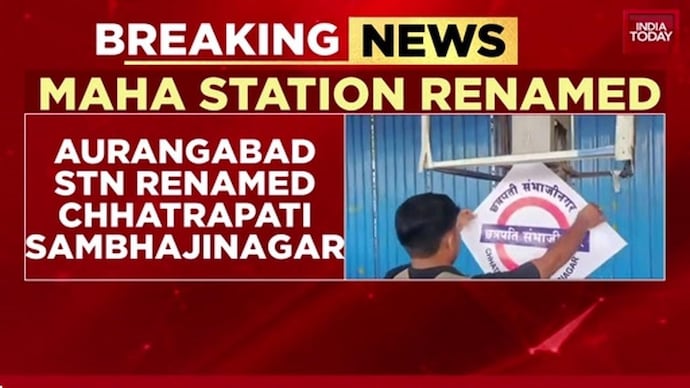
This special report covers the official renaming of the Aurangabad railway station to Chhatrapati Sambhaji Nagar railway station by the Central Railway. The report details the new station code, CPSN, and notes this development comes years after the city of Aurangabad was itself renamed by the Maharashtra government, then headed by Eknath Shinde. According to an official release, 'The competent authority has approved the change in the name of 'Aurangabad' Railway station of Nanded Division over South Central Railway as 'CHHATRAPATI SAMBHAJINAGAR' Railway station with the Railway Code for Station as CPSN.' The renaming honours the Maratha ruler Chhatrapati Sambhaji, son of Chhatrapati Shivaji Maharaj, and replaces the name of the Mughal emperor Aurangzeb. The original proposal for the city's name change was initiated by the earlier Uddhav Thackeray-led government.
Pakistani Defence Minister Khawaja Asif claimed that India was “never truly united except under Aurangzeb,” a statement widely criticised for ignoring basic historical facts. Speaking to Samaa TV, he said, “History shows that India was never truly united, except briefly under Aurangzeb. Pakistan was created in the name of Allah. At home, we argue and compete, but in a fight with India we come together.”
Former US President Donald Trump has announced that the United States will help Pakistan develop its oil reserves following a trade deal. In a surprising statement, Trump said, "Who knows? Maybe they'll be selling oil to India someday." This development comes after Pakistan's Finance Minister, Mohammad Aurangzeb, reportedly sealed a deal with US Commerce Secretary Howard Lutnick in Washington on July 18th. The announcement is being seen as a significant shift in US policy towards Pakistan, especially given Trump's previous criticisms of the country. While the former president is hard-selling the trade agreement, the geopolitical and economic practicalities of Pakistan supplying oil to India remain a subject of analysis, considering the historical tensions and the vast difference in trade volumes between India-US and Pakistan-US.
The show delves into the escalating political confrontation over the Election Commission's Special Intensive Revision of electoral rolls in Bihar, with Rashtriya Janata Dal leader Tejashwi Yadav hinting at a potential poll boycott due to concerns about the fairness of the process.
In an exclusive interview with India Today, actor-politician Pawan Kalyan spoke on Hindi language row, portrayal of Mughals in textbooks, his upcoming film, ‘Hari Hara Veera Mallu’ where the Mughal emperor Aurangzeb is portrayed as the antagonist and other issues.
In this edition of Democratic Newsroom, the focus is on the debate over NCERT's portrayal of Mughal rulers such as Akbar, Babur, and Aurangzeb.