Vietnamese crab exporter

Topic

Advertisement
TOPIC

EPFO

The Employees’ Provident Fund Organization (EPFO) is a statutory body of the Government of India that manages the employer–employee contribution of the PF and more. It manages the Employees’ Provident Fund (EPF), Pension Scheme (EPS), and Deposit Linked Insurance (EDLI)—enabling millions of employees to save regularly and secure retirement income. In June this year, EPFO's net addition to its subscriber base was around 2.19 million, the highest growth rate it has registered since data has been maintained from September 2017. The Death Relief Fund ex gratia has been enhanced to a great extent from ₹7.5 lakh to ₹15 lakh, providing more help or assistance to the family of the deceased central government employees. A digital leap: Creating and activating the Universal. Account Number (UAN) now requires the UMANG app and Aadhaar face authentication, allowing employees to manage their accounts separately online. EPFO continues to evolve, increasing schematic job coverage, deepening digital services, and strengthening safety nets for workers and their families. Its continuous digitisation drive, like paperless claims and Aadhaar-linked accounts, makes access quicker, easier, and more transparent. As India’s workforce expands and junior employees join the system, EPFO is positioning itself not just as a retirement fund manager, but as an encyclopedic interpersonal security partner that adapts to new needs while protecting workers’ futures.

  • ALL
  • STORIES
  • VIDEOS

STORIES

Why India's govt websites are stuck in the 1990s

From booking Tatkal train tickets and filing RTIs to accessing EPF claims and court records, millions in India rely on government websites every day. Yet many users say these portals remain slow, glitchy and difficult to navigate. We tested some of these websites and spoke to users and experts to understand why.

Load More

VIDEOS

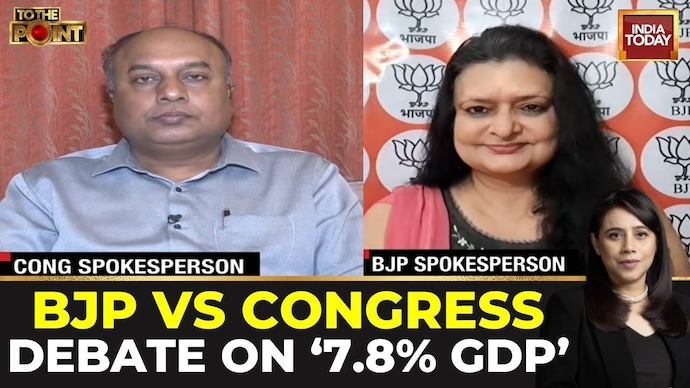
India's 7.8% GDP Growth, Base Year Rebasing, and Market Reactions Spark BJP-Congress Clash

A debate on India's economic growth numbers features BJP National Spokesperson Sanju Verma and Congress National Spokesperson Brajesh Kalappa. Defending the official 7.8% real GDP growth figure for Q1 FY27, Sanju Verma dismissed claims by former finance secretary Subhash Garg regarding a 2.6% growth rate, arguing that comparing new series data with old series data is misleading. She cited strong economic indicators, including a 23.4% rise in capital expenditure, robust auto sales, credit expansion, and rising GST collections. In response, Brajesh Kalappa questioned the credibility of the numbers, pointing to negative stock market reactions, rising unemployment, falling purchasing power, and stagnant job creation. Kalappa also challenged the rationale behind changing GDP calculation parameters and questioned why public advisories against spending on gold or foreign travel were being issued if the economy was booming. The discussion concluded with heated exchanges over base year revisions, international credit ratings, and political commentary surrounding India's economic performance.

Jayant Sinha Explains India's Economic Shift Toward 'Viksit Bharat' and Budget 2026

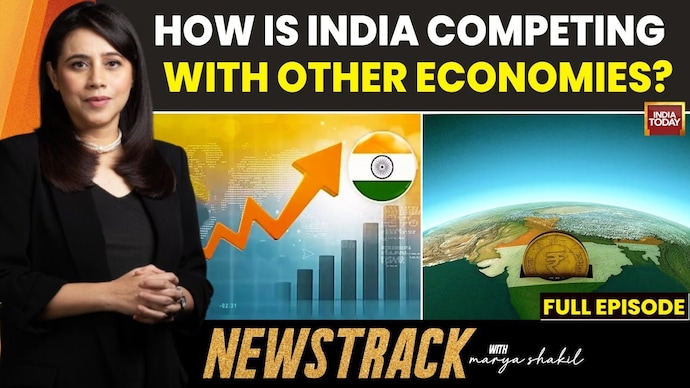
In this special report, former Minister of State for Finance Jayant Sinha joins Maria Shakil to decode the health of the Indian economy ahead of Budget 2026. Sinha hails the recently signed India-European Union Free Trade Agreement as the 'mother of all deals', predicting it will significantly boost employment in sectors like textiles. He provides a detailed breakdown of India's GDP, noting that the private sector accounts for two-thirds of economic activity. Sinha outlines the vision for 'Viksit Bharat' by 2047, explaining how the income pyramid is shifting as more households move from the 'Aam Janata' category into the middle and global classes. Addressing concerns over jobless growth, he cites stable unemployment rates and rising EPFO subscriptions as evidence of formalisation. Sinha also discusses the impact of AI and the necessity of increasing productivity to compete with global economies like China and the United States.

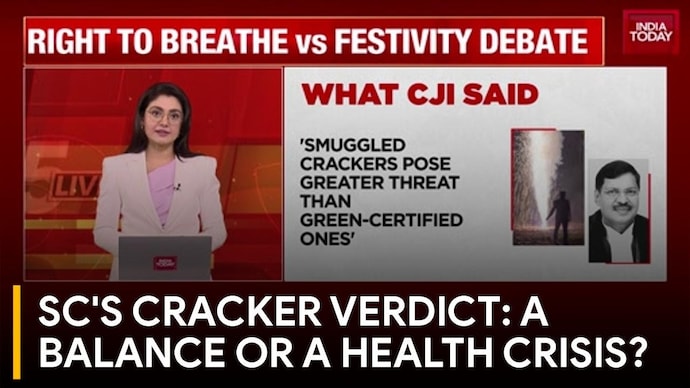
Delhi's Diwali War: SC Allows Green Crackers, Activists Warn Of 'Apocalypse' Air

This special report investigates the Supreme Court's decision to permit certified green firecrackers in Delhi-NCR for Diwali, a ruling made amidst existing air quality concerns and the implementation of GRAP-1 measures. India Today's Sonal Mehrotra Kapoor moderates a debate featuring activist Sujata Pandey, environmentalist Vimlendu Jha, and Bhavreen Kandhari, discussing the bench's ruling led by CJI B.R. Gavai. The discussion addresses perspectives on faith versus selective activism and evaluates whether the decision offers a pragmatic solution to illegal cracker smuggling or presents a public health risk. The program details green cracker specifications, enforcement challenges, and the conflict between celebration rights and the right to clean air in the capital. Environmentalist Vimlendu Jha commented on the Supreme Court's approach to balancing interests. The report further covers Delhi's air pollution situation, including contributing factors like industrial and vehicular emissions, and the Delhi government's proposed cloud seeding or artificial rain initiative. Additionally, the program explains recent updates to Employees' Provident Fund Organisation (EPFO) rules, outlining conditions for withdrawing up to 100% of the PF balance.

EPFO Big Change: Can you now withdraw 100% of your PF money?

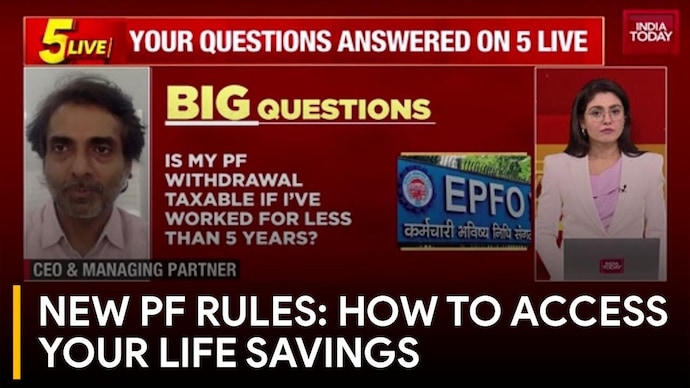
This special report unpacks the major changes to the Employees' Provident Fund Organisation (EPFO) withdrawal rules, featuring insights from financial expert Shruthi Mahajan. When asked about the changes, Mahajan stated, 'there are new regulations that are very, very pro-employees only.' The discussion clarifies the significant confusion around these new policies, explaining that while 100% withdrawal is now permitted under certain conditions, there are nuances. For instance, in case of unemployment, a member can withdraw 75% of their PF balance after one month of joblessness, but a 12-month wait is required for a final settlement. The segment also details the simplified, online process for advance withdrawals for essential needs like medical emergencies, education, and marriage, and the updated procedures for nominees to claim funds.

EPFO Overhauls PF Rules: Easier Access To Funds, But With New Conditions

This special report from Business Today TV details significant reforms by the EPFO's Central Board of Trustees, affecting over 7 crore subscribers. The Central Board of Trustees of EPF organization has announced major steps to benefit over 7 crore subscribers of the scheme. Key changes include merging 13 partial withdrawal categories into three streamlined options for essential needs, housing, and special circumstances. While withdrawal limits for education and marriage have been increased, a new rule locks 25% of the PF balance to safeguard retirement savings. The timeline for full withdrawal after a job loss has been extended from two to twelve months, and final pension withdrawal is now only possible 36 months after retirement. Additionally, a 'Vishwas Scheme' has been launched to reduce litigation over penal damages, and pensioners can now get digital life certificates at their doorstep for free via a partnership with the postal department.

Budget 2024: Direct Benefit Transfer scheme for 210 lakh youth

Finance Minister Nirmala Sitharaman, in Budget 2024-25, announced one-month wages for all people newly entering the workplace in all formal sectors. Direct Benefit Transfer of one month salary in three instalments to first-time employees as registered in the EPFO will be up to Rs 15,000.