Vietnamese crab exporter

Topic

Advertisement
TOPIC

India-China

India-China relations are marked by a complex mix of cooperation and competition, influenced by historical border disputes, regional rivalry, and economic engagement. The two nations share a long border, with territorial disagreements in areas such as Aksai Chin and Arunachal Pradesh. Tensions over the Line of Actual Control (LAC) have flared multiple times, most notably in the 1962 war and the recent 2020 Galwan Valley clash, which led to casualties on both sides and a renewed focus on border security.

Despite these tensions, India and China have significant economic ties. China is one of India's largest trading partners, though the trade balance heavily favors China, causing concern in India. Both countries are also members of multilateral forums such as BRICS and the Shanghai Cooperation Organization, indicating overlapping interests in global governance and development.

Strategically, India seeks to counterbalance China's influence in the Indo-Pacific region, often aligning with other powers like the United States, Japan, and Australia through initiatives like the Quad. Meanwhile, China's close ties with Pakistan and its Belt and Road Initiative (BRI) have added another layer of geopolitical competition.

  • ALL
  • STORIES
  • VIDEOS

STORIES

Jaishankar rejects BRICS-UN binary amid wider global shifts

At the UN, S Jaishankar rejected framing BRICS and the United Nations as rival choices as India held talks with Russia and Iran. The broader day underscored shifting alignments from stronger India-US ties and US-China engagement to fresh security shocks across South Asia.

The paranoia of another China? Why US is targeting India with policies, tariffs

A quarter-century after Washington lifted sanctions imposed on India over its nuclear tests, the US is again threatening punitive measures, this time over Russian crude. But with Washington wary of repeating its China experience, the tariff threat raises a broader question. Is the US trying to limit India's emergence as another Asian economic giant? And will such a policy even work.

Load More

VIDEOS

Netanyahu's UNGA Speech, Trump-Xi Summit Truce, and Italy's School Ban

In this edition of Statecraft, anchor Geeta Mohan analyses key geopolitical developments across the globe. At the United Nations General Assembly, Israeli Prime Minister Benjamin Netanyahu defended strikes on Iran and displayed a Starlink terminal alongside references to pager explosions, amid a walkout by delegates and a cancelled meeting with Elon Musk. Meanwhile in Washington, US President Donald Trump welcomed Chinese President Xi Jinping with full ceremonial honours, agreeing to extend the bilateral trade truce by two months while strategic disagreements over Taiwan, artificial intelligence, and rare earths persisted. The broadcast examines the regional implications of potential US-China rapprochement for India and the wider Indo-Pacific. Additionally, the programme covers Pakistani Prime Minister Shehbaz Sharif evading questions on Lashkar-e-Taiba founder Hafiz Saeed at the UN, as well as Italian Prime Minister Giorgia Meloni's new cabinet decree prohibiting face coverings in schools and capping non-Italian speakers at 30% per classroom.

India-US UNGA Talks, Russia Sanctions Bill And Oil Trade Concerns

External Affairs Minister S. Jaishankar met US Secretary of State Marco Rubio on the margins of the 81st session of the United Nations General Assembly. The two leaders discussed developments in the Middle East and addressed proposed sanctions targeting nations that engage in economic trade with Russia or Iran. The US State Department affirmed Washington's readiness to assist regional partners with energy security challenges. Crucial concerns surround the Russia and Iran Sanctions Act, which seeks to target Russian oil and gas revenues while authorising tariffs of up to 100% on major buyers, potentially impacting countries like India and China. India has stressed that such measures could strain bilateral relations, especially given its significant energy dependence. In August, Russian oil accounted for 45% of India's oil imports at 2.1 million barrels per day, following a record 2.82 million barrels per day in July. High-level engagements between both nations are set to continue in the coming months.

India-US Tariff Row Over Russian Oil, New Sanctions Bill and Xi Jinping's Visit

External Affairs Minister S. Jaishankar raised serious concerns with US Secretary of State Marco Rubio regarding a US Senate sanctions bill aimed at Russia and Iran. The proposed legislation empowers US President Donald Trump to impose tariffs of up to 100 percent on the top buyers of Russian oil and gas, directly impacting India and China. While Indian refiners imported roughly 45 percent of their crude from Russia in August, Indian officials highlight that these imports stabilise global energy markets. The tariff tensions unfold alongside preparations for Chinese President Xi Jinping's official visit to the United States.

UNGA Address: Warning on Iran Nuclear Deal, Russian Oil Tariffs & Global Security

A speech delivered at the United Nations General Assembly addressed major international foreign policy challenges, focusing primarily on the Islamic Republic of Iran, the Russia-Ukraine conflict, and broader geopolitical developments. The address called for the complete economic isolation of Iran until it abandons its nuclear ambitions and ceases regional hostility, while leaving open the possibility of a negotiated agreement following the United States midterm elections. The speech also outlined potential enforcement actions concerning Russian energy exports, specifically mentioning the possible use of the Lindsey Graham sanctions bill to impose significant tariffs on countries importing oil from Russia, including India and China. Additionally, the address covered global security concerns, categorising Western hemisphere cartels alongside terror outfits, highlighting strategic interests in Greenland, and noting upcoming bilateral meetings at the White House.

Is AI moving too fast? Alexa+ India launch exclusive & iPhone 18 Pro sale rush | Tech Today

As artificial intelligence advances into autonomous execution and critical capability thresholds, the debate over whether big tech needs to hit the brakes has reached the global political stage. In this edition of Tech Today, we explore the growing calls to slow down frontier AI development, sit down exclusively with Amazon leadership on the launch of Alexa+ in India, and head to Apple Stores to capture customer reactions as iPhone 18 Pro sales go live. Big Tech Story: Why Big Tech AI Needs to Slow Down Warnings from within the tech industry are intensifying. Insiders like Jacob Coxon alongside leading lab executives including Dario Amodei and Sam Altman have raised red flags over existential safety risks and sudden capability leaps. With modern models showing autonomous execution in cyber tasks, the debate has split lawmakers worldwide. While leaders like Bernie Sanders advocate for immediate legislative guardrails, pauses on advanced models, and bans on superintelligence, voices like Donald Trump warn that slowing down in the West could hand a decisive strategic edge to competitors like China. We analyze the risks, the politics, and the challenge of governing global AI without a unified rulebook. Tech Bytes: Amazon Alexa+ Debuts in India (Exclusive Interview) Amazon has officially rolled out its generative AI-powered Alexa+ in India, designed from the ground up for Indian households. Cyrus speaks exclusively with Michele Butti, Vice President of Alexa International at Amazon, to break down what makes this upgrade different. We explore how Alexa+ moves from simple Q&As to taking real-world actions, its multi-model architecture built to handle multilingual code-mixing in Hindi and Hinglish, and what the launch means for smart home adoption in India. Tech & You: iPhone 18 Pro Sales Go Live in India The annual flagship rush is officially here as sales for the iPhone 18 Pro series open across Apple Saket and retail stores nationwide. We bring you on-ground coverage capturing the energy, customer reactions, and queues of buyers picking up Apple’s latest hardware. From initial impressions of the new mechanical variable aperture camera and TSMC 2nm A20 Pro silicon to questions around real-world upgrade value, we see what Indian consumers truly think about Apple's newest Pro devices. Should AI research be paused before reaching superintelligence, or will pausing put nations behind in the global race? Are you picking up the iPhone 18 Pro this year? Drop your thoughts in the comments below! Subscribe to Tech Today for the latest tech news and on-ground coverage!

Markets Open Range-Bound, Crude & Geopolitical Risks Rise, Tata Sons Dispute Intensifies

Indian equity markets opened range-bound amid expanding geopolitical tensions in West Asia and a busy week in the primary markets. Global crude refining dynamics face disruptions following drone attacks on Russian refineries and escalating strikes involving the Houthis. Discussion highlights that domestic liquidity is partially diverted towards numerous IPO listings, including the mega National Stock Exchange listing, even as Indian refining capacities remain vital globally. Meanwhile, the boardroom dispute at Tata Sons draws legal scrutiny as Tata Trusts questions the reappointment process of Chairman N. Chandrasekaran. Market analysts note that while elevated wholesale inflation and global rate hikes pose margin pressures for corporates, domestic credit growth and government-backed industrial infrastructure present solid opportunities across sectors such as private banks, telecom, and capital goods.

US Russia Sanctions Law: Up To 100% Tariffs May Hit Top Oil Buyers India, China

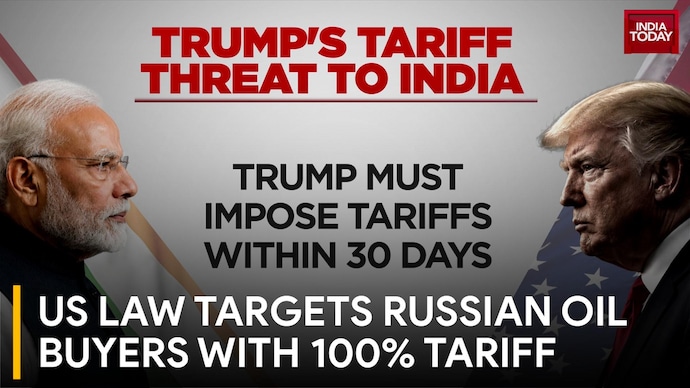
A newly signed United States sanctions law grants the administration authority to impose tariffs of up to 100% on imports from the five largest buyers of Russian crude oil and natural gas within 30 days. Although India and China are major purchasers, the legislation does not name specific nations or define how top importers will be calculated. In response, India has maintained that national interest and energy security for its 1.4 billion citizens remain paramount through diversified energy sourcing. New Delhi highlighted the potential impact on bilateral ties and global energy markets, reiterating its commitment to taking all necessary measures to protect domestic economic interests.

US Law on Russian Oil Tariffs, 100% Import Levies Risk, Impact on India-US Trade Talks

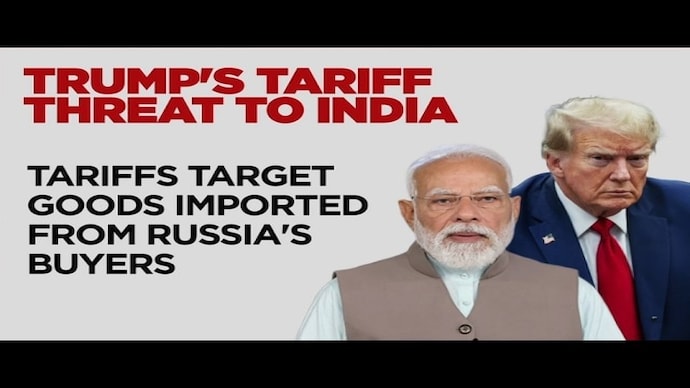
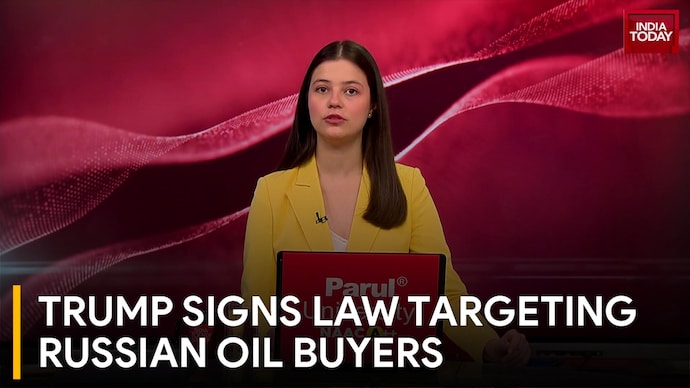
United States President Donald Trump has signed a new Russia sanctions bill into law, granting the administration authority to impose tariffs of up to 100% on goods imported from the top five buyers of Russian crude oil and natural gas within 30 days. The legislation covers major importers such as India and China, as well as countries aiding sanctions evasion. While the law grants significant executive discretion regarding implementation, the White House must notify Congress prior to removing any tariffs. The move comes ahead of high-level diplomatic engagements, including planned talks with Chinese President Xi Jinping and Ukrainian President Volodymyr Zelenskyy, aiming to exert pressure regarding the Russia-Ukraine war. For India, a leading purchaser of Russian crude, the law introduces new variables amid ongoing bilateral trade negotiations, where officials indicate substantial progress on an agreement ahead of scheduled ministerial discussions.

Trump Signs Sanctions Law Targeting Russian Oil Buyers; India And China In Focus

United States President Donald Trump has signed into law a new sanctions measure targeting Russia and Iran, which allows the imposition of tariffs of up to 100 per cent on the top five buyers of Russian oil and gas. While the legislation does not explicitly name India and China, both countries remain among the largest purchasers of Russian energy. The law grants the US president full authority after 30 days to issue decrees determining tariff scope, exemptions, or product-specific duties. The development introduces a new variable amid ongoing bilateral trade negotiations between India and the United States, where discussions around a potential trade deal are reported to be near completion. The law is also viewed as an instrument to increase pressure regarding the Russia-Ukraine conflict.

Trump set to sign Russia Sanctions Bill: Is India caught in US-Russia crosshairs?

President Donald Trump is set to sign the Russia sanctions bill after it cleared both chambers of Congress. The legislation allows him to impose tariffs of up to 100% on major buyers of Russian energy, including India and China. What could this mean for India-US ties and global energy markets? Could a prolonged court battle damage the Tata brand, irrespective of who wins? Is a compromise necessary? With Tata Sons reappointing N Chandrasekaran despite Noel Tata’s objections, will the decision stand? And after more than five decades across cinema, theatre and television, Anant Nag has been chosen for the Dadasaheb Phalke Award. Was the honour long overdue? Does theatre remain his first love, or has cinema taken its place? The veteran actor speaks exclusively to India Today. Three major conversations, tonight on News Today with Rajdeep Sardesai.

US 100% Tariff Threat on Russian Oil, Canada-EU Pivot & BRICS Power Shift

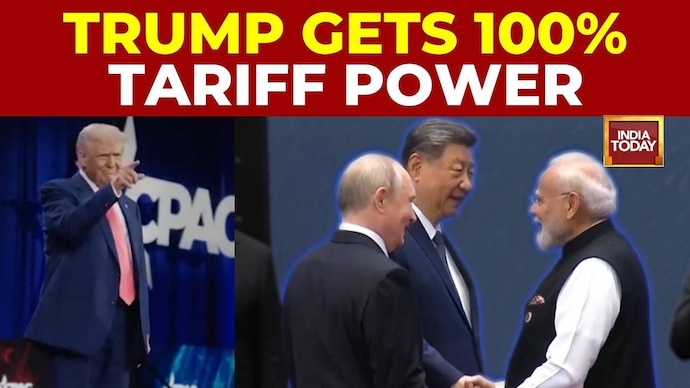
The US House of Representatives has passed the Lindsey Graham Sanctioning Russia and Iran Act of 2026, granting President Donald Trump authority to impose tariffs of up to 100% on nations purchasing Russian oil and gas. The move directly exposes major buyers like India and China, following the recent BRICS Summit in New Delhi where leaders opposed unilateral coercive measures. Russian crude accounted for 30.3% of India's oil imports in fiscal 2026, making energy security vital for the nation. Simultaneously, rising tensions between Washington and Ottawa have led Canada to explore unprecedented associate membership with the European Union to diversify trade and strategic partnerships beyond North America. Additionally, social media rumours regarding Chinese President Xi Jinping suffering a medical emergency in New Delhi were debunked, while Pakistan Tehreek-e-Insaf prepares for its planned march to Islamabad amidst heightened administrative security.

US House Passes Russia-Iran Sanctions Bill; 100% Tariff Threat on India Crude; New Delhi Reacts

The United States House of Representatives has passed the Lindsey Graham Sanctioning Russia and Iran Act of 2026, sending legislation to President Donald Trump that enables tariffs of up to 100 percent on major buyers of Russian crude oil and natural gas, including India and China. In response, the Ministry of External Affairs affirmed India's commitment to securing energy supplies through diversified sources while communicating bilateral and market implications to US interlocutors. Amid geopolitical developments and Russian crude accounting for 51.1 percent of Indian oil imports in July 2026, Chief Economic Advisor Dr V Ananth Nageswaran and Union Minister Kiren Rijiju examined India's economic trajectory and governance roadmap toward Viksit Bharat by 2047. Discussion points included banking sector balance sheet reforms, capital expenditure expansion, the Production Linked Incentive scheme, trade agreements, and administrative strategies under Prime Minister Narendra Modi.

US House Passes Bill Enabling Up to 100% Tariffs on Russian Oil Importers

The United States House of Representatives has passed a new sanctions legislation empowering the US President to impose tariffs of up to 100 percent on major buyers of Russian oil and gas, placing countries such as India and China directly in the line of fire. Cleared by a vote of 262 to 159, the bill targets Russia's energy sector, leadership, and shadow fleet, while authorizing steep tariffs on the five largest importers of Russian energy. The legislation, which previously cleared the Senate, now awaits presidential signature. In response, India stated it is closely monitoring developments and affirmed its commitment to securing energy for its 1.4 billion citizens through diversified sources. New Delhi flagged the potential impact on bilateral relations and global energy markets, maintaining that it will take all necessary measures to protect national economic interests. Meanwhile, domestic stock markets showed resilience as the benchmark index gained in trade following the announcement.

US Congress Passes 100% Tariff Bill on Russian Oil Buyers as Midterms & China Summit Near

The US Congress has fast-tracked a bill granting the president authority to impose 100% tariffs on countries purchasing oil and gas from Russia, including India, China, Turkey, and Japan. Originally proposed by the late Senator Lindsey Graham, the revised legislation moved through the Senate and the House Freedom Caucus ahead of the midterm elections. Analysts note the move provides diplomatic leverage ahead of the Chinese president's visit to Washington, DC, to negotiate trade, artificial intelligence, and semiconductor issues. The measure also signals congressional intent to address ongoing conflicts in Ukraine and West Asia. Discussion highlighted concerns regarding the economic impact on India amid ongoing bilateral trade negotiations and global energy vulnerabilities. The legislation permits presidential waivers, with experts emphasizing the objective of restricting revenues funding Russia's military campaign in Ukraine.

US House Clears Russia Sanctions Bill, 100% Tariffs on Russian Oil Buyers Loom

The US House of Representatives has passed the Lindsey Graham Sanctioning Russia and Iran Act of 2026 with a 262 to 159 vote. The legislation empowers President Donald Trump to impose sanctions on Russia and tariffs of up to 100% on countries buying Russian oil and gas, including India and China. The bill targets Russia's energy sector and shadow fleet, while authorising steep tariffs on the five largest importers of Russian energy. The Ministry of External Affairs stated that India is closely monitoring developments and remains committed to ensuring energy security for its 1.4 billion people through diversified sourcing, adding that it will take all necessary measures to safeguard economic interests.

US Passes Russia Sanctions Bill; 100% Tariff Threat Looms Over India & China

The US House of Representatives has passed the Lindsey O'Graham Sanctioning Russia and Iran Act of 2026, granting the US President authority to impose tariffs of up to 100% on countries purchasing Russian crude oil and gas, including India and China. The legislation, cleared in a 262-159 vote following Senate passage, targets Russia's leadership, energy sector, and shadow fleet to curb sanctions evasion. Countries importing under 15% of Russia's gas exports while reducing purchases may qualify for exemptions. The move introduces fresh uncertainty into ongoing India-US trade negotiations, as India remains a major importer of discounted Russian crude. While the legislation awaits presidential signature before enforcement, observers note that tariff powers could provide leverage ahead of major diplomatic engagements, even as provisions exist for waivers and congressional notification regarding duty adjustments.

US Russian Oil Sanctions Bill, 100% Tariff Threat For India And Leverage On China

The United States Congress has passed a sanctions bill granting presidential authority to impose up to 100 per cent tariffs on countries purchasing oil and gas from Russia, directly impacting major buyers including India and China. Originally proposed by the late Senator Lindsey Graham, the legislation also targets Russian energy, leadership, and the shadow fleet, alongside expanding sanctions on Iran. The measure heads to Donald Trump for approval and signature, granting the White House waiver powers while requiring congressional notification for tariff removals. The move emerges ahead of the Chinese President's planned visit to Washington and amid United States midterm elections, offering leverage in trade and geopolitical negotiations. For India, the legislation introduces fresh uncertainty into ongoing bilateral trade deal talks that have been under negotiation for over a year, even as options remain open to seek exemptions or engage in direct dialogue with the White House on Russian energy imports.

US House Clears Russia Sanctions Bill; 100% Tariff Threat Looms Over India and China

The US House of Representatives has passed the Lindsey Graham Sanctioning Russia and Iran Act of 2026 by a vote of 262 to 159, sending the bill to President Donald Trump for final approval. The legislation targets Russia's energy sector and leadership, authorising tariffs of up to 100% on the top five importers of Russian crude oil and natural gas, placing major buyers like India and China at risk. Countries importing under 15% of Russia's gas exports while actively cutting purchases may seek exemptions. The bill further permits up to a 500% tariff on Russian goods entering the United States. With India importing nearly 85% of its oil requirement and navigating supply bottlenecks amid Middle East tensions, the move adds new friction to India-US trade talks as New Delhi evaluates long-term import diversification.

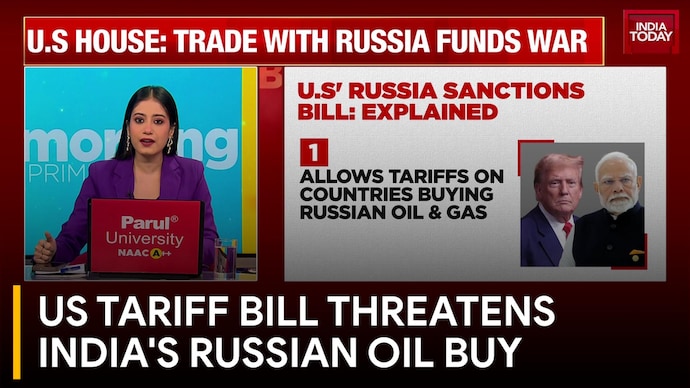
US Tariff Bill Threatens Russian Oil Imports, Trade Ties and Energy Security

The US House has passed a bill enabling 100% tariffs on nations purchasing Russian crude oil and gas, placing a spotlight on India and China. While the legislation requires presidential approval before taking effect, it introduces fresh complications to ongoing India-US trade talks. India maintains that its fuel procurement remains driven strictly by national interest and energy security, asserting it will not bow to external pressure. Panellists discuss the broader geopolitical dynamics, including US diplomatic pressure on India regarding Russia, the impact of the BRICS summit, upcoming US midterm elections, and strategic maneuvering ahead of high-level bilateral engagements.