
Iran deal largely done: Trump's big announcement after talks with Gulf leaders
In a post on Truth Social, Trump said the agreement had been "largely negotiated" and that only the final details remained under discussion before a formal announcement.
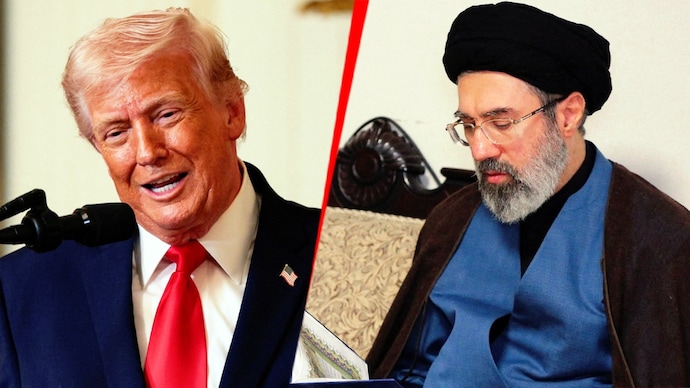

US President Donald Trump on Sunday claimed that Washington and Tehran were nearing a broad agreement aimed at reducing tensions in the Gulf region, saying the Strait of Hormuz would reopen as part of the proposed understanding.
In a post on Truth Social, Trump said the agreement had been "largely negotiated" and that only the final details remained before a formal announcement.
"An Agreement has been largely negotiated, subject to finalization between the United States of America, the Islamic Republic of Iran, and the various other Countries, as listed," Trump wrote.
Furthermore, the President said that reopening the Strait of Hormuz, one of the world's most critical oil shipping routes and a flashpoint in recent regional tensions, would be a key outcome of the deal.
"Final aspects and details of the Deal are currently being discussed, and will be announced shortly. In addition to many other elements of the Agreement, the Strait of Hormuz will be opened," he said.
The Republican leader also informed that the breakthrough followed a series of high-level conversations involving leaders from across the Middle East and beyond, amid growing diplomatic efforts to stabilise the region after months of military escalation surrounding the Iran conflict.
According to Trump, he held discussions from the Oval Office with Saudi Crown Prince Mohammed bin Salman, UAE President Mohammed bin Zayed Al Nahyan, Qatar Emir Tamim bin Hamad Al Thani, Pakistan Army chief Asim Munir, Turkish President Recep Tayyip Erdogan, Egyptian President Abdel Fattah el-Sisi, Jordan’s King Abdullah II and Bahrain’s King Hamad bin Isa Al Khalifa, among others.
Trump said the talks centred on Iran and a broader "Memorandum of Understanding pertaining to PEACE".
The US president also said he separately spoke to Israeli Prime Minister Benjamin Netanyahu, adding that the conversation had "gone very well".
IRAN DISPUTES HORMUZ CLAIM
Iranian media, however, rejected Trump's assertion that the Strait of Hormuz would fully reopen under the proposed agreement, insisting that control over the waterway would remain with Tehran.
The semi-official Fars News Agency described Trump's remarks as "far from reality" and said they did not reflect the actual terms being discussed.
According to the report, even if an agreement is reached, Iran would retain authority over shipping routes, transit timing, passage procedures and permits in the Strait of Hormuz.
"Based on the latest exchanged text, if a possible agreement is reached, the Strait of Hormuz will still be under Iran's management," the agency reported.
It added that while Tehran could restore shipping traffic to pre-war levels, it should not be interpreted as unrestricted access.
"The management of the strait, determining the route, time, manner of passage, and issuing permits will remain exclusively under the control and discretion of the Islamic Republic of Iran," the report said.
PAK-MEDIATED TALKS GATHER PACE
Iran said on Saturday it was working toward a Memorandum of Understanding (MoU) to end the conflict with the United States after high-level talks in Tehran involving Asim Munir.
Pakistan's military described the discussions as 'encouraging', while two Pakistani sources involved in the negotiations told Reuters that the proposed agreement was "fairly comprehensive to terminate the war".
According to news agency Reuters, the framework under discussion would unfold in three phases: formally ending the conflict, resolving the Strait of Hormuz crisis and opening a 30-day negotiation window for a broader agreement, with the possibility of an extension.
Trump had earlier told Axios he would decide on Sunday whether to resume attacks on Iran.
"Either we reach a good deal or I'll blow them to a thousand hells," he was quoted as saying.
US LAYS OUT CONDITIONS
US Secretary of State Marco Rubio, currently visiting India, reiterated Washington's conditions for ending the conflict.
"Iran can never have a nuclear weapon. The straits need to be open without tolls. They need to turn over their enriched uranium," Rubio said.
Speaking in New Delhi on Saturday, Rubio said negotiations were continuing and hinted at developments in the coming days.
"Even as I speak to you now, there's some work being done. There is a chance that, whether it's later today, tomorrow, in a couple days, we may have something to say," he told reporters.
Iran has repeatedly denied pursuing nuclear weapons, maintaining that its uranium enrichment programme is meant for civilian purposes. Tehran has demanded an end to the US blockade on its ports, the lifting of sanctions on oil exports and oversight over the Strait of Hormuz.
Iranian Foreign Ministry spokesperson Esmail Baghaei said tensions had eased somewhat, though major disagreements remained unresolved.
"The trend this week has been towards a reduction in disputes, but there are still issues that need to be discussed through mediators," he said.
Baghaei added that while lifting restrictions on Iranian shipping remained important, Tehran's immediate priority was preventing fresh American attacks and ending the conflict in Lebanon, where Iran-backed Hezbollah fighters continue battling Israeli forces in the south.
Trump had earlier warned that failure to secure an agreement could prove catastrophic, saying "a whole civilization will die", before later cautioning that "the Clock is Ticking" for Iran.