
One month on, Nepal floods leave 1,453 dead, nearly 5,300 still missing

Broken roads, buried remains and isolated villages continue to shape Nepal's recovery a month after the floods. Authorities are using DNA profiling to identify victims, rebuilding vital bridges and roads and relying on helicopters and temporary crossings to reach stranded communities as death toll reaches 1,453.
 Last UpdatedSep 26, 2026 17:13 IST
 Published by
A month after devastating flash floods struck Nepal’s central and northern districts, at least 1,453 people have died and 5,285 remain unaccounted for, according to the National Disaster Risk Reduction and Management Authority (NDRRMA).
The agency said Saturday that 1,451 bodies have been recovered, while two people died during treatment. A total of 13,795 people have been rescued so far.
Of those rescued, 1,113 people are currently staying at 21 holding centres, including 187 from Nuwakot, 805 from Rasuwa and 121 from Dhading.
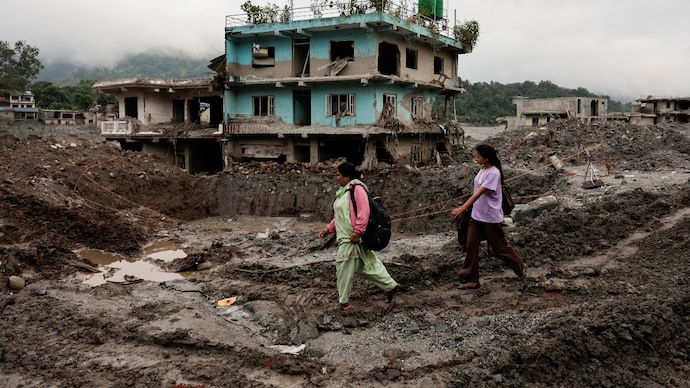
The floods began near the Nepal-Tibet border on August 26, devastating towns and villages across northern and central Nepal. The Bhotekoshi River carried the floodwaters downstream, sweeping away homes, vehicles, roads and bridges and damaging hydropower projects.
The disaster also killed 43 people in Tibet, while more than 500 remain unaccounted for, according to Chinese media reports.
In Nepal, security agencies have provided medical treatment to around 11,000 flood-affected people. Seven people injured in the disaster are still undergoing treatment, NDRRMA said.
Identifying the dead remains a major challenge. Of the 1,453 bodies recovered, only 112 have been identified and handed over to their families.
Many bodies were badly damaged or fragmented, making visual identification difficult. Nepal Police is therefore using DNA profiling to match recovered remains with people reported missing after the floods.
Police have collected 1,329 DNA samples from recovered bodies and remains and another 2,060 samples from relatives of missing people.
Authorities have also uploaded details of 1,421 unidentified bodies on the Nepal Police website to help families establish possible identities.
With mortuaries unable to accommodate the large number of recovered bodies, authorities have buried many unidentified remains after completing required procedures and collecting DNA samples and identifying details. The samples are being preserved for future comparison if matches are established.
Nepal Police has urged relatives of missing people to provide blood samples for DNA profiling. It has said samples should preferably come from a first-degree relative, such as a parent or child, or a sibling if no first-degree relative is available.
Recovery operations have focused on locating those still missing, recovering bodies, reopening roads and bridges, restoring essential services and reaching communities that remain difficult to access.
The floods washed away around 40 kilometres of roads and 41 motorable bridges between Rasuwa and Dhading, according to the Department of Roads. The damage disrupted key links between Rasuwa and Nuwakot and cut off several settlements from regular road access.
Authorities have been constructing temporary tracks and installing Bailey bridges to restore connectivity. An Army-installed bridge at Devighat has reopened the Galchhi-Bidur road link, while work is under way on another Bailey bridge at Betrawati. The government is also preparing a bridge at Syabrubesi.
The main road connecting Syabrubesi with Rasuwagadhi remains completely damaged. Authorities have begun surveying the route for a new road and aim to restore traffic on the Galchhi-Syabrubesi section by mid-October.
The damaged road network has also complicated relief deliveries to remote communities. In Rasuwa, supplies have accumulated at Dhunche, while some villages have relied on helicopters, drones and temporary crossings for food and other essentials.
Limited airlift capacity has prevented supplies from reaching all affected communities simultaneously, The Kathmandu Post reported.
Search operations have also continued at damaged hydropower projects where workers went missing during the floods. Rescue teams have recovered bodies from tunnels at the Chilime and Upper Trishuli-1 projects, while searches for others continue.
Fresh heavy rain has further complicated recovery efforts. Three days of continuous rainfall have disrupted major road links, while landslides have blocked or restricted traffic at several locations.
At Krishnabhir in Dhading, where the highway was already damaged by the August floods, continuing mudslides have further affected the road.
Police said landslides occurred at seven locations along the Prithvi Highway in Dhading. The road was completely blocked at Krishnabhir and Tigraang Khola, while traffic was restricted to one lane at five other locations. Continued rain has also hampered debris-clearance operations.
The rainfall has added to the difficulties faced by people displaced by the August floods. Radio Nepal reported that families living in temporary shelters in Nuwakot were struggling with leaking tents and protecting relief supplies from the incessant rain.
Despite the challenges, authorities continue to work on restoring road connectivity and reaching affected communities. The government has said repairing the damaged road network remains a priority, with the infrastructure ministry targeting the reopening of key routes in phases.