
Sex sells: Trump boasts he convinced Nvidia board to rehire Jensen Huang

Donald Trump claimed he personally persuaded Nvidia's board to reinstate Jensen Huang as CEO, assuring them that his return posed no national security threat.
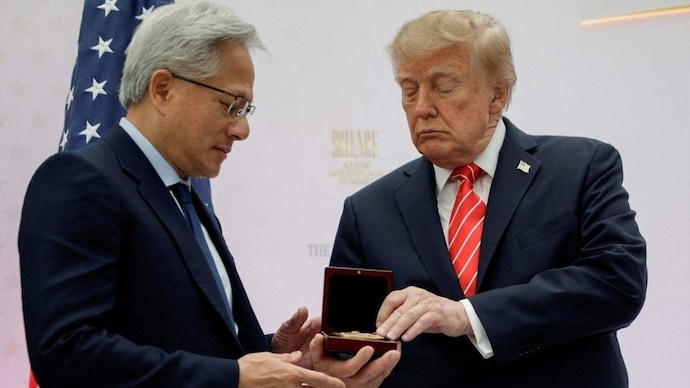


"Sex sells, fellas," US President Donald Trump said, suggesting that the controversy surrounding Nvidia CEO Jensen Huang's extramarital affairs may have inadvertently benefited the chipmaker, as the companies stocks soared after Jensen's return. Trump, who claimed he personally persuaded Nvidia's board to reinstate Huang, described the executive's indiscretion as "unfortunate" but argued that the resulting attention could prove a "net positive" for the company.
In a phone interview with CNBC shortly after Nvidia announced Huang's return, Trump said he had spoken directly to members of the company's board and persuaded them to bring back its founder.
"I spoke to them, let me put it that way," Trump said when asked whether he had contacted Nvidia's board.
"And I convinced them," he added.
During the interview, Trump repeatedly returned to the publicity generated by the allegations surrounding Huang's personal life, arguing that the controversy had brought Nvidia into the spotlight more than it otherwise would have.
"Sex sells, fellas. Now Cramer would not know that because he's a, he's a very, very, very committed person, but sex sells," Trump said, referring to CNBC's Jim Cramer, the well-known host of the financial markets programme Mad Money.
"And it really brought it out much more so than it would have come out without it," Trump added.
Trump also said Huang had apologised to Nvidia, the country and his family, including his wife, whom the US President described as a "fantastic woman".
"He's apologised for that to the company, to the country and to his family and his wife, who's a fantastic person. I know her. She's a fantastic woman, by the way," Trump said.
According to Trump, Huang's apology had been accepted and the controversy appeared to have subsided.
"They've accepted and I think everyone's accepted now. I actually think it'd be, it could be, I mean, it sounds strange, but I think it could be a net positive," he said.
Nvidia announced that its board had voted to reinstate Huang, less than two weeks after his resignation following revelations of multiple alleged extramarital affairs. The controversy also involved an alleged relationship with Alice Huang, a Singapore-based businesswoman suspected by US intelligence officials of having links to Chinese espionage.
The allegations raised questions about potential national security risks, given Nvidia's prominent position in the US semiconductor and artificial intelligence industries.
Trump, however, had consistently defended the Nvidia co-founder, insisting that he had done nothing wrong and that retaining his leadership was in the interests of both the company and the country.
"Jensen did nothing wrong," Trump said during the CNBC interview, expressing support for the board's decision.
He also revealed that Nvidia's board had sought assurances from the US administration about potential national security concerns associated with Huang's return.
"They did ask for assurance on the national security threat. And we gave them assurances, at least with everything we know and we know a lot," Trump said.
Earlier, in a post on Truth Social, Trump had welcomed the board's decision, describing it as "correct and proper" and calling Huang a "national treasure".
"The country needs Jensen's leadership at NVIDIA to ensure the success and prosperity of not only the company but also the American economy. The United States government has no reason to believe that Jensen's return to NVIDIA poses any risk to national security," he wrote.
In another post, Trump congratulated Nvidia on what he called an "absolutely GREAT decision".
The national security concerns stem from allegations surrounding Huang's reported association with Alice Huang, a Chinese national who has been suspected of having links to Chinese intelligence. The allegations have raised questions about potential access to sensitive information at Nvidia, which plays a crucial role in the US artificial intelligence and semiconductor industries.

Ajmal Abbas works with the news desk at IndiaToday.in, where he edits news reports from a wide spectrum of national and international news, and also heads the shift.
Politics and stories from south India and the political dynamics in West Asia are two topics that excite him most.
Originally from Kerala, Ajmal joined India Today in July 2023. He began his career in 2015 as a trainee with the Press Trust of India after completing his post-graduation in journalism from the Indian Institute of Mass Communication, New Delhi.
Before joining the India Today Group, he worked with Times Network as a Senior Special Correspondent, where he reported and edited stories from India’s major metro cities with a focus on urban mobility, civic administration, and infrastructure for Times Now. He has also worked with Tehelka Magazine as a reporter and was associated with two other media houses in Kerala.
Ajmal is an organic journalist for whom news provides the greatest high. He also closely follows the latest developments in digital storytelling across the world.
He is fluent in English and his mother tongue, Malayalam, and has professional expertise in Hindi. He can also speak and understand Tamil, and read and write Arabic.
READ MORE