
Big win for Trump as US Supreme Court lets White House ballroom construction continue
The Supreme Court allowed the Trump administration to continue the White House ballroom project while litigation proceeds. The split order keeps construction moving and sharpens questions over executive power and oversight.
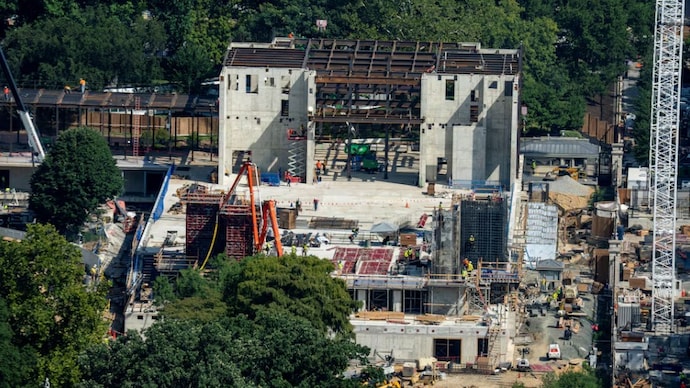

The US Supreme Court on Monday allowed Donald Trump’s administration to continue construction of a USD 400-million White House ballroom while a legal challenge to the project proceeds. The ruling hands the US President a major win after a lower court had ordered a halt to above-ground work.
The 5-4 ruling temporarily blocks a lower court order that had stopped above-ground construction of the planned 90,000-square-foot ballroom. The court did not rule on the legality of the project itself, instead finding that the National Trust for Historic Preservation, which challenged the construction, likely lacked the legal standing to bring the case.
Chief Justice John Roberts was the lone conservative justice to dissent, joining the court’s three liberal justices. In his dissent, Roberts said the project was “likely unlawful”, arguing that Congress has constitutional authority over federal property in Washington and had not expressly authorised construction of the ballroom.
The National Trust sued after the Trump administration demolished the White House East Wing and began work on the ballroom without seeking specific approval from Congress. The group’s president and CEO, Brent Leggs, said the ruling was disappointing and reiterated that the construction was unlawful.
GOLDEN AGE FOR AMERICA, SAYS TRUMP
Trump welcomed the Supreme Court ruling in a social media post, calling the legal challenge baseless and celebrating the project as part of what he described as a “Golden Age for America.”
He said the ballroom would be among the greatest buildings ever constructed in Washington DC, and portrayed the broader complex as a major security project.
The Trump administration has described the project as a national security necessity, citing features including bomb shelters, medical facilities and protection against drones and missiles. Justice Department lawyers told the Supreme Court that the integrated complex was “vitally required by national security”.
The ballroom project is part of Trump’s broader efforts to reshape the Washington landscape. His plans also include building a 250-foot arch and revamping the Kennedy Center, a major cultural and performance venue.
WHY THE BALLROOM PROJECT WAS CHALLENGED
The legal battle began after the administration demolished the East Wing, which housed the First Lady’s offices and a White House movie theatre, and began constructing the 90,000-square-foot ballroom. The East Wing was originally built in 1902 during Theodore Roosevelt’s presidency and was greatly expanded in 1942 during Franklin Roosevelt’s presidency.
US District Judge Richard Leon had ordered the administration to stop above-ground construction, while allowing underground work and measures deemed necessary for White House security to continue. The DC Circuit Court of Appeals later upheld that order in a 2-1 decision.
The appeals court had said that each president is a “temporary tenant, not the owner” of the White House and cannot fundamentally reshape it without congressional approval.
The Trump administration appealed to the Supreme Court, arguing that stopping the project would cause irreparable harm and compromise national security. Government lawyers also argued that the preservation group had no legal standing to challenge the project.
The Justice Department has said the overall project, including the underground facilities and above-ground ballroom, was about 65 per cent complete as of August 14. Court filings indicate that the framework could be completed by November, much of the facade by April and the full project by August 2028.
For now, construction can continue while the broader legal dispute returns to the lower courts. The US Supreme Court’s order therefore gives Trump a temporary victory but does not finally settle whether the ballroom project itself was lawfully authorised.