Vietnamese crab exporter
Advertisement

Putin Meets Xi at Bishkek SCO Summit, Offers Visa-Free Travel, Modi Bilateral Awaited

Russian President Vladimir Putin met Chinese President Xi Jinping on the sidelines of the SCO summit in Bishkek. During the bilateral talks, Moscow expressed readiness to work towards permanent visa-free travel arrangements between Russia and China, while Putin offered condolences over the recent floods in China. The meeting highlights deepening Russia-China ties amid growing Russian economic reliance on Beijing following the Ukraine conflict, particularly in crude oil trade. Meanwhile, a bilateral meeting is scheduled between Prime Minister Narendra Modi and President Putin to discuss energy cooperation, crude oil purchases, and Arctic projects, though no meeting is scheduled between Modi and Xi Jinping.

Read More

VIDEOS FROM OTHER SECTIONS

LATEST VIDEOS

PM Modi To Meet Vladimir Putin At SCO Summit In Bishkek; Defence, Trade, Energy On Agenda

Prime Minister Narendra Modi and Russian President Vladimir Putin are set to hold a bilateral meeting on the sidelines of the SCO summit in Bishkek. The discussions between the two leaders are expected to cover defence, energy, trade, economy, investments, space, and undersea capabilities. The meeting takes place amid global geopolitical turbulence and discussions around an alternative world order, with Washington closely observing the engagement between India and Russia. The strategic partnership between both nations spans wide-ranging areas, continuing India's engagement in the SCO process, which India joined as a permanent member with Russia's support.

SCO Summit: India-Iran Bilateral, West Asia Peace, Countering China Challenge

At the SCO summit, bilateral discussions were held between India and Iran to reaffirm bilateral friendship and address regional geopolitical tensions in West Asia. The discussions highlighted the need to expand and diversify the bilateral trade basket while supporting efforts toward lasting peace. Meanwhile, no bilateral meeting was scheduled with the Chinese leadership. India continues to navigate challenges regarding the regional bloc by opposing the Belt and Road Initiative and the China-Pakistan Economic Corridor over sovereignty and territorial integrity concerns. Furthermore, India is advancing strategic connectivity alternatives, including the Chabahar Port, while advocating for a multipolar platform and resisting attempts to turn the grouping into an anti-Western or China-centric bloc.

PM Modi-Putin Bilateral at SCO: Focus on Energy, S-400 Defence Ties & Trade Imbalance

Prime Minister Narendra Modi and Russian President Vladimir Putin are set to hold a high-stakes bilateral meeting on the sidelines of the SCO summit in Bishkek. The dialogue focuses on key pillars of the strategic partnership, including energy supplies, trade relations, and defence collaboration. India seeks to address a widening bilateral trade deficit exceeding 50 billion dollars by pushing for increased exports to Russian markets despite overall bilateral trade crossing 100 billion dollars. Energy security remains central, with discussions covering continued Russian oil deliveries and steady fertilizer imports vital for India and the Global South amid ongoing global supply disruptions. On the defence front, India's interest in acquiring five additional S-400 surface-to-air missile units is highlighted following their role in Operation Sindoor. The meeting unfolds against the backdrop of US pressure, geopolitical shifts, and upcoming engagements at the BRICS Summit in India.

advertisement

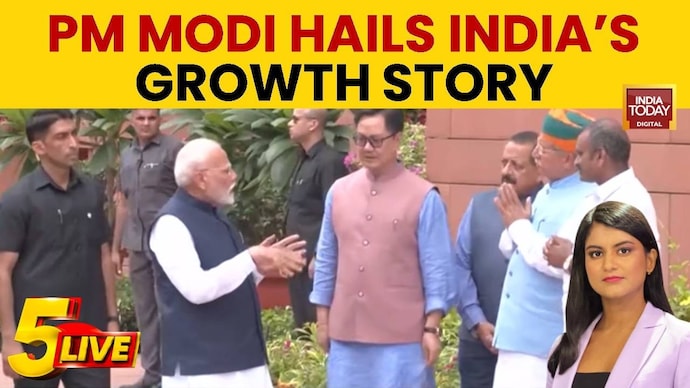
India's Q1 GDP Hits 7.8%, Manufacturing Surges 9.2% As PM Modi Hails Herculean Growth

Prime Minister Narendra Modi hailed India's economic growth as gross domestic product expanded by 7.8% in the first quarter of financial year 2026-27, calling it a Herculean feat. The Prime Minister stated that the collective strength of the people ensured strong growth despite global uncertainties, oil price shocks, and supply chain issues, remarking that doomsayers were doomed while India bloomed. The growth numbers surpassed projections, driven primarily by robust domestic consumption and substantial government capital expenditure in infrastructure, including railways expansion. Key industrial sectors reflected sharp upturns, with manufacturing growing at 9.2% compared to 8.3% a year earlier, and electricity recording 8.9% growth against a contraction previously. Economists noted that trickle-down impacts of past policy measures, welfare schemes, and resilient exports helped shield the domestic economy from international challenges, raising full-year growth expectations for the fiscal year toward 7%.