
Vietnamese crab exporter
Advertisement

'Xi Needs Modi More Than Modi Needs Xi': Viraansh Bhanushali

In an interview with India Today during the eighteenth BRICS summit in New Delhi, former Oxford Union chief of staff Viraansh Bhanushali shared perspectives on the evolving role of the BRICS bloc and India's position in global geopolitics. Discussing the summit's theme of resilience and sustainability amidst global tensions, Bhanushali stated that institutions rooted in Western dominance have failed the Global South, especially regarding the weaponization of the US dollar. He emphasized that "BRICS can be its own thing" and urged member nations to construct alternative institutional mechanisms for trade, technology sharing, and mobility rather than replicating Western models like the G7 or G20. On India-China relations and President Xi Jinping's visit to India, Bhanushali noted that mutual economic interdependence serves as a strategic factor, asserting that "Xi needs Modi more than Modi needs Xi at this point." He concluded by noting that rising global scrutiny of India reflects its growing international economic and geopolitical stature.

Read More

VIDEOS FROM OTHER SECTIONS

LATEST VIDEOS

'Thank God Supreme Leader Is Alive': Iran's Pezeshkian On Rumours Regarding Mojtaba Khamenei

An interviewee addressed widespread speculation regarding the supreme leader, confirming that the leader remains alive and continues his duties. The guest criticized targeted assassinations of commanders, scientists, and civilians across Syria, Lebanon, Gaza, Iraq, Qatar, and Iran. The speaker condemned these actions by the United States and Israel as state terrorism, stating that entire families, buildings, bridges, and factories are destroyed under the pretext of counter-terrorism operations.

Modi At BRICS 2026: 'Global South Needs To Change Pyramid Of Privilege To Platform of Partnership'

Speaking at the 20th anniversary BRICS Summit hosted under India's presidency, Prime Minister Narendra Modi called for urgent reforms in multilateral institutions. Addressing world leaders, he emphasised that the Global South must transition from being a rule taker to a rule shaper, declaring, 'UN Security Council में reform अब और टाला नहीं जा सकता'. He highlighted that India's chairship has been driven by a people-centric and humanity-first approach across more than 350 meetings held in 30 cities. To sustain institutional momentum, PM Modi proposed a 'BRICS continuity and implementation mechanism' supported by a Troika follow-up framework and a secure digital repository. Outlining key global governance priorities across representation, responsiveness, and rule-making, he advocated a ten-point roadmap for global reforms, voting power recalibration in international financial bodies, and the creation of a seafarers emergency support network. Aligning his address with the United Nations Day for South-South Cooperation, he underscored that a shared global future requires shared decision-making power.

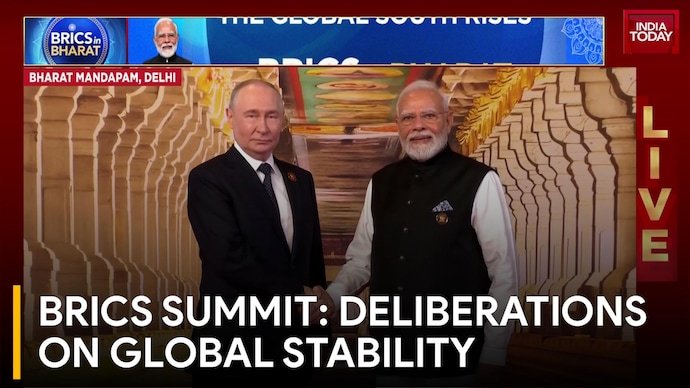
BRICS Summit Engagements, Bilateral Deliberations And Focus On Regional Stability

World leaders gathered at Bharat Mandapam for the BRICS summit, with bilateral meetings taking place on the sidelines against the backdrop of the iconic Ramanathaswamy Temple from Rameshwaram. Discussions focused on the significance of member nations managing mutual differences and disputes to establish regional and economic stability. The deliberations emphasized moving beyond standard diplomatic statements to create actionable mechanisms for long-term global cooperation.

advertisement

BRICS Summit at Bharat Mandapam: West Asia Stability, Global Power Shifts and Multilateralism

World leaders gather at Bharat Mandapam in Delhi for the BRICS Summit as strategic discussions center on global stability, regional security, and the future of multilateralism. Key deliberations highlight the crisis in West Asia, emphasizing the need for direct dialogue and coexistence between Arab nations and regional neighbours to build a sustainable security architecture. Panellists address shifting global power dynamics, changing modes of modern warfare, and the impact of major power policies on international waterways such as the Strait of Hormuz and Bab el-Mandeb. The forum underscores the importance of consensus, resilience, and reinvigorating international institutions to address economic turmoil and strategic realignments affecting member nations.