How AI is transforming India's engineering sector
Manufacturing has been stuck at 13–17% of GDP for two decades. Top engineering and energy executives say AI could change that, but only if it reaches beyond the big plants.
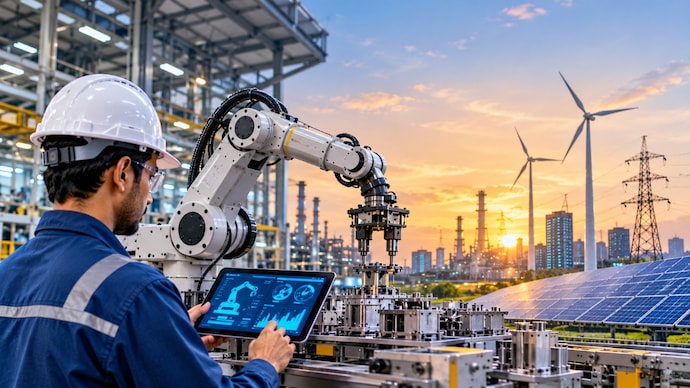
For two decades, India’s manufacturing sector has been stuck in a narrow band. Its share of GDP has hovered between 13% and 17% despite considerable policy effort. The government now wants to break out, with a technology-first plan. NITI Aayog’s Frontier Tech Hub, working with CII and Deloitte, has published a 10-year roadmap (2026–2035) that aims to lift manufacturing’s share from 17% to over 25%, create 100 million jobs and put India among the world’s top three manufacturing hubs.
The roadmap also carries a warning. It estimates that delayed adoption of frontier technologies could cost India $270 billion in potential GDP gains by 2035 and $1 trillion by 2047. A separate Angel One report estimates that wider adoption of AI, robotics and automation could add $1.1 trillion to manufacturing GDP by 2047.
Industry leaders say the shift has already begun, and that cost alone will not get India there.
Intelligence in the asset
“India is at an inflection point,” says Sanoj Somasundaran, CTO of SKF India (Industrial) and Director, Technology Development, ISEAM. Manufacturing contributes around 17% of GDP, he notes, and the leap to 25% needs more than cost:
“That leap will not come from cost advantage alone. It will come from intelligence engineered into the asset itself.”
Somasundaran points to three shifts under way on Indian shop floors: equipment that signals failure well before it happens, rotating systems that use measurably less energy for the same output, and smaller manufacturers gaining access to industrial intelligence without the capital base of a large plant. “This is India’s moment to convert manufacturing scale into manufacturing intelligence,” he says.
Connected, but exposed
Greater connectivity brings its own risks. Roshan Varadarajan, Vice President, Industrial Automation, Greater India, at Schneider Electric, says:
“India’s industries are becoming more digital and connected, but this also brings new challenges around cybersecurity, interoperability, scalability and operational resilience.”
His answer is secure, open and software-defined automation backed by local engineering depth. India is a strategic R&D hub for the company, with more than 6,000 engineers, and products made here are exported to over 30 countries. That base, Varadarajan says, allows Schneider to build “India-for-India solutions” for the domestic market.
Building the grid, and the brains behind it
The sharpest test of AI’s promise may be in energy. The country’s data centre boom is changing the load profile of the grid. The Ministry of Power has projected that AI data centres will add 26.3 GW to demand by 2031–32, largely to be met by renewables. That is nearly double the 13.56 GW the ministry projected in March. A recent report projects total data centre capacity of 12 GW by 2030, with AI-dedicated capacity growing nearly 24-fold. Analysts have warned that such demand can be spiky, with sharp ramps that need reliable supply, transmission planning and grid balancing.
Pratik Agarwal, Chairman of Serentica Renewables and Resonia Ltd and Managing Director of Sterlite Electric Limited, says the opportunity lies in a change of direction:
“India’s opportunity is to move from simply localising manufacturing to building the technology and engineering capabilities that can create global leadership.”
At Resonia, mechanisation, automation and digital tools are being used across transmission construction to cut manual intervention and build the grid “faster, safer and at greater scale.”
At Serentica, the company is deploying SERA, its proprietary technology ecosystem, which “combines AI, digital platforms and real-time intelligence to optimise renewable generation, storage, markets and customer demand as an integrated portfolio.” Agarwal says the next competitive advantage will come from pairing advanced engineering with indigenous technology.
Simarpreet Singh, Executive Director and CEO of Hartek Power, ties the two trends together. The expansion of data centres and AI-led applications is creating demand for reliable power systems, he says, while renewable growth makes smart grid solutions more important.
“AI can help forecast demand, optimise renewable generation, predict equipment failures and identify grid constraints, improving reliability and efficiency.”
For manufacturers, he adds, combining AI with automation can improve productivity and precision, helping Indian EPC and renewable energy companies “move higher up the global value chain.”
The diffusion problem
The biggest risk may be uneven adoption. Srivatsan Iyer, Global CEO of Hero Future Energies, agrees that India’s next manufacturing advantage will come from engineering depth combined with “AI-led productivity and quality,” with AI improving yields, tightening process control and sharpening renewable-generation forecasts. In the power system, he says, it can also detect faults and theft. On adoption, he is blunt:
“The bigger challenge is diffusion. If advanced digital tools remain concentrated among large companies, the technology gap will widen.”
The numbers suggest the stakes for smaller firms are high. A PwC report published in March projects that AI could add $135.6–149.9 billion to the growth of India’s manufacturing MSMEs by 2035, provided MSMEs reach 50% of manufacturing value added. Iyer says making digital tools accessible to MSMEs, along with the right skills and data infrastructure, can help India “move decisively up the global value chain.”
The road ahead
The gap between ambition and delivery remains wide. India invests less than 1% of GDP in research and development, while China spends over 2%. For the engineering sector, the argument from industry is now consistent: scale built the base, but intelligence, spread well beyond the largest plants, will determine whether India climbs the value chain or stays where it is.

