PM inaugurates Bengaluru Metro's Pink Line, takes ride with DK Shivakumar
PM Modi, during his Karnataka visit, inaugurated the Bengaluru Metro's Pink Line, flagged off Bengaluru-Mangaluru-Madgaon Vande Bharat Express and inaugurated four redeveloped railway stations under the Amrit Bharat Station Scheme.
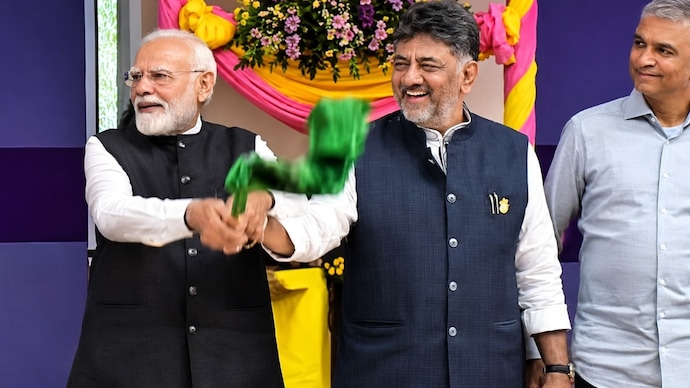
Prime Minister Narendra Modi on Friday inaugurated Bengaluru Metro's Pink Line, flagged off the Bengaluru-Mangaluru-Madgaon Vande Bharat Express and launched development projects worth Rs 15,600 crore.
PM Modi took a ride on the newly opened 7.5-km stretch between Tavarekere and IIM Bangalore Metro station. He was accompanied by Karnataka Chief Minister DK Shivakumar, Governor Sudha Yadav, Bengaluru South MP Tejasvi Surya and Minister KB Gowda.
Before boarding the metro, the Prime Minister purchased a ticket at the counter using UPI.
While flagging off the services, PM held Shivakumar's hand as the two leaders jointly waved the flag to mark the launch of Pink Line services. The two were also seen exchanging smiles and sharing a light-hearted moment.
The Pink Line, which connects Kalena Agrahara to Tavarekere, has been developed at a cost of around Rs 3,470 crore. Its inauguration adds another corridor to Bengaluru's expanding metro network.
In the railway sector, the Prime Minister flagged off the Bengaluru-Mangaluru-Madgaon Vande Bharat Express, which is expected to provide faster connectivity between Bengaluru, coastal Karnataka and Goa.
PM Modi also inaugurated four redeveloped railway stations, Chamarajanagar, Chikkamagaluru, Sakleshpur and Subrahmanya Road, under the Amrit Bharat Station Scheme.
He further dedicated the 45-km Bagalkot-Wandal railway line doubling section, part of the 284-km Gadag-Hospet Doubling Project, and the electrification of the 55-km Sakleshpur-Subrahmanya Road Ghat railway section to the nation.
The Prime Minister's Karnataka visit also included the inauguration and launch of several infrastructure and development projects worth over Rs 15,600 crore.
According to an official statement, the Prime Minister inaugurated the Transmission Scheme for Integration of Renewable Energy Zones (Phase-II) in Koppal-II and Gadag-II, developed at a cost of around Rs 4,450 crore.
He also inaugurated the transmission scheme for the solar energy zone in Bidar, built with an investment of around Rs 1,370 crore.
During the visit, PM Modi laid the foundation stone for the transmission scheme to integrate the Davanagere-Chitradurga and Ballari renewable energy zones, estimated to cost over Rs 3,450 crore.
He also laid the foundation stone for a transmission system strengthening project to integrate additional renewable energy potential in Davanagere and Ballari, involving an investment of over Rs 1,100 crore.
The Prime Minister dedicated to the nation India's largest underground LPG storage cavern in Mangaluru, built at a cost of over Rs 850 crore. With a storage capacity of 80,000 metric tonnes, the facility is expected to strengthen India's LPG storage infrastructure.
The project also includes a 9.4-km LPG pipeline connecting New Mangalore Port to the main terminal to facilitate LPG transportation and storage.
He also dedicated the Devangonthi Marketing Terminal of Mangalore Refinery and Petrochemicals Limited (MRPL) in Bengaluru. Built at an investment of Rs 330 crore, the facility will strengthen petroleum product storage and distribution infrastructure in Karnataka.
PM Modi also laid the foundation stone for GAIL's Compressed Biogas Plant at Haralakunte in Bengaluru. The plant will process around 300 tonnes of municipal solid waste daily to produce 12.6 tonnes of compressed biogas.
The Prime Minister is now scheduled to travel to Mysuru to participate in a tree plantation programme at Bharat Vann and inaugurate the COSMOS-Mysuru Planetarium.
The Prime Minister will also attend the golden jubilee celebrations of Prashanti Kutiram, the residential headquarters campus of Swami Vivekananda Yoga Anusandhana Samsthana (S-VYASA).
He is scheduled to lay the foundation stone for the Golden Jubilee Administrative Block and launch the S-VYASA off-campus in Thiruvananthapuram, Kerala. The programme will also mark the birth centenary of former RSS general secretary H V Sheshadri.

