Goa makes ITI equal to Class 12. Should the rest of India follow?
Goa's decision to treat Class 10 plus a two-year ITI course as equivalent to Class 12 has reopened India's biggest education debate: should states prioritise job-ready skills over degrees? The answer is not to abandon education, but to stop treating academic and vocational learning as enemies.
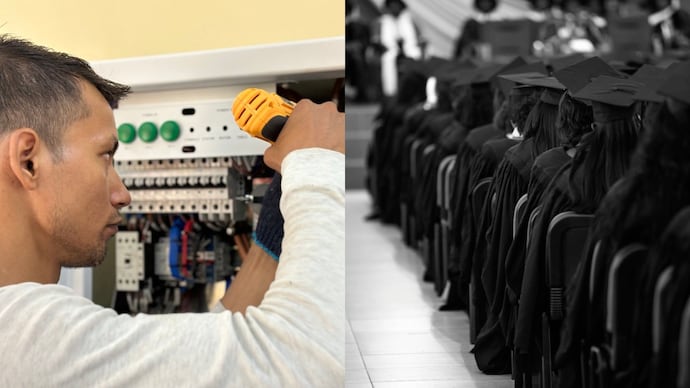
Every Indian parent and their child knows the traditional middle-class script by heart -- Class 10 to Class 12 to college degree to job. You don't really choose it anymore. You just fall into it, the way you fall into your mother tongue.
So when a kid says, "I want to be an electrician" instead of "I want to do BCom", a lot of Indian households still have the same reflex: “But what will you study?” As if a trade isn't studying. As if wiring a house correctly is somehow lesser than memorising a textbook chapter you'll forget by June.
Goa has just poked at that reflex.
The state announced that students who finish Class 10 and then complete a two-year ITI course will now be treated as equal to Class 12 pass-outs, through a Goa Board equivalency certificate. It's also building real bridges between ITIs and colleges, so a plumbing or fitter diploma doesn't have to be a dead end. It can lead somewhere further, if the student wants it to.
It's a genuinely good move. But it shouldn't be read as India admitting degrees are pointless, or that every 15-year-old should be nudged towards a trade instead of a textbook.
INDIA'S DEGREE OBSESSION IS A REAL PROBLEM
For decades, a graduation degree has functioned less like an education and more like a certificate of respectability. You didn't need it to know something. You needed it so nobody could ask why you didn't have one.
That's created a strange, lopsided economy. Millions of young Indians spend three or four years chasing a degree that has almost nothing to do with the job they eventually want, and often can't get. The country is now struggling with a massive graduate unemployability crisis – we churn out the second-highest number of graduates yearly (after China) and there are simply not enough matching jobs for all.
Meanwhile, the country is short of people who can actually fix things. A commerce graduate might be unemployed for a year. But an electrician who can genuinely diagnose a short circuit gets hired the same week.
This isn't new, either. Back in 2016, the central government was already talking about setting up a dedicated ITI board, modelled on CBSE and ICSE, specifically because over 20 lakh students were graduating from ITIs every year with a trade certificate that employers respected, but no formal Class 10 or 12 equivalence.
That meant many of them couldn't use it to get into a regular college or apply for government jobs that simply asked for "Class 12 pass" on the form.
Bihar solved this for its own ITI graduates years ago. In 2018, the Bihar School Examination Board decided that ITI pass-outs wouldn't need to sit the full Intermediate exam at all. They only had to clear standalone Hindi and English papers, since those were the two subjects an ITI course never covered.
Pass those two papers, and the board issued an Intermediate-equivalent certificate anyway, letting ITI graduates walk into any college or government job that asked for a "Class 12 pass".
Goa isn't starting a new idea. It's finally finishing an old one, and doing it with more intent. It's the first state to hit 100 percent placement in government ITI apprenticeships, and it's pulled in industry money. TATA Technologies alone has put around Rs 165 crore into upgrading five of its ITIs.
The National Education Policy 2020 wanted at least half of all students to get some vocational exposure. Goa is one of the only states actually trying to hit that number with something more than a circular.
So yes, every other state should be watching this closely.
BUT HERE'S WHERE INDIA COULD MISS THE POINT
India has a talent for taking a sensible correction and often turning it into a new extreme.
"Degrees are overrated" can curdle into "education doesn't matter" faster than you'd think, especially in a country where policy tends to swing from one extreme to the other instead of settling in the middle. And wit that the NEP target of 50% Gross Enrolment Ratio (GER) for college education essentially goes out the door.
An ITI can teach you to rewire a switchboard or repair an engine. That's real, valuable, immediately employable knowledge. But it isn't the same as an education. A plumber still needs to read a contract, understand a loan, argue his case in a language beyond his own trade, and make sense of a world that keeps changing around him.
And trades change. Ask anyone who trained on carburettors right before fuel injection took over, or anyone who mastered a manual skill an app quietly made obsolete. A person with only narrow, task-specific training can get stuck when the task disappears. A person with a stronger educational base, plus a skill, can actually pivot.
So the real question was never degree versus ITI. That's a false fight.
INDIA NEEDS BOTH, NOT A NEW PECKING ORDER
The one thing Goa has genuinely gotten right is that an ITI education shouldn't be a dead end anymore. If a student finishes Class 10 and two years of vocational training, they should be able to walk into a college without anyone treating them as the "weaker" student who couldn't cut it academically. That's exactly why the ITI-college tie-ups matter as much as the equivalency certificate itself.
India doesn't need fewer educated people. It needs fewer people holding degrees that taught them almost nothing, and more people who leave school with both -- a real foundation and a skill they can actually use on day one.
Let a future electrician still study a bit of maths. Let a future engineer understand how a motor is actually wound by hand before they design the next one. Let vocational training be something a school offers with pride, not something it quietly reserves for the students it's already given up on.
Goa's ITI move is a step in the right direction. But if other states copy the headline, "skills instead of education", without copying the intent, they won't fix anything. They'll just trade one broken hierarchy for another.
Every Indian parent and their child knows the traditional middle-class script by heart -- Class 10 to Class 12 to college degree to job. You don't really choose it anymore. You just fall into it, the way you fall into your mother tongue.
So when a kid says, "I want to be an electrician" instead of "I want to do BCom", a lot of Indian households still have the same reflex: “But what will you study?” As if a trade isn't studying. As if wiring a house correctly is somehow lesser than memorising a textbook chapter you'll forget by June.
Goa has just poked at that reflex.
The state announced that students who finish Class 10 and then complete a two-year ITI course will now be treated as equal to Class 12 pass-outs, through a Goa Board equivalency certificate. It's also building real bridges between ITIs and colleges, so a plumbing or fitter diploma doesn't have to be a dead end. It can lead somewhere further, if the student wants it to.
It's a genuinely good move. But it shouldn't be read as India admitting degrees are pointless, or that every 15-year-old should be nudged towards a trade instead of a textbook.
INDIA'S DEGREE OBSESSION IS A REAL PROBLEM
For decades, a graduation degree has functioned less like an education and more like a certificate of respectability. You didn't need it to know something. You needed it so nobody could ask why you didn't have one.
That's created a strange, lopsided economy. Millions of young Indians spend three or four years chasing a degree that has almost nothing to do with the job they eventually want, and often can't get. The country is now struggling with a massive graduate unemployability crisis – we churn out the second-highest number of graduates yearly (after China) and there are simply not enough matching jobs for all.
Meanwhile, the country is short of people who can actually fix things. A commerce graduate might be unemployed for a year. But an electrician who can genuinely diagnose a short circuit gets hired the same week.
This isn't new, either. Back in 2016, the central government was already talking about setting up a dedicated ITI board, modelled on CBSE and ICSE, specifically because over 20 lakh students were graduating from ITIs every year with a trade certificate that employers respected, but no formal Class 10 or 12 equivalence.
That meant many of them couldn't use it to get into a regular college or apply for government jobs that simply asked for "Class 12 pass" on the form.
Bihar solved this for its own ITI graduates years ago. In 2018, the Bihar School Examination Board decided that ITI pass-outs wouldn't need to sit the full Intermediate exam at all. They only had to clear standalone Hindi and English papers, since those were the two subjects an ITI course never covered.
Pass those two papers, and the board issued an Intermediate-equivalent certificate anyway, letting ITI graduates walk into any college or government job that asked for a "Class 12 pass".
Goa isn't starting a new idea. It's finally finishing an old one, and doing it with more intent. It's the first state to hit 100 percent placement in government ITI apprenticeships, and it's pulled in industry money. TATA Technologies alone has put around Rs 165 crore into upgrading five of its ITIs.
The National Education Policy 2020 wanted at least half of all students to get some vocational exposure. Goa is one of the only states actually trying to hit that number with something more than a circular.
So yes, every other state should be watching this closely.
BUT HERE'S WHERE INDIA COULD MISS THE POINT
India has a talent for taking a sensible correction and often turning it into a new extreme.
"Degrees are overrated" can curdle into "education doesn't matter" faster than you'd think, especially in a country where policy tends to swing from one extreme to the other instead of settling in the middle. And wit that the NEP target of 50% Gross Enrolment Ratio (GER) for college education essentially goes out the door.
An ITI can teach you to rewire a switchboard or repair an engine. That's real, valuable, immediately employable knowledge. But it isn't the same as an education. A plumber still needs to read a contract, understand a loan, argue his case in a language beyond his own trade, and make sense of a world that keeps changing around him.
And trades change. Ask anyone who trained on carburettors right before fuel injection took over, or anyone who mastered a manual skill an app quietly made obsolete. A person with only narrow, task-specific training can get stuck when the task disappears. A person with a stronger educational base, plus a skill, can actually pivot.
So the real question was never degree versus ITI. That's a false fight.
INDIA NEEDS BOTH, NOT A NEW PECKING ORDER
The one thing Goa has genuinely gotten right is that an ITI education shouldn't be a dead end anymore. If a student finishes Class 10 and two years of vocational training, they should be able to walk into a college without anyone treating them as the "weaker" student who couldn't cut it academically. That's exactly why the ITI-college tie-ups matter as much as the equivalency certificate itself.
India doesn't need fewer educated people. It needs fewer people holding degrees that taught them almost nothing, and more people who leave school with both -- a real foundation and a skill they can actually use on day one.
Let a future electrician still study a bit of maths. Let a future engineer understand how a motor is actually wound by hand before they design the next one. Let vocational training be something a school offers with pride, not something it quietly reserves for the students it's already given up on.
Goa's ITI move is a step in the right direction. But if other states copy the headline, "skills instead of education", without copying the intent, they won't fix anything. They'll just trade one broken hierarchy for another.
Every Indian parent and their child knows the traditional middle-class script by heart -- Class 10 to Class 12 to college degree to job. You don't really choose it anymore. You just fall into it, the way you fall into your mother tongue.
So when a kid says, "I want to be an electrician" instead of "I want to do BCom", a lot of Indian households still have the same reflex: “But what will you study?” As if a trade isn't studying. As if wiring a house correctly is somehow lesser than memorising a textbook chapter you'll forget by June.
Goa has just poked at that reflex.
The state announced that students who finish Class 10 and then complete a two-year ITI course will now be treated as equal to Class 12 pass-outs, through a Goa Board equivalency certificate. It's also building real bridges between ITIs and colleges, so a plumbing or fitter diploma doesn't have to be a dead end. It can lead somewhere further, if the student wants it to.
It's a genuinely good move. But it shouldn't be read as India admitting degrees are pointless, or that every 15-year-old should be nudged towards a trade instead of a textbook.
INDIA'S DEGREE OBSESSION IS A REAL PROBLEM
For decades, a graduation degree has functioned less like an education and more like a certificate of respectability. You didn't need it to know something. You needed it so nobody could ask why you didn't have one.
That's created a strange, lopsided economy. Millions of young Indians spend three or four years chasing a degree that has almost nothing to do with the job they eventually want, and often can't get. The country is now struggling with a massive graduate unemployability crisis – we churn out the second-highest number of graduates yearly (after China) and there are simply not enough matching jobs for all.
Meanwhile, the country is short of people who can actually fix things. A commerce graduate might be unemployed for a year. But an electrician who can genuinely diagnose a short circuit gets hired the same week.
This isn't new, either. Back in 2016, the central government was already talking about setting up a dedicated ITI board, modelled on CBSE and ICSE, specifically because over 20 lakh students were graduating from ITIs every year with a trade certificate that employers respected, but no formal Class 10 or 12 equivalence.
That meant many of them couldn't use it to get into a regular college or apply for government jobs that simply asked for "Class 12 pass" on the form.
Bihar solved this for its own ITI graduates years ago. In 2018, the Bihar School Examination Board decided that ITI pass-outs wouldn't need to sit the full Intermediate exam at all. They only had to clear standalone Hindi and English papers, since those were the two subjects an ITI course never covered.
Pass those two papers, and the board issued an Intermediate-equivalent certificate anyway, letting ITI graduates walk into any college or government job that asked for a "Class 12 pass".
Goa isn't starting a new idea. It's finally finishing an old one, and doing it with more intent. It's the first state to hit 100 percent placement in government ITI apprenticeships, and it's pulled in industry money. TATA Technologies alone has put around Rs 165 crore into upgrading five of its ITIs.
The National Education Policy 2020 wanted at least half of all students to get some vocational exposure. Goa is one of the only states actually trying to hit that number with something more than a circular.
So yes, every other state should be watching this closely.
BUT HERE'S WHERE INDIA COULD MISS THE POINT
India has a talent for taking a sensible correction and often turning it into a new extreme.
"Degrees are overrated" can curdle into "education doesn't matter" faster than you'd think, especially in a country where policy tends to swing from one extreme to the other instead of settling in the middle. And wit that the NEP target of 50% Gross Enrolment Ratio (GER) for college education essentially goes out the door.
An ITI can teach you to rewire a switchboard or repair an engine. That's real, valuable, immediately employable knowledge. But it isn't the same as an education. A plumber still needs to read a contract, understand a loan, argue his case in a language beyond his own trade, and make sense of a world that keeps changing around him.
And trades change. Ask anyone who trained on carburettors right before fuel injection took over, or anyone who mastered a manual skill an app quietly made obsolete. A person with only narrow, task-specific training can get stuck when the task disappears. A person with a stronger educational base, plus a skill, can actually pivot.
So the real question was never degree versus ITI. That's a false fight.
INDIA NEEDS BOTH, NOT A NEW PECKING ORDER
The one thing Goa has genuinely gotten right is that an ITI education shouldn't be a dead end anymore. If a student finishes Class 10 and two years of vocational training, they should be able to walk into a college without anyone treating them as the "weaker" student who couldn't cut it academically. That's exactly why the ITI-college tie-ups matter as much as the equivalency certificate itself.
India doesn't need fewer educated people. It needs fewer people holding degrees that taught them almost nothing, and more people who leave school with both -- a real foundation and a skill they can actually use on day one.
Let a future electrician still study a bit of maths. Let a future engineer understand how a motor is actually wound by hand before they design the next one. Let vocational training be something a school offers with pride, not something it quietly reserves for the students it's already given up on.
Goa's ITI move is a step in the right direction. But if other states copy the headline, "skills instead of education", without copying the intent, they won't fix anything. They'll just trade one broken hierarchy for another.

