Delhi's oldest rare book house: A story that begins with a Parsi in Calcutta
A South Delhi antiquarian bookstore, Memoirs of India traces its origins to a rare collection acquired in Kolkata in the late 1960s. Now in its third generation, it preserves books, maps and manuscripts as a working archive of India's past. Its shelves hold signed editions, first printings and out-of-print works, each carrying the story of its author, its time and the journey that brought it here.
A Parsi merchant, a business deal, and a decision that changed the course of the Jain family. When the family moved from Kolkata to Delhi in the 1980s, they inherited not gold or diamonds but history, preserved in centuries-old books, rare manuscripts handled by some of history's greatest minds, vintage maps that tell stories beyond geography, and paintings that became part of the collection through a business transaction.
It was in the 1960s when a Parsi doctor bought some furniture from GC Jain, a bibliophile and merchant from Calcutta. Along with the payment, the doctor also gave Jain a few rare books.
Unaware of their true value, the doctor parted with them, but Jain immediately recognised the treasure they held.
"He was a friend of my grandfather, and in his will, which was later executed by his wife, a metal trunk filled with rare books was passed on to my grandfather," says Rishabh Jain, GC Jain's grandson, who now manages the family's rare book store in the quiet lanes of South Delhi.
After moving to Delhi, Jain turned that unexpected inheritance into what is today recognised as Delhi's oldest rare book house, a legacy that has been preserved by three generations of the family.
Over the years, it grew into a lifelong passion and in due course became a family bequest.
The family's rare book business began in 1967.
Its South Delhi bookstore was established later and, for many years, relied almost entirely on word-of-mouth recommendations.
Today, its online presence has introduced a new generation of readers and collectors, including Gen Z, to rare books and India's historical heritage. The collection has grown to nearly 8,000 rare and antiquarian books, maps, prints and artworks.
The many journeys GC Jain and his son made to Europe in search of the treasures they found in rare books eventually became something extraordinary.
Despite limited financial resources, the father-son duo managed to build an eye-catching collection through patience, persistence, and a keen eye for history. As the saying goes, you don't choose the book, the book chooses you.
One acquisition remains especially memorable. In 1984, the family purchased nearly 100 copies of the Constitution of India for around Rs 100 each.
"A turning point came in February of the same year when, with the support of a Kashmiri Pandit, my father secured a stall at the International Book Fair at Pragati Maidan in New Delhi," tells Rishabh Jain to India Today while recalling the old days.
"During the fair, then Prime Minister Indira Gandhi visited our stall and spent nearly thirty minutes browsing through the rare books," he says.
The store now attracts collectors, historians, students and first-time buyers from India and abroad.
Walking through the aisles feels less like entering a store and more like moving through an archive that speaks through the air. Every shelf has a different period of history.
There are original editions of James Tod's Annals and Antiquities of Rajasthan, Niccolao Manucci's Storia do Mogor, early travel narratives, British-era gazetteers, military accounts, colour plate books and illustrated volumes that documented India long before photography became common.
The shelves hold the stories that travel far. A signed 1912 edition of Rabindranath Tagore's Gitanjali, shows a direct link to India's first Nobel laureate, alongside an illustrated edition of Jane Austen's Pride and Prejudice.
There is a signed copy of Mandela: The Authorised Portrait, a first edition of Vladimir Nabokov's Lolita in its original Olympia Press format, Sir Edmund Hillary's signed account of the first successful ascent of Mount Everest, and a signed first edition of Harry Potter and the Goblet of Fire.
The collection also includes signed works by Neil Armstrong, Ravi Shankar and David Beckham, as well as Kumar Shri Ranjitsinhji's limited signed edition of The Jubilee Book of Cricket.
The shelves also preserve books that are no longer available in the market, making the collection tenor not only for collectors but also for researchers.
The store is equally known for its collection of antique maps and engravings. Many depict Delhi, Varanasi and other Indian cities as they appeared through the eyes of British surveyors, artists and travellers.
The aesthetics that India misses can be found in these now.
Rishabh and his sister Rashi carefully restore the past through expertise in preservation.
"My father depended almost entirely on word-of-mouth. When I joined, I wanted to create a space that reflected what this collection really is. To me, it is a treasure built with love," says Rishabh.
Torn pages are repaired, bindings recreated, damaged covers restored and fragile volumes prepared for another generation of readers.
Many books printed in India were produced on thin paper that becomes acidic over time, while decades of poor storage often leave them damaged.
The economics of rare books have changed dramatically over the years.
Several institutions, researchers and private collectors have relied on the family's expertise to source historically significant material.
The store has also collaborated with cultural institutions on exhibitions and research involving rare books and artworks.
Inside the South Delhi store, history is not displayed behind museum ropes.
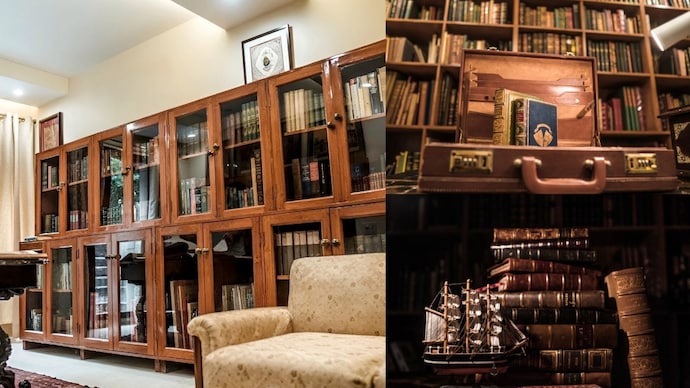
Instead, it rests inside glass cabinets, on wooden shelves, and wrapped in ageing paper. Every rare book, manuscript, map, and painting tells a story of its own.
The journey to build this remarkable collection began in Calcutta when a Parsi doctor, unable to repay a debt, offered old furniture to GC Jain.
Hidden among those pieces were rare books and manuscripts that sparked a lifelong passion for collecting. What started as an unexpected business transaction grew into a legacy built over decades and is now being preserved by the family's third generation.
A Parsi merchant, a business deal, and a decision that changed the course of the Jain family. When the family moved from Kolkata to Delhi in the 1980s, they inherited not gold or diamonds but history, preserved in centuries-old books, rare manuscripts handled by some of history's greatest minds, vintage maps that tell stories beyond geography, and paintings that became part of the collection through a business transaction.
It was in the 1960s when a Parsi doctor bought some furniture from GC Jain, a bibliophile and merchant from Calcutta. Along with the payment, the doctor also gave Jain a few rare books.
Unaware of their true value, the doctor parted with them, but Jain immediately recognised the treasure they held.
"He was a friend of my grandfather, and in his will, which was later executed by his wife, a metal trunk filled with rare books was passed on to my grandfather," says Rishabh Jain, GC Jain's grandson, who now manages the family's rare book store in the quiet lanes of South Delhi.
After moving to Delhi, Jain turned that unexpected inheritance into what is today recognised as Delhi's oldest rare book house, a legacy that has been preserved by three generations of the family.
Over the years, it grew into a lifelong passion and in due course became a family bequest.
The family's rare book business began in 1967.
Its South Delhi bookstore was established later and, for many years, relied almost entirely on word-of-mouth recommendations.
Today, its online presence has introduced a new generation of readers and collectors, including Gen Z, to rare books and India's historical heritage. The collection has grown to nearly 8,000 rare and antiquarian books, maps, prints and artworks.
The many journeys GC Jain and his son made to Europe in search of the treasures they found in rare books eventually became something extraordinary.
Despite limited financial resources, the father-son duo managed to build an eye-catching collection through patience, persistence, and a keen eye for history. As the saying goes, you don't choose the book, the book chooses you.
One acquisition remains especially memorable. In 1984, the family purchased nearly 100 copies of the Constitution of India for around Rs 100 each.
"A turning point came in February of the same year when, with the support of a Kashmiri Pandit, my father secured a stall at the International Book Fair at Pragati Maidan in New Delhi," tells Rishabh Jain to India Today while recalling the old days.
"During the fair, then Prime Minister Indira Gandhi visited our stall and spent nearly thirty minutes browsing through the rare books," he says.
The store now attracts collectors, historians, students and first-time buyers from India and abroad.
Walking through the aisles feels less like entering a store and more like moving through an archive that speaks through the air. Every shelf has a different period of history.
There are original editions of James Tod's Annals and Antiquities of Rajasthan, Niccolao Manucci's Storia do Mogor, early travel narratives, British-era gazetteers, military accounts, colour plate books and illustrated volumes that documented India long before photography became common.
The shelves hold the stories that travel far. A signed 1912 edition of Rabindranath Tagore's Gitanjali, shows a direct link to India's first Nobel laureate, alongside an illustrated edition of Jane Austen's Pride and Prejudice.
There is a signed copy of Mandela: The Authorised Portrait, a first edition of Vladimir Nabokov's Lolita in its original Olympia Press format, Sir Edmund Hillary's signed account of the first successful ascent of Mount Everest, and a signed first edition of Harry Potter and the Goblet of Fire.
The collection also includes signed works by Neil Armstrong, Ravi Shankar and David Beckham, as well as Kumar Shri Ranjitsinhji's limited signed edition of The Jubilee Book of Cricket.
The shelves also preserve books that are no longer available in the market, making the collection tenor not only for collectors but also for researchers.
The store is equally known for its collection of antique maps and engravings. Many depict Delhi, Varanasi and other Indian cities as they appeared through the eyes of British surveyors, artists and travellers.
The aesthetics that India misses can be found in these now.
Rishabh and his sister Rashi carefully restore the past through expertise in preservation.
"My father depended almost entirely on word-of-mouth. When I joined, I wanted to create a space that reflected what this collection really is. To me, it is a treasure built with love," says Rishabh.
Torn pages are repaired, bindings recreated, damaged covers restored and fragile volumes prepared for another generation of readers.
Many books printed in India were produced on thin paper that becomes acidic over time, while decades of poor storage often leave them damaged.
The economics of rare books have changed dramatically over the years.
Several institutions, researchers and private collectors have relied on the family's expertise to source historically significant material.
The store has also collaborated with cultural institutions on exhibitions and research involving rare books and artworks.
Inside the South Delhi store, history is not displayed behind museum ropes.
Instead, it rests inside glass cabinets, on wooden shelves, and wrapped in ageing paper. Every rare book, manuscript, map, and painting tells a story of its own.
The journey to build this remarkable collection began in Calcutta when a Parsi doctor, unable to repay a debt, offered old furniture to GC Jain.
Hidden among those pieces were rare books and manuscripts that sparked a lifelong passion for collecting. What started as an unexpected business transaction grew into a legacy built over decades and is now being preserved by the family's third generation.

