Isro completes 3 Gaganyaan crew capsule tests. Know how these will keep astronauts safe
Isro announced on July 12 that it has successfully completed three major qualification tests on the Gaganyaan crew module, the capsule that will carry Indian astronauts to space and bring them home.
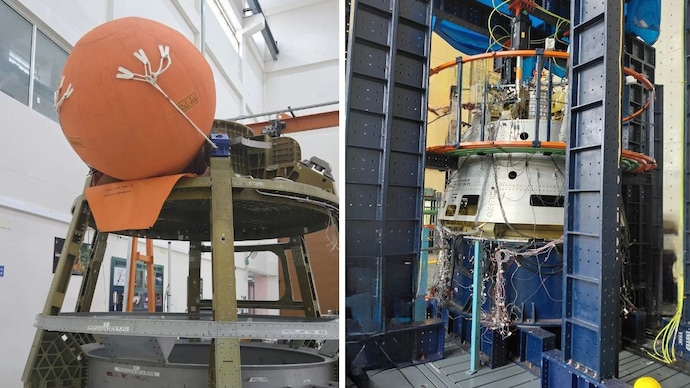
The Indian Space Research Organisation (Isro) has successfully completed three major qualification tests on the crew module of the Gaganyaan mission, the space agency announced on July 12. With this, India's first human spaceflight mission has cleared three more hurdles on its way to the launch pad.
The crew module is the capsule in which Indian astronauts will live during the mission and return to Earth.
A qualification test is a trial in which a system is deliberately pushed harder than it will ever be pushed in an actual flight. If it survives on the ground, it earns the right to fly.
Here is what Isro tested, and why each test matters for the safety of the astronauts.
WHY MUST GAGANYAAN CREW MODULE STAY UPRIGHT IN THE SEA?
At the end of the mission, the crew module will parachute down into the sea. But the sea is not a polite host. Waves can tip the capsule over, leaving it bobbing nose-down. An inverted capsule makes it harder for the crew to exit and for recovery teams to reach them.
Isro's answer is the Crew Module Uprighting System, or CMUS. Think of it as a set of inflatable balloons attached to the capsule. The balloons are filled using stored cold gas, which simply means compressed gas released from high-pressure bottles.
Nothing is burnt, nothing explodes.
In the float inflation test, engineers opened the control valves and let the stored gas inflate the primary flotation system. The balloons filled up within the required time, and did so across the entire range of bottle pressures the system may encounter.
HOW DOES CREW MODULE SEPARATE FROM SERVICE MODULE?
The crew module does not travel alone. Attached to it is the service module, which supplies power and propulsion. The two are linked by an umbilical, a term borrowed from the cord that connects a baby to its mother.
Through this link flow electricity and the fluids of the Environment Control and Life Support System, the machinery that keeps the air inside breathable and the temperature liveable.
Before the capsule re-enters the atmosphere, this cord must be cut cleanly. A connector that refuses to let go could spell disaster.
Isro tested the separation of the umbilical unit on the crew module side, called CSU-2, from a simulated capsule. The separation was clean, and the capsule panel it was attached to remained structurally sound.
WHAT IS THE APEX COVER ON THE CREW MODULE?
The apex cover is the lid at the top of the capsule. Its job is to shield the parachutes tucked underneath.
Before the parachutes open, the cover is flung off at a predetermined altitude using pyrotechnically actuated thrusters, which are small devices fired by controlled explosive charges.
That violent departure shakes the capsule. To prove the structure can take it, engineers applied roughly 1.75 times the estimated loads to a simulated crew module on an instrumented test rig. Every strain and deformation measured stayed within design margins.
Three tests, three passes. The capsule that will carry India's astronauts is proving itself, one trial at a time.
The Indian Space Research Organisation (Isro) has successfully completed three major qualification tests on the crew module of the Gaganyaan mission, the space agency announced on July 12. With this, India's first human spaceflight mission has cleared three more hurdles on its way to the launch pad.
The crew module is the capsule in which Indian astronauts will live during the mission and return to Earth.
A qualification test is a trial in which a system is deliberately pushed harder than it will ever be pushed in an actual flight. If it survives on the ground, it earns the right to fly.
Here is what Isro tested, and why each test matters for the safety of the astronauts.
WHY MUST GAGANYAAN CREW MODULE STAY UPRIGHT IN THE SEA?
At the end of the mission, the crew module will parachute down into the sea. But the sea is not a polite host. Waves can tip the capsule over, leaving it bobbing nose-down. An inverted capsule makes it harder for the crew to exit and for recovery teams to reach them.
Isro's answer is the Crew Module Uprighting System, or CMUS. Think of it as a set of inflatable balloons attached to the capsule. The balloons are filled using stored cold gas, which simply means compressed gas released from high-pressure bottles.
Nothing is burnt, nothing explodes.
In the float inflation test, engineers opened the control valves and let the stored gas inflate the primary flotation system. The balloons filled up within the required time, and did so across the entire range of bottle pressures the system may encounter.
HOW DOES CREW MODULE SEPARATE FROM SERVICE MODULE?
The crew module does not travel alone. Attached to it is the service module, which supplies power and propulsion. The two are linked by an umbilical, a term borrowed from the cord that connects a baby to its mother.
Through this link flow electricity and the fluids of the Environment Control and Life Support System, the machinery that keeps the air inside breathable and the temperature liveable.
Before the capsule re-enters the atmosphere, this cord must be cut cleanly. A connector that refuses to let go could spell disaster.
Isro tested the separation of the umbilical unit on the crew module side, called CSU-2, from a simulated capsule. The separation was clean, and the capsule panel it was attached to remained structurally sound.
WHAT IS THE APEX COVER ON THE CREW MODULE?
The apex cover is the lid at the top of the capsule. Its job is to shield the parachutes tucked underneath.
Before the parachutes open, the cover is flung off at a predetermined altitude using pyrotechnically actuated thrusters, which are small devices fired by controlled explosive charges.
That violent departure shakes the capsule. To prove the structure can take it, engineers applied roughly 1.75 times the estimated loads to a simulated crew module on an instrumented test rig. Every strain and deformation measured stayed within design margins.
Three tests, three passes. The capsule that will carry India's astronauts is proving itself, one trial at a time.

