The 20% question: Re-evaluation returns, and CBSE faces its next big credibility test
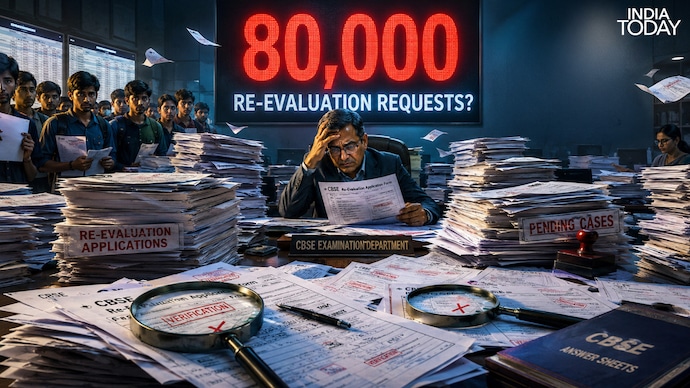
As the CBSE Class 12 verification and re-evaluation process begins today, the board could face nearly 80,000 applications if Union Education Minister Dharmendra Pradhan's estimate proves accurate. For students, the issue is no longer just marks, but trust in the evaluation process.
The board exams may be over, but for many CBSE Class 12 students, questions over their marks remain unresolved. As the re-evaluation window opens today, students are getting another opportunity to challenge scores they believe do not reflect their performance.
CBSE had delayed the process from its original May 29 schedule, saying the additional time would help ensure a glitch-free and transparent system.
Over the past week, students have been carefully reviewing scanned answer sheets, searching for possible omissions and marking errors while sharing concerns online.
More than 4 lakh students have sought access to over 11 lakh evaluated answer books, transforming what was intended as a transparency reform into one of the largest post-result review exercises in CBSE's history.
If Union Education Minister Dharmendra Pradhan's estimate is correct, nearly one in five students who accessed their evaluated answer books could seek verification or re-evaluation, potentially resulting in as many as 80,000 applications.
In the coming days, the process will become about more than individual marks. It may offer the clearest measure yet of how much confidence students place in India's largest school examination board.
OVER 4 LAKH STUDENTS, 11 LAKH ANSWER SHEETS: WHAT DOES IT SIGNAL?
More than 4,04,319 students applied for scanned copies of their evaluated answer books after the declaration of Class 12 results, covering 11,31,961 answer sheets across subjects.
The scale of participation suggests that students are no longer willing to accept marks at face value. Instead, they want to see exactly how their papers were evaluated before deciding their next step.
THE 20% QUESTION: COULD APPLICATIONS CROSS 80,000?
In an exclusive interview with India Today, Union Education Minister Dharmendra Pradhan estimated that 15–20 percent of students who viewed their answer sheets may eventually seek verification of marks or re-evaluation.
If that projection holds, CBSE could receive between 60,000 and 80,000 formal challenges, potentially one of the largest post-result review exercises in the Board's history.
WHEN A TRANSPARENCY REFORM CREATED MORE QUESTIONS THAN ANSWERS
This year, CBSE introduced a major reform by allowing students to obtain scanned copies of their evaluated answer sheets before applying for verification or re-evaluation.
The move was designed to increase trust in the evaluation process. For many students, however, it had the opposite effect.
After reviewing their answer books, students reported blurred scans, missing pages, answer sheet mismatches, unevaluated responses and other alleged discrepancies, raising fresh concerns about the accuracy of the evaluation process.
'THIS SHOULD NEVER HAVE HAPPENED'
Dharmendra Pradhan has described the controversies surrounding this year's examination process as "deeply unfortunate", saying such incidents should never have occurred.
His remarks come as criticism grows over both the implementation of the On-Screen Marking (OSM) system and the handling of post-result grievances.
The minister also said that instructions had been issued to State Bank of India, Indian Bank, Canara Bank and Bank of Baroda to facilitate smooth integration with the CBSE platform. He added that trial runs had been carried out to assess security measures and system capacity.
DID DELAY MAKE A BAD SITUATION WORSE?
The controversy deepened when students faced delays in receiving their scanned answer sheets.
Although access to scripts began on May 19, schedules and timelines were revised multiple times, leaving many students uncertain about when they would receive the documents needed to decide whether to challenge their marks.
The delays coincided with college admissions, counselling rounds and scholarship applications, increasing anxiety among students racing against critical deadlines.
THE OSM SYSTEM UNDER THE SCANNER
The expected surge in re-evaluation requests comes amid growing concerns over CBSE's new On-Screen Marking system.
While the Board introduced digital evaluation to improve efficiency and transparency, complaints from students have sparked questions about whether the system was fully prepared for implementation at a national scale.
CBSE BREAKS SILENCE ON OSM CONTROVERSY
Amid the growing controversy surrounding the On-Screen Marking system, CBSE has finally responded to concerns raised by students and parents.
In a statement posted on social media, the Board said it is closely monitoring vulnerabilities identified in the OSM portal of its service provider after concerns were flagged in the public domain.
CBSE said an expert team of cybersecurity professionals from various government agencies and Indian Institutes of Technology (IITs) has been working over the past few days to strengthen the platform's security infrastructure and address potential risks.
AWS BUCKET ALLEGATIONS RAISE FRESH SECURITY QUESTIONS
The controversy has also taken a new turn with fresh allegations regarding the security of CBSE's digital infrastructure.
Nineteen-year-old ethical hacker Nisarga Adhikary claimed that answer sheets and question papers stored on an Amazon Web Services (AWS) bucket linked to CBSE were publicly accessible online due to an alleged misconfiguration.
In a social media post, Adhikary alleged that the AWS bucket allowed unauthenticated access to examination-related files, potentially exposing sensitive documents.
While CBSE has not publicly confirmed the specific allegations, the claims have added another layer to the ongoing debate over the security and preparedness of the Board's digital examination infrastructure.
THE RS 23 CRORE QUESTION
The controversy has also reignited debate over the cost of post-result grievance mechanisms.
According to an RTI response obtained by educationist Keshav Agarwal, CBSE collected nearly Rs 23 crore during the 2024-25 academic session through scanned answer-sheet access, verification of marks and re-evaluation requests.
The figures have intensified scrutiny over whether students should bear substantial costs while concerns about evaluation accuracy persist.
MORE THAN MARKS, A TEST OF TRUST
The number of students who ultimately apply for verification and re-evaluation may become the clearest indicator of public confidence in this year's evaluation process.
A surge in applications would not only increase CBSE's administrative burden but also intensify questions about transparency, accountability and the effectiveness of large-scale digital evaluation systems.
CBSE'S TOUGHEST TEST MAY HAVE JUST BEGUN
Over the next few days, thousands of students will decide whether to challenge their marks.
If tens of thousands ultimately seek re-evaluation, the message will be difficult to ignore: this is no longer just a post-result process. It is a referendum on confidence in India's largest school examination board.
For CBSE, the board exams may be over. Its toughest test may only be beginning.
The board exams may be over, but for many CBSE Class 12 students, questions over their marks remain unresolved. As the re-evaluation window opens today, students are getting another opportunity to challenge scores they believe do not reflect their performance.
CBSE had delayed the process from its original May 29 schedule, saying the additional time would help ensure a glitch-free and transparent system.
Over the past week, students have been carefully reviewing scanned answer sheets, searching for possible omissions and marking errors while sharing concerns online.
More than 4 lakh students have sought access to over 11 lakh evaluated answer books, transforming what was intended as a transparency reform into one of the largest post-result review exercises in CBSE's history.
If Union Education Minister Dharmendra Pradhan's estimate is correct, nearly one in five students who accessed their evaluated answer books could seek verification or re-evaluation, potentially resulting in as many as 80,000 applications.
In the coming days, the process will become about more than individual marks. It may offer the clearest measure yet of how much confidence students place in India's largest school examination board.
OVER 4 LAKH STUDENTS, 11 LAKH ANSWER SHEETS: WHAT DOES IT SIGNAL?
More than 4,04,319 students applied for scanned copies of their evaluated answer books after the declaration of Class 12 results, covering 11,31,961 answer sheets across subjects.
The scale of participation suggests that students are no longer willing to accept marks at face value. Instead, they want to see exactly how their papers were evaluated before deciding their next step.
THE 20% QUESTION: COULD APPLICATIONS CROSS 80,000?
In an exclusive interview with India Today, Union Education Minister Dharmendra Pradhan estimated that 15–20 percent of students who viewed their answer sheets may eventually seek verification of marks or re-evaluation.
If that projection holds, CBSE could receive between 60,000 and 80,000 formal challenges, potentially one of the largest post-result review exercises in the Board's history.
WHEN A TRANSPARENCY REFORM CREATED MORE QUESTIONS THAN ANSWERS
This year, CBSE introduced a major reform by allowing students to obtain scanned copies of their evaluated answer sheets before applying for verification or re-evaluation.
The move was designed to increase trust in the evaluation process. For many students, however, it had the opposite effect.
After reviewing their answer books, students reported blurred scans, missing pages, answer sheet mismatches, unevaluated responses and other alleged discrepancies, raising fresh concerns about the accuracy of the evaluation process.
'THIS SHOULD NEVER HAVE HAPPENED'
Dharmendra Pradhan has described the controversies surrounding this year's examination process as "deeply unfortunate", saying such incidents should never have occurred.
His remarks come as criticism grows over both the implementation of the On-Screen Marking (OSM) system and the handling of post-result grievances.
The minister also said that instructions had been issued to State Bank of India, Indian Bank, Canara Bank and Bank of Baroda to facilitate smooth integration with the CBSE platform. He added that trial runs had been carried out to assess security measures and system capacity.
DID DELAY MAKE A BAD SITUATION WORSE?
The controversy deepened when students faced delays in receiving their scanned answer sheets.
Although access to scripts began on May 19, schedules and timelines were revised multiple times, leaving many students uncertain about when they would receive the documents needed to decide whether to challenge their marks.
The delays coincided with college admissions, counselling rounds and scholarship applications, increasing anxiety among students racing against critical deadlines.
THE OSM SYSTEM UNDER THE SCANNER
The expected surge in re-evaluation requests comes amid growing concerns over CBSE's new On-Screen Marking system.
While the Board introduced digital evaluation to improve efficiency and transparency, complaints from students have sparked questions about whether the system was fully prepared for implementation at a national scale.
CBSE BREAKS SILENCE ON OSM CONTROVERSY
Amid the growing controversy surrounding the On-Screen Marking system, CBSE has finally responded to concerns raised by students and parents.
In a statement posted on social media, the Board said it is closely monitoring vulnerabilities identified in the OSM portal of its service provider after concerns were flagged in the public domain.
CBSE said an expert team of cybersecurity professionals from various government agencies and Indian Institutes of Technology (IITs) has been working over the past few days to strengthen the platform's security infrastructure and address potential risks.
AWS BUCKET ALLEGATIONS RAISE FRESH SECURITY QUESTIONS
The controversy has also taken a new turn with fresh allegations regarding the security of CBSE's digital infrastructure.
Nineteen-year-old ethical hacker Nisarga Adhikary claimed that answer sheets and question papers stored on an Amazon Web Services (AWS) bucket linked to CBSE were publicly accessible online due to an alleged misconfiguration.
In a social media post, Adhikary alleged that the AWS bucket allowed unauthenticated access to examination-related files, potentially exposing sensitive documents.
While CBSE has not publicly confirmed the specific allegations, the claims have added another layer to the ongoing debate over the security and preparedness of the Board's digital examination infrastructure.
THE RS 23 CRORE QUESTION
The controversy has also reignited debate over the cost of post-result grievance mechanisms.
According to an RTI response obtained by educationist Keshav Agarwal, CBSE collected nearly Rs 23 crore during the 2024-25 academic session through scanned answer-sheet access, verification of marks and re-evaluation requests.
The figures have intensified scrutiny over whether students should bear substantial costs while concerns about evaluation accuracy persist.
MORE THAN MARKS, A TEST OF TRUST
The number of students who ultimately apply for verification and re-evaluation may become the clearest indicator of public confidence in this year's evaluation process.
A surge in applications would not only increase CBSE's administrative burden but also intensify questions about transparency, accountability and the effectiveness of large-scale digital evaluation systems.
CBSE'S TOUGHEST TEST MAY HAVE JUST BEGUN
Over the next few days, thousands of students will decide whether to challenge their marks.
If tens of thousands ultimately seek re-evaluation, the message will be difficult to ignore: this is no longer just a post-result process. It is a referendum on confidence in India's largest school examination board.
For CBSE, the board exams may be over. Its toughest test may only be beginning.

