From classrooms to homes: Education Ministry takes e-waste awareness drive to schools
The Education Ministry's nationwide campaign is teaching students to collect and manage e-waste responsibly. It aims to carry habits of segregation and of reuse and authorised recycling into homes.
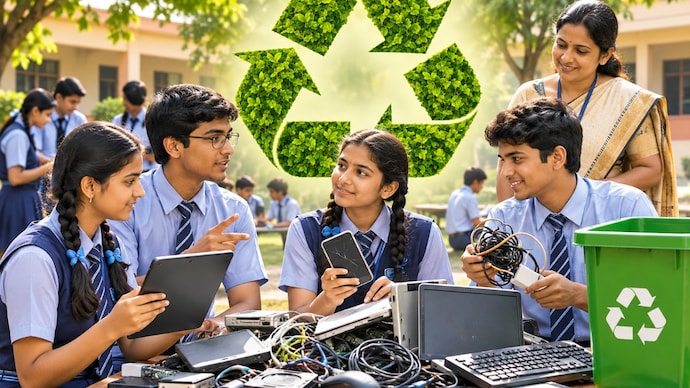
A discarded mobile phone, a broken toy with a blinking light, an old charger lying in a drawer or a television that no longer works. These objects are often put aside until someone decides to throw them away. Yet, once discarded, they become part of a growing waste problem that India can no longer afford to overlook.
The Department of School Education and Literacy under the Union Ministry of Education has taken up this concern through a nationwide campaign to make students aware of the need to manage electronic waste, commonly known as e-waste, in a responsible manner.
The initiative, undertaken under Special Campaign 6 and the Eco Clubs for Mission LiFE, seeks to bring the subject into schools and encourage children to carry the message beyond their classrooms.
The campaign has moved beyond lectures and awareness material.
Schools have organised collection drives, quizzes, workshops and exhibitions, while students have been encouraged to identify discarded electronic items and ensure that they reach authorised recyclers or refurbishers.
A video shared by the Ministry on X also brought the subject into a school setting, with two students discussing the proper handling of e-waste.
The scale of the exercise is worth noting.
According to the Ministry, more than 2.02 crore students and teachers across 2.85 lakh schools collected 58.79 lakh e-waste items during the preparatory and implementation phases of Special Campaign 6, held between September 16 and October 31, 2026.
The Department also reported that over 6.29 lakh e-waste awareness workshops were organised during the campaign's preparatory phase.
A nationwide collection drive was held on October 28, with schools taking part across states and Union Territories.
The need for such an exercise is evident from the figures.
According to data placed before Parliament by the Ministry of Environment, Forest and Climate Change, India generated an estimated 13.97 lakh metric tonnes of e-waste in 2024-25. Of this, about 11.59 lakh metric tonnes were reported as recycled.
The figures point to the scale of the task, even as the country has made progress in bringing more waste into formal recycling channels.
For Shohini Dutta, Chief Philanthropy Officer at Bajaj Foundation, the first step towards addressing the problem is to change how people deal with unwanted electronic goods. In a conversation with this publication, she said that awareness alone would not suffice unless it led to a change in everyday habits.
“Segregation is the first and the most important step,” Dutta said. Electronic waste, she explained, must be kept apart from ordinary household rubbish. Without this separation, it becomes difficult to ensure that the material reaches the right channel for reuse, refurbishment or recycling.
She also drew attention to a common misconception: that every electronic item no longer in use must immediately be sent for recycling.
That, she said, should be the last resort. An old phone, laptop or other device may still have a useful life if it can be repaired, refurbished or sold through a responsible platform. Recycling becomes necessary when the item has reached the end of its useful life.
The distinction matters. Electronic goods contain materials that can be recovered and put to further use, including precious metals and plastics.
When such items are burnt, dismantled carelessly or processed through unsafe methods, valuable resources may be lost and harmful substances can enter the environment.
A responsible recycler, Dutta said, should work towards recovering these materials and returning them to the production cycle.
This is the principle of a circular economy: keeping resources in use for as long as possible.
The question, then, is how a household should proceed. Dutta's advice is straightforward.
First, determine whether the item can be repaired, reused or refurbished. If it has reached the end of its life, keep it separate from regular waste and hand it over to an authorised recycler.
She noted that finding the right channel can still be difficult for many households, despite the growing number of collection services and online platforms. Resident welfare associations, local collection drives and verified recycling services can help bridge this gap.
The role of schools becomes important here. Children may not control every household decision, but they can ask questions.
Why is an old phone being handed to an informal scrap dealer? Can it be refurbished? Is the person collecting it an authorised recycler? Such questions can begin a conversation at home, where many disposal decisions are made.
Dutta described this as a two-way process. Schools introduce the subject to children, and children carry it back to their parents. She cited Delhi's Green Diwali campaign as an example of how sustained school-based awareness can gradually influence household practices.
The e-waste campaign, she cautioned, is still at an early stage and will require time before such habits become commonplace.
The task is not confined to large cities. Small electronic toys, household appliances, chargers and other gadgets are now found in homes across the country. Their eventual disposal is a concern shared by urban and rural communities alike.
India's E-Waste (Management) Rules, 2022, require producers, refurbishers and recyclers covered by the rules to register with the Central Pollution Control Board.
The framework also places responsibility on producers through the Extended Producer Responsibility system. But rules and recycling facilities can do only so much if households continue to mix electronic waste with ordinary rubbish.
The Ministry's school campaign is therefore an attempt to begin the work where habits are formed. Its success will depend not merely on the number of workshops held or items collected, but on whether students, parents and communities learn to separate, reuse and dispose of electronic goods responsibly.
The lesson must travel home; otherwise, it will remain within the school gates.

