NEET storm shakes streets and Parliament: Remember how the controversy began?
The NEET UG 2026 paper leak controversy, which began with allegations of a suspicious 'guess paper', has escalated into a nationwide political row. From investigations and re-test reforms to protests and Parliament disruptions, the issue continues to raise questions over exam transparency.
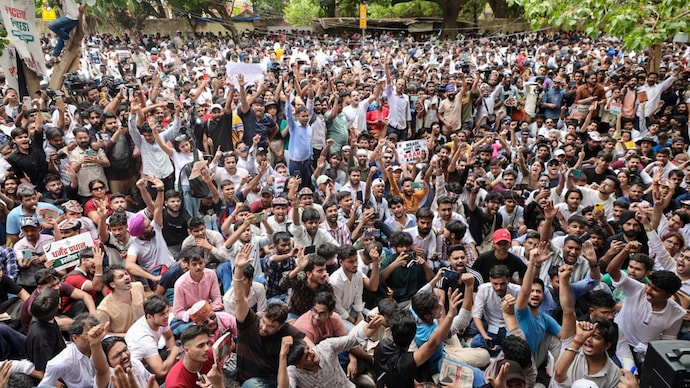
The NEET UG 2026 paper leak controversy returned to the centre stage on July 22 as Parliament witnessed disruptions, with the Lok Sabha and Rajya Sabha adjourned till 2 pm amid Opposition protests. MPs demanded an immediate discussion on the alleged paper leak and sought the resignation of Union Education Minister Dharmendra Pradhan.
Outside Parliament, protests continued as students and activists raised concerns over examination transparency, accountability, and alleged irregularities affecting lakhs of medical aspirants.
Tamil Nadu’s ruling party Tamilaga Vettri Kazhagam (TVK) intensified the political debate, stating that it was not merely seeking action against irregularities but wanted NEET scrapped altogether. The party also demanded that states be given greater powers over medical education.
Meanwhile, Prime Minister Narendra Modi, addressing the NDA Parliamentary Party meeting on July 21, called the NEET paper leak a “ghor paap” (grave sin) and said the government had acted immediately after the allegations surfaced. He added that 13 accused had been arrested and assured strict action against those responsible.
But how did the controversy begin? What started as questions over a suspicious “guess paper” eventually turned into one of India’s biggest examination controversies.
A ‘GUESS PAPER’ SPARKS NATIONWIDE CONTROVERSY
The National Testing Agency (NTA) conducted NEET UG 2026 on May 3 for more than 22 lakh candidates across India. The agency maintained that the examination was conducted under strict security protocols, including GPS-tracked transportation of question papers, biometric verification, AI-assisted CCTV monitoring, and signal jammers at examination centres.
However, after the provisional answer key was released on May 6, questions emerged over an alleged “guess paper” that reportedly matched several questions from the actual examination.
Investigators examined claims that a handwritten question bank had circulated before the exam, particularly in Rajasthan. The key question was whether the material was merely an unusually accurate prediction or evidence of a larger paper leak.
On May 7, the NTA acknowledged receiving complaints of alleged malpractice from Rajasthan and Uttarakhand. A day later, it referred the matter to central agencies for independent verification and necessary action.
At that stage, there was no official confirmation of a full-scale paper leak.
PROBS INTENSIFIES, RAJASTHAN SOG BEGINS INVESTIGATION
The controversy escalated after the Rajasthan Police Special Operations Group (SOG) launched an investigation into alleged NEET UG 2026 irregularities.
Investigators examined claims that a question bank containing more than 400 questions had circulated before the exam, with reports suggesting that around 135 questions matched the actual paper. Officials, however, maintained that the investigation was still underway and that it was too early to conclude whether the material indicated a leak or a highly accurate guess paper.
The Rajasthan SOG detained several suspects and questioned more than 20 people as part of the probe.
Amid mounting pressure, the NTA cancelled NEET UG 2026 on May 12 and announced a re-examination.
On May 15, Education Minister Dharmendra Pradhan said the re-test would be conducted on June 21, stating that the alleged leak had happened under the cover of “guess papers”.
NTA FACES QUESTIONS OVER EXAMINATION SECURITY
On May 22, the NTA told the Parliamentary Standing Committee on Education that there was no complete paper leak in NEET UG 2026. The agency said only certain questions had been compromised and maintained that the issue involved malpractice rather than a full examination leak.
The statement appeared different from Education Minister Dharmendra Pradhan’s earlier remarks about a “breach in the chain of command”.
NTA Director General Abhishek Singh appeared before the committee, where officials explained that even a limited compromise of questions could damage confidence in the examination system and justified cancellation of the test.
Meanwhile, the CBI arrested additional accused, including a doctor from Latur and a coaching institute faculty member from Pune, taking the total number of arrests to 13. Investigators alleged that a network was involved in obtaining and circulating questions before the examination.
SUPREME COURT CLEARS WAY FOR PEN-AND-PAPER RE-TEST
Ahead of the re-test, the Prime Minister’s Office monitored the examination process, including question paper setting, printing, transportation, and delivery at centres.
Speaking exclusively to India Today, Education Minister Dharmendra Pradhan said the government was taking all possible steps to ensure a fair and transparent re-examination. He said those involved in malpractice would not be spared and described the controversy around NEET and other examinations as “deeply unfortunate”.
On June 2, the Supreme Court allowed the NEET UG 2026 re-examination to continue in the traditional pen-and-paper format, rejecting a plea seeking a computer-based test.
The court observed that changing the format at the final stage could create practical difficulties, clearing the way for the June 21 OMR-based examination.
On the same day, a 16-year-old cybersecurity researcher raised concerns over alleged vulnerabilities in the NTA’s re-test portal, claiming that certain administrative and user data could have been exposed. The claims were not independently verified but added to concerns over examination security.
NTA STRENGTHENS SECURITY AHEAD OF RE-TEST
Following the controversy, the NTA introduced multiple security measures for the June 21 re-examination.
For the first time, the Indian Air Force was involved in transporting question papers as part of a multi-layered security arrangement. Question paper setters were kept in isolation until the examination date, while stricter monitoring was implemented during printing, transportation, and distribution.
Authorities also warned students against fake calls and messages claiming to provide leaked papers.
The Press Information Bureau (PIB) repeatedly issued clarifications against fake notices and viral claims related to the re-test. The NTA also introduced a dedicated portal for candidates and stakeholders to report fake claims about leaked papers and answer keys.
TELEGRAM ROW AND MISINFORMATION BATTLE
Ahead of the re-test, the government temporarily restricted access to Telegram, citing concerns over the platform’s alleged misuse by cheating networks and groups spreading fake examination-related information.
Telegram founder Pavel Durov criticised the move, stating that restricting access could affect millions of users instead of targeting those allegedly involved in malpractice.
Opposition leaders also questioned the decision, arguing that the government should focus on fixing examination security instead of restricting platforms.
The Delhi High Court also heard concerns regarding the restrictions and the handling of the re-examination process.
JUNE 21 RE-TEST
The NEET UG 2026 re-test was conducted on June 21 amid enhanced security arrangements, including CCTV surveillance, biometric verification, GPS tracking of paper movement, and stricter monitoring.
After the exam, protests continued.CJP founder Abhijeet Dipke staged demonstrations at Jantar Mantar in Delhi, demanding accountability over the NEET controversy.
On June 23, Education Minister Dharmendra Pradhan indicated that NEET could move to a fully computer-based format from the following year as part of broader examination reforms.
On June 24, Prime Minister Narendra Modi praised officials involved in conducting the re-test, calling it a successful effort to restore confidence in the examination system.
PROTESTS INTENSIFY, POLITICAL BATTLE REACHES PARLIAMENT
The controversy gained political momentum as Opposition parties stepped up attacks on the government.
The Cockroach Janata Party announced protests demanding the resignation of Education Minister Dharmendra Pradhan, while climate activist Sonam Wangchuk joined a hunger strike at Jantar Mantar over examination-related concerns.
On July 15, the CJP announced a mass hunger strike supported by Wangchuk, demanding accountability and reforms in India’s examination system.
On July 16, the CBI claimed that a Maharashtra-based coaching institute owner had allegedly paid Rs 5 lakh to obtain NEET UG Chemistry questions before the exam.
RESULTS BRING FRESH ALLEGATIONS
The NTA announced the NEET UG 2026 re-test results on July 17. Around 11.21 lakh candidates qualified for the examination, with 138 candidates scoring above 690 marks out of 720.
However, fresh concerns emerged after some candidates alleged discrepancies between their OMR sheets and scorecards.
Students from Maharashtra’s Beed district claimed mismatches between their recorded responses and marks awarded. One candidate alleged that their OMR sheet reflected 609 marks, while the final result showed only 167 marks.
The NTA rejected such claims, stating that several viral OMR images were fake, digitally altered, or AI-generated. The agency said its official records matched the declared results and warned of legal action against those spreading fabricated documents.
NEET ROW DOMINATES MONSOON SESSION
The controversy entered Parliament as the Monsoon Session began on a stormy note.
Opposition parties disrupted proceedings in both Houses, demanding discussions on the alleged NEET paper leak, action against protesters, and accountability from the government.
Congress leader Rahul Gandhi accused the government of failing students and called for action against those responsible for repeated examination failures.
Former Odisha Chief Minister Naveen Patnaik, also demanded the resignation of Education Minister Dharmendra Pradhan, alleging that lakhs of students had suffered due to examination irregularities.
Samajwadi Party chief Akhilesh Yadav raised the issue in Parliament, accusing the Centre of failing to protect students’ interests.
WHAT'S NEXT
The NEET UG 2026 controversy has grown from allegations of a suspicious question paper leak into a broader debate over the credibility of India’s examination system.
While the government has highlighted arrests, security upgrades, and reforms to restore confidence, students and Opposition parties continue to demand greater transparency and accountability.
As investigations continue and questions over examination reforms remain unresolved, the NEET row has brought renewed focus on whether India’s biggest entrance tests have adequate safeguards to protect millions of young aspirants competing for limited opportunities.
The NEET UG 2026 paper leak controversy returned to the centre stage on July 22 as Parliament witnessed disruptions, with the Lok Sabha and Rajya Sabha adjourned till 2 pm amid Opposition protests. MPs demanded an immediate discussion on the alleged paper leak and sought the resignation of Union Education Minister Dharmendra Pradhan.
Outside Parliament, protests continued as students and activists raised concerns over examination transparency, accountability, and alleged irregularities affecting lakhs of medical aspirants.
Tamil Nadu’s ruling party Tamilaga Vettri Kazhagam (TVK) intensified the political debate, stating that it was not merely seeking action against irregularities but wanted NEET scrapped altogether. The party also demanded that states be given greater powers over medical education.
Meanwhile, Prime Minister Narendra Modi, addressing the NDA Parliamentary Party meeting on July 21, called the NEET paper leak a “ghor paap” (grave sin) and said the government had acted immediately after the allegations surfaced. He added that 13 accused had been arrested and assured strict action against those responsible.
But how did the controversy begin? What started as questions over a suspicious “guess paper” eventually turned into one of India’s biggest examination controversies.
A ‘GUESS PAPER’ SPARKS NATIONWIDE CONTROVERSY
The National Testing Agency (NTA) conducted NEET UG 2026 on May 3 for more than 22 lakh candidates across India. The agency maintained that the examination was conducted under strict security protocols, including GPS-tracked transportation of question papers, biometric verification, AI-assisted CCTV monitoring, and signal jammers at examination centres.
However, after the provisional answer key was released on May 6, questions emerged over an alleged “guess paper” that reportedly matched several questions from the actual examination.
Investigators examined claims that a handwritten question bank had circulated before the exam, particularly in Rajasthan. The key question was whether the material was merely an unusually accurate prediction or evidence of a larger paper leak.
On May 7, the NTA acknowledged receiving complaints of alleged malpractice from Rajasthan and Uttarakhand. A day later, it referred the matter to central agencies for independent verification and necessary action.
At that stage, there was no official confirmation of a full-scale paper leak.
PROBS INTENSIFIES, RAJASTHAN SOG BEGINS INVESTIGATION
The controversy escalated after the Rajasthan Police Special Operations Group (SOG) launched an investigation into alleged NEET UG 2026 irregularities.
Investigators examined claims that a question bank containing more than 400 questions had circulated before the exam, with reports suggesting that around 135 questions matched the actual paper. Officials, however, maintained that the investigation was still underway and that it was too early to conclude whether the material indicated a leak or a highly accurate guess paper.
The Rajasthan SOG detained several suspects and questioned more than 20 people as part of the probe.
Amid mounting pressure, the NTA cancelled NEET UG 2026 on May 12 and announced a re-examination.
On May 15, Education Minister Dharmendra Pradhan said the re-test would be conducted on June 21, stating that the alleged leak had happened under the cover of “guess papers”.
NTA FACES QUESTIONS OVER EXAMINATION SECURITY
On May 22, the NTA told the Parliamentary Standing Committee on Education that there was no complete paper leak in NEET UG 2026. The agency said only certain questions had been compromised and maintained that the issue involved malpractice rather than a full examination leak.
The statement appeared different from Education Minister Dharmendra Pradhan’s earlier remarks about a “breach in the chain of command”.
NTA Director General Abhishek Singh appeared before the committee, where officials explained that even a limited compromise of questions could damage confidence in the examination system and justified cancellation of the test.
Meanwhile, the CBI arrested additional accused, including a doctor from Latur and a coaching institute faculty member from Pune, taking the total number of arrests to 13. Investigators alleged that a network was involved in obtaining and circulating questions before the examination.
SUPREME COURT CLEARS WAY FOR PEN-AND-PAPER RE-TEST
Ahead of the re-test, the Prime Minister’s Office monitored the examination process, including question paper setting, printing, transportation, and delivery at centres.
Speaking exclusively to India Today, Education Minister Dharmendra Pradhan said the government was taking all possible steps to ensure a fair and transparent re-examination. He said those involved in malpractice would not be spared and described the controversy around NEET and other examinations as “deeply unfortunate”.
On June 2, the Supreme Court allowed the NEET UG 2026 re-examination to continue in the traditional pen-and-paper format, rejecting a plea seeking a computer-based test.
The court observed that changing the format at the final stage could create practical difficulties, clearing the way for the June 21 OMR-based examination.
On the same day, a 16-year-old cybersecurity researcher raised concerns over alleged vulnerabilities in the NTA’s re-test portal, claiming that certain administrative and user data could have been exposed. The claims were not independently verified but added to concerns over examination security.
NTA STRENGTHENS SECURITY AHEAD OF RE-TEST
Following the controversy, the NTA introduced multiple security measures for the June 21 re-examination.
For the first time, the Indian Air Force was involved in transporting question papers as part of a multi-layered security arrangement. Question paper setters were kept in isolation until the examination date, while stricter monitoring was implemented during printing, transportation, and distribution.
Authorities also warned students against fake calls and messages claiming to provide leaked papers.
The Press Information Bureau (PIB) repeatedly issued clarifications against fake notices and viral claims related to the re-test. The NTA also introduced a dedicated portal for candidates and stakeholders to report fake claims about leaked papers and answer keys.
TELEGRAM ROW AND MISINFORMATION BATTLE
Ahead of the re-test, the government temporarily restricted access to Telegram, citing concerns over the platform’s alleged misuse by cheating networks and groups spreading fake examination-related information.
Telegram founder Pavel Durov criticised the move, stating that restricting access could affect millions of users instead of targeting those allegedly involved in malpractice.
Opposition leaders also questioned the decision, arguing that the government should focus on fixing examination security instead of restricting platforms.
The Delhi High Court also heard concerns regarding the restrictions and the handling of the re-examination process.
JUNE 21 RE-TEST
The NEET UG 2026 re-test was conducted on June 21 amid enhanced security arrangements, including CCTV surveillance, biometric verification, GPS tracking of paper movement, and stricter monitoring.
After the exam, protests continued.CJP founder Abhijeet Dipke staged demonstrations at Jantar Mantar in Delhi, demanding accountability over the NEET controversy.
On June 23, Education Minister Dharmendra Pradhan indicated that NEET could move to a fully computer-based format from the following year as part of broader examination reforms.
On June 24, Prime Minister Narendra Modi praised officials involved in conducting the re-test, calling it a successful effort to restore confidence in the examination system.
PROTESTS INTENSIFY, POLITICAL BATTLE REACHES PARLIAMENT
The controversy gained political momentum as Opposition parties stepped up attacks on the government.
The Cockroach Janata Party announced protests demanding the resignation of Education Minister Dharmendra Pradhan, while climate activist Sonam Wangchuk joined a hunger strike at Jantar Mantar over examination-related concerns.
On July 15, the CJP announced a mass hunger strike supported by Wangchuk, demanding accountability and reforms in India’s examination system.
On July 16, the CBI claimed that a Maharashtra-based coaching institute owner had allegedly paid Rs 5 lakh to obtain NEET UG Chemistry questions before the exam.
RESULTS BRING FRESH ALLEGATIONS
The NTA announced the NEET UG 2026 re-test results on July 17. Around 11.21 lakh candidates qualified for the examination, with 138 candidates scoring above 690 marks out of 720.
However, fresh concerns emerged after some candidates alleged discrepancies between their OMR sheets and scorecards.
Students from Maharashtra’s Beed district claimed mismatches between their recorded responses and marks awarded. One candidate alleged that their OMR sheet reflected 609 marks, while the final result showed only 167 marks.
The NTA rejected such claims, stating that several viral OMR images were fake, digitally altered, or AI-generated. The agency said its official records matched the declared results and warned of legal action against those spreading fabricated documents.
NEET ROW DOMINATES MONSOON SESSION
The controversy entered Parliament as the Monsoon Session began on a stormy note.
Opposition parties disrupted proceedings in both Houses, demanding discussions on the alleged NEET paper leak, action against protesters, and accountability from the government.
Congress leader Rahul Gandhi accused the government of failing students and called for action against those responsible for repeated examination failures.
Former Odisha Chief Minister Naveen Patnaik, also demanded the resignation of Education Minister Dharmendra Pradhan, alleging that lakhs of students had suffered due to examination irregularities.
Samajwadi Party chief Akhilesh Yadav raised the issue in Parliament, accusing the Centre of failing to protect students’ interests.
WHAT'S NEXT
The NEET UG 2026 controversy has grown from allegations of a suspicious question paper leak into a broader debate over the credibility of India’s examination system.
While the government has highlighted arrests, security upgrades, and reforms to restore confidence, students and Opposition parties continue to demand greater transparency and accountability.
As investigations continue and questions over examination reforms remain unresolved, the NEET row has brought renewed focus on whether India’s biggest entrance tests have adequate safeguards to protect millions of young aspirants competing for limited opportunities.
The NEET UG 2026 paper leak controversy returned to the centre stage on July 22 as Parliament witnessed disruptions, with the Lok Sabha and Rajya Sabha adjourned till 2 pm amid Opposition protests. MPs demanded an immediate discussion on the alleged paper leak and sought the resignation of Union Education Minister Dharmendra Pradhan.
Outside Parliament, protests continued as students and activists raised concerns over examination transparency, accountability, and alleged irregularities affecting lakhs of medical aspirants.
Tamil Nadu’s ruling party Tamilaga Vettri Kazhagam (TVK) intensified the political debate, stating that it was not merely seeking action against irregularities but wanted NEET scrapped altogether. The party also demanded that states be given greater powers over medical education.
Meanwhile, Prime Minister Narendra Modi, addressing the NDA Parliamentary Party meeting on July 21, called the NEET paper leak a “ghor paap” (grave sin) and said the government had acted immediately after the allegations surfaced. He added that 13 accused had been arrested and assured strict action against those responsible.
But how did the controversy begin? What started as questions over a suspicious “guess paper” eventually turned into one of India’s biggest examination controversies.
A ‘GUESS PAPER’ SPARKS NATIONWIDE CONTROVERSY
The National Testing Agency (NTA) conducted NEET UG 2026 on May 3 for more than 22 lakh candidates across India. The agency maintained that the examination was conducted under strict security protocols, including GPS-tracked transportation of question papers, biometric verification, AI-assisted CCTV monitoring, and signal jammers at examination centres.
However, after the provisional answer key was released on May 6, questions emerged over an alleged “guess paper” that reportedly matched several questions from the actual examination.
Investigators examined claims that a handwritten question bank had circulated before the exam, particularly in Rajasthan. The key question was whether the material was merely an unusually accurate prediction or evidence of a larger paper leak.
On May 7, the NTA acknowledged receiving complaints of alleged malpractice from Rajasthan and Uttarakhand. A day later, it referred the matter to central agencies for independent verification and necessary action.
At that stage, there was no official confirmation of a full-scale paper leak.
PROBS INTENSIFIES, RAJASTHAN SOG BEGINS INVESTIGATION
The controversy escalated after the Rajasthan Police Special Operations Group (SOG) launched an investigation into alleged NEET UG 2026 irregularities.
Investigators examined claims that a question bank containing more than 400 questions had circulated before the exam, with reports suggesting that around 135 questions matched the actual paper. Officials, however, maintained that the investigation was still underway and that it was too early to conclude whether the material indicated a leak or a highly accurate guess paper.
The Rajasthan SOG detained several suspects and questioned more than 20 people as part of the probe.
Amid mounting pressure, the NTA cancelled NEET UG 2026 on May 12 and announced a re-examination.
On May 15, Education Minister Dharmendra Pradhan said the re-test would be conducted on June 21, stating that the alleged leak had happened under the cover of “guess papers”.
NTA FACES QUESTIONS OVER EXAMINATION SECURITY
On May 22, the NTA told the Parliamentary Standing Committee on Education that there was no complete paper leak in NEET UG 2026. The agency said only certain questions had been compromised and maintained that the issue involved malpractice rather than a full examination leak.
The statement appeared different from Education Minister Dharmendra Pradhan’s earlier remarks about a “breach in the chain of command”.
NTA Director General Abhishek Singh appeared before the committee, where officials explained that even a limited compromise of questions could damage confidence in the examination system and justified cancellation of the test.
Meanwhile, the CBI arrested additional accused, including a doctor from Latur and a coaching institute faculty member from Pune, taking the total number of arrests to 13. Investigators alleged that a network was involved in obtaining and circulating questions before the examination.
SUPREME COURT CLEARS WAY FOR PEN-AND-PAPER RE-TEST
Ahead of the re-test, the Prime Minister’s Office monitored the examination process, including question paper setting, printing, transportation, and delivery at centres.
Speaking exclusively to India Today, Education Minister Dharmendra Pradhan said the government was taking all possible steps to ensure a fair and transparent re-examination. He said those involved in malpractice would not be spared and described the controversy around NEET and other examinations as “deeply unfortunate”.
On June 2, the Supreme Court allowed the NEET UG 2026 re-examination to continue in the traditional pen-and-paper format, rejecting a plea seeking a computer-based test.
The court observed that changing the format at the final stage could create practical difficulties, clearing the way for the June 21 OMR-based examination.
On the same day, a 16-year-old cybersecurity researcher raised concerns over alleged vulnerabilities in the NTA’s re-test portal, claiming that certain administrative and user data could have been exposed. The claims were not independently verified but added to concerns over examination security.
NTA STRENGTHENS SECURITY AHEAD OF RE-TEST
Following the controversy, the NTA introduced multiple security measures for the June 21 re-examination.
For the first time, the Indian Air Force was involved in transporting question papers as part of a multi-layered security arrangement. Question paper setters were kept in isolation until the examination date, while stricter monitoring was implemented during printing, transportation, and distribution.
Authorities also warned students against fake calls and messages claiming to provide leaked papers.
The Press Information Bureau (PIB) repeatedly issued clarifications against fake notices and viral claims related to the re-test. The NTA also introduced a dedicated portal for candidates and stakeholders to report fake claims about leaked papers and answer keys.
TELEGRAM ROW AND MISINFORMATION BATTLE
Ahead of the re-test, the government temporarily restricted access to Telegram, citing concerns over the platform’s alleged misuse by cheating networks and groups spreading fake examination-related information.
Telegram founder Pavel Durov criticised the move, stating that restricting access could affect millions of users instead of targeting those allegedly involved in malpractice.
Opposition leaders also questioned the decision, arguing that the government should focus on fixing examination security instead of restricting platforms.
The Delhi High Court also heard concerns regarding the restrictions and the handling of the re-examination process.
JUNE 21 RE-TEST
The NEET UG 2026 re-test was conducted on June 21 amid enhanced security arrangements, including CCTV surveillance, biometric verification, GPS tracking of paper movement, and stricter monitoring.
After the exam, protests continued.CJP founder Abhijeet Dipke staged demonstrations at Jantar Mantar in Delhi, demanding accountability over the NEET controversy.
On June 23, Education Minister Dharmendra Pradhan indicated that NEET could move to a fully computer-based format from the following year as part of broader examination reforms.
On June 24, Prime Minister Narendra Modi praised officials involved in conducting the re-test, calling it a successful effort to restore confidence in the examination system.
PROTESTS INTENSIFY, POLITICAL BATTLE REACHES PARLIAMENT
The controversy gained political momentum as Opposition parties stepped up attacks on the government.
The Cockroach Janata Party announced protests demanding the resignation of Education Minister Dharmendra Pradhan, while climate activist Sonam Wangchuk joined a hunger strike at Jantar Mantar over examination-related concerns.
On July 15, the CJP announced a mass hunger strike supported by Wangchuk, demanding accountability and reforms in India’s examination system.
On July 16, the CBI claimed that a Maharashtra-based coaching institute owner had allegedly paid Rs 5 lakh to obtain NEET UG Chemistry questions before the exam.
RESULTS BRING FRESH ALLEGATIONS
The NTA announced the NEET UG 2026 re-test results on July 17. Around 11.21 lakh candidates qualified for the examination, with 138 candidates scoring above 690 marks out of 720.
However, fresh concerns emerged after some candidates alleged discrepancies between their OMR sheets and scorecards.
Students from Maharashtra’s Beed district claimed mismatches between their recorded responses and marks awarded. One candidate alleged that their OMR sheet reflected 609 marks, while the final result showed only 167 marks.
The NTA rejected such claims, stating that several viral OMR images were fake, digitally altered, or AI-generated. The agency said its official records matched the declared results and warned of legal action against those spreading fabricated documents.
NEET ROW DOMINATES MONSOON SESSION
The controversy entered Parliament as the Monsoon Session began on a stormy note.
Opposition parties disrupted proceedings in both Houses, demanding discussions on the alleged NEET paper leak, action against protesters, and accountability from the government.
Congress leader Rahul Gandhi accused the government of failing students and called for action against those responsible for repeated examination failures.
Former Odisha Chief Minister Naveen Patnaik, also demanded the resignation of Education Minister Dharmendra Pradhan, alleging that lakhs of students had suffered due to examination irregularities.
Samajwadi Party chief Akhilesh Yadav raised the issue in Parliament, accusing the Centre of failing to protect students’ interests.
WHAT'S NEXT
The NEET UG 2026 controversy has grown from allegations of a suspicious question paper leak into a broader debate over the credibility of India’s examination system.
While the government has highlighted arrests, security upgrades, and reforms to restore confidence, students and Opposition parties continue to demand greater transparency and accountability.
As investigations continue and questions over examination reforms remain unresolved, the NEET row has brought renewed focus on whether India’s biggest entrance tests have adequate safeguards to protect millions of young aspirants competing for limited opportunities.

