He scored 53 in JEE but still got into Stanford, Princeton and Caltech: Here's how
Stanford student Justin Sato shared his JEE score of 53 out of 360 in a viral LinkedIn post. The post has reignited debate over India's exam-led IIT admissions and the broader criteria used by top US universities.
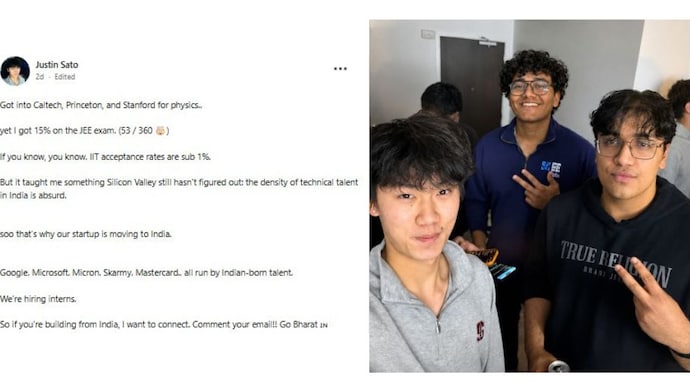
Scoring just 53 out of 360 in the Joint Entrance Examination (JEE) would end the dream of studying at an IIT for most aspirants. But for Justin Sato, it did not stop him from earning admission to three of the world's most prestigious universities, Stanford University, Princeton University and the California Institute of Technology (Caltech).
The Stanford student's LinkedIn post, in which he shared his JEE score, has gone viral, sparking fresh debate over how India's exam-centric admissions system differs from the holistic selection process followed by leading US universities.
STANFORD STUDENT SHARES HIS JEE SCORE
Sato, who is pursuing Physics and Mathematics at Stanford University, revealed that he scored 53 out of 360, or roughly 15 percent, in the JEE before securing admission to Stanford, Princeton and Caltech.
Explaining the context behind the score, he said it was a reflection of the intense competition in India's engineering entrance examination rather than a measure of a student's overall academic potential.
Pointing to the Indian Institutes of Technology (IITs), Sato noted that their acceptance rates are below one per cent, underscoring the highly competitive nature of the exam.
Sato said his experience gave him a deeper appreciation of India's engineering talent. He described the country's technical talent pool as exceptional and said the level of competition among aspiring engineers is unlike anywhere else.
HOW US UNIVERSITIES EVALUATE APPLICANTS
Sato's post also drew attention to the contrasting admission processes in India and the US. While entry to the IITs depends largely on JEE scores, universities such as Stanford, Princeton, and Caltech take a holistic approach, evaluating applicants on academics, research, extracurricular activities, essays, and personal achievements.
He also shared that his startup, Skarmy, is expanding to India, describing the country as a key destination for engineering talent. Sato invited students and young innovators to connect with him and said the company is currently hiring interns.
The post has fueled conversations about how different education systems identify talent, with IITs emphasising entrance exam performance and leading US universities considering a broader range of accomplishments and potential.
Scoring just 53 out of 360 in the Joint Entrance Examination (JEE) would end the dream of studying at an IIT for most aspirants. But for Justin Sato, it did not stop him from earning admission to three of the world's most prestigious universities, Stanford University, Princeton University and the California Institute of Technology (Caltech).
The Stanford student's LinkedIn post, in which he shared his JEE score, has gone viral, sparking fresh debate over how India's exam-centric admissions system differs from the holistic selection process followed by leading US universities.
STANFORD STUDENT SHARES HIS JEE SCORE
Sato, who is pursuing Physics and Mathematics at Stanford University, revealed that he scored 53 out of 360, or roughly 15 percent, in the JEE before securing admission to Stanford, Princeton and Caltech.
Explaining the context behind the score, he said it was a reflection of the intense competition in India's engineering entrance examination rather than a measure of a student's overall academic potential.
Pointing to the Indian Institutes of Technology (IITs), Sato noted that their acceptance rates are below one per cent, underscoring the highly competitive nature of the exam.
Sato said his experience gave him a deeper appreciation of India's engineering talent. He described the country's technical talent pool as exceptional and said the level of competition among aspiring engineers is unlike anywhere else.
HOW US UNIVERSITIES EVALUATE APPLICANTS
Sato's post also drew attention to the contrasting admission processes in India and the US. While entry to the IITs depends largely on JEE scores, universities such as Stanford, Princeton, and Caltech take a holistic approach, evaluating applicants on academics, research, extracurricular activities, essays, and personal achievements.
He also shared that his startup, Skarmy, is expanding to India, describing the country as a key destination for engineering talent. Sato invited students and young innovators to connect with him and said the company is currently hiring interns.
The post has fueled conversations about how different education systems identify talent, with IITs emphasising entrance exam performance and leading US universities considering a broader range of accomplishments and potential.

