The Legend of Karna review: Karna deserves a richer, more nuanced story
The Legend of Karna series review: SonyLiv's The Legend of Karna retells the Mahabharata through Karna's early years in Hastinapur. The series foregrounds action and spectacle, but its writing and animation limit the emotional depth.
SonyLiv's new animated series, The Legend of Karna, arrives at a time when mythological epics are firmly back in the spotlight. Nitesh Tiwari's Ramayana has reignited conversations following the release of its trailer, while Christopher Nolan's The Odyssey, rooted in Greek mythology, continues to generate buzz. Riding this wave of renewed interest in ancient legends, The Legend of Karna turns its focus to one of the Mahabharata's most compelling and tragic heroes. But does the series do justice to its towering protagonist? Let's find out.
Few characters in the epic inspire as much sympathy as Karna (Anup Soni), the tragic warrior whose story has fascinated readers and scholars for generations. Born to Kunti before her marriage and abandoned at birth, he grows up in the home of charioteer Adhirath (Paritosh Sand), unaware of his royal lineage. His life is defined by rejection, questions of identity and a constant desire to prove his worth in a society obsessed with birth and status. Countless books, films and television adaptations have explored these themes, often portraying him as one of mythology's greatest tragic heroes.
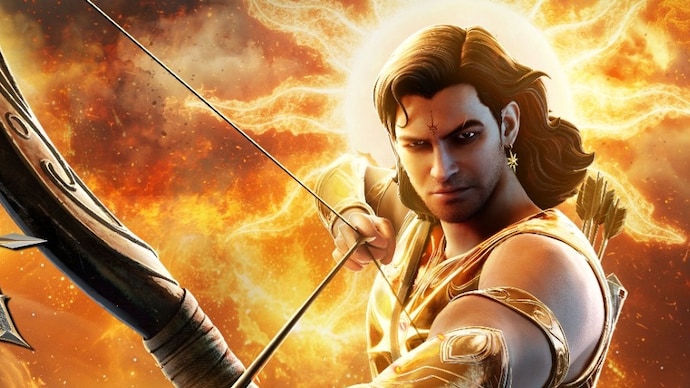
This series chooses a different route. Rather than dwelling on Karna's inner conflict, The Legend of Karna presents him as a near-invincible action hero determined to challenge the system. He is seen effortlessly defeating enemies and displaying extraordinary combat skills. By the end of the available episodes, he is breaking through fortress gates and overpowering armies almost single-handedly. You rarely see his vulnerable side.
The story opens on the battlefield of Kurukshetra, where Bhishma is lying on a bed of arrows reflecting on the chain of events that led to the devastating war. His regret over Karna's treatment becomes the starting point for a journey back into the warrior's life.
From there, the series follows Karna's early years in Hastinapur, where he is repeatedly reminded that he does not belong among the Kshatriyas (warrior clan). Despite the humiliation, he remains fiercely loyal to the family that raised him and refuses to be apologetic for his origins.
One of the show's more interesting choices is its portrayal of Duryodhana. Rather than presenting him simply as an antagonist, the series highlights his unwavering faith in Karna. Their friendship is presented as a bond built on mutual respect rather than political convenience, giving their relationship emotional weight. Dhritarashtra, too, is written with surprising empathy, recognising in Karna – a man judged for circumstances beyond his control.
With only five episodes currently available, the series largely functions as an introduction to Karna's early years in Hastinapur.
It establishes Karna's world, his relationships and the prejudices he faces, but stops short of exploring the morally complicated decisions that define the latter half of his journey. Whether future episodes will engage with those darker aspects remains to be seen.
The storytelling leans heavily on action, with frequent combat sequences punctuated by conversations between Karna and the people who shape his life, including Kunti, Adhirath and Duryodhana. At times, these exchanges feel overly explanatory, with dialogue that lacks emotional depth.
Animation should have been one of the series' biggest advantages. Instead, it often becomes one of its weaker aspects. The stylised 3D animation struggles with facial expressions, giving some characters an artificial appearance, but the surroundings are far more impressive. The glowing colour palette, expansive battlefields and imaginative production design help create a world that feels suitably mythic. Certain settings, particularly Dhritarashtra's unconventional royal court beneath a towering tree, stand out.
Costume design also lacks variety. Karna appears in almost identical attire throughout, regardless of where the story takes him, making the visual world feel less dynamic than it could have been.
The writing is another area where the series falls short. Some of the dialogues feel too contemporary for a story set in the mythological era, while others reduce deep philosophical ideas to simple one-liners. The Mahabharat is known for its complex questions about duty, power and right and wrong. Here, many of those ideas are presented as direct statements that aim to create impact rather than encourage deeper thought.
If the series wants to introduce Karna to a younger generation, the flat dialogue is certainly not the way to do it. Simplifying an epic should not mean flattening its emotional and philosophical richness.
By the end of the first five episodes, The Legend of Karna succeeds in recounting familiar events but rarely offers a compelling new way of understanding them. It presents Karna as heroic almost from beginning to end, leaving little room for contradiction, vulnerability and moral dilemmas.
The series has its moments, particularly in its portrayal of Karna and Duryodhana's friendship, as well as some of its world-building and action sequences. However, the simplistic writing, uneven animation and lack of emotional depth prevent it from becoming the layered retelling that Karna's story deserves.
The Legend of Karna may work as an accessible introduction for younger viewers, but for audiences familiar with the Mahabharata, it feels like a missed opportunity to explore one of its most complex characters.
SonyLiv's new animated series, The Legend of Karna, arrives at a time when mythological epics are firmly back in the spotlight. Nitesh Tiwari's Ramayana has reignited conversations following the release of its trailer, while Christopher Nolan's The Odyssey, rooted in Greek mythology, continues to generate buzz. Riding this wave of renewed interest in ancient legends, The Legend of Karna turns its focus to one of the Mahabharata's most compelling and tragic heroes. But does the series do justice to its towering protagonist? Let's find out.
Few characters in the epic inspire as much sympathy as Karna (Anup Soni), the tragic warrior whose story has fascinated readers and scholars for generations. Born to Kunti before her marriage and abandoned at birth, he grows up in the home of charioteer Adhirath (Paritosh Sand), unaware of his royal lineage. His life is defined by rejection, questions of identity and a constant desire to prove his worth in a society obsessed with birth and status. Countless books, films and television adaptations have explored these themes, often portraying him as one of mythology's greatest tragic heroes.
This series chooses a different route. Rather than dwelling on Karna's inner conflict, The Legend of Karna presents him as a near-invincible action hero determined to challenge the system. He is seen effortlessly defeating enemies and displaying extraordinary combat skills. By the end of the available episodes, he is breaking through fortress gates and overpowering armies almost single-handedly. You rarely see his vulnerable side.
The story opens on the battlefield of Kurukshetra, where Bhishma is lying on a bed of arrows reflecting on the chain of events that led to the devastating war. His regret over Karna's treatment becomes the starting point for a journey back into the warrior's life.
From there, the series follows Karna's early years in Hastinapur, where he is repeatedly reminded that he does not belong among the Kshatriyas (warrior clan). Despite the humiliation, he remains fiercely loyal to the family that raised him and refuses to be apologetic for his origins.
One of the show's more interesting choices is its portrayal of Duryodhana. Rather than presenting him simply as an antagonist, the series highlights his unwavering faith in Karna. Their friendship is presented as a bond built on mutual respect rather than political convenience, giving their relationship emotional weight. Dhritarashtra, too, is written with surprising empathy, recognising in Karna – a man judged for circumstances beyond his control.
With only five episodes currently available, the series largely functions as an introduction to Karna's early years in Hastinapur.
It establishes Karna's world, his relationships and the prejudices he faces, but stops short of exploring the morally complicated decisions that define the latter half of his journey. Whether future episodes will engage with those darker aspects remains to be seen.
The storytelling leans heavily on action, with frequent combat sequences punctuated by conversations between Karna and the people who shape his life, including Kunti, Adhirath and Duryodhana. At times, these exchanges feel overly explanatory, with dialogue that lacks emotional depth.
Animation should have been one of the series' biggest advantages. Instead, it often becomes one of its weaker aspects. The stylised 3D animation struggles with facial expressions, giving some characters an artificial appearance, but the surroundings are far more impressive. The glowing colour palette, expansive battlefields and imaginative production design help create a world that feels suitably mythic. Certain settings, particularly Dhritarashtra's unconventional royal court beneath a towering tree, stand out.
Costume design also lacks variety. Karna appears in almost identical attire throughout, regardless of where the story takes him, making the visual world feel less dynamic than it could have been.
The writing is another area where the series falls short. Some of the dialogues feel too contemporary for a story set in the mythological era, while others reduce deep philosophical ideas to simple one-liners. The Mahabharat is known for its complex questions about duty, power and right and wrong. Here, many of those ideas are presented as direct statements that aim to create impact rather than encourage deeper thought.
If the series wants to introduce Karna to a younger generation, the flat dialogue is certainly not the way to do it. Simplifying an epic should not mean flattening its emotional and philosophical richness.
By the end of the first five episodes, The Legend of Karna succeeds in recounting familiar events but rarely offers a compelling new way of understanding them. It presents Karna as heroic almost from beginning to end, leaving little room for contradiction, vulnerability and moral dilemmas.
The series has its moments, particularly in its portrayal of Karna and Duryodhana's friendship, as well as some of its world-building and action sequences. However, the simplistic writing, uneven animation and lack of emotional depth prevent it from becoming the layered retelling that Karna's story deserves.
The Legend of Karna may work as an accessible introduction for younger viewers, but for audiences familiar with the Mahabharata, it feels like a missed opportunity to explore one of its most complex characters.
SonyLiv's new animated series, The Legend of Karna, arrives at a time when mythological epics are firmly back in the spotlight. Nitesh Tiwari's Ramayana has reignited conversations following the release of its trailer, while Christopher Nolan's The Odyssey, rooted in Greek mythology, continues to generate buzz. Riding this wave of renewed interest in ancient legends, The Legend of Karna turns its focus to one of the Mahabharata's most compelling and tragic heroes. But does the series do justice to its towering protagonist? Let's find out.
Few characters in the epic inspire as much sympathy as Karna (Anup Soni), the tragic warrior whose story has fascinated readers and scholars for generations. Born to Kunti before her marriage and abandoned at birth, he grows up in the home of charioteer Adhirath (Paritosh Sand), unaware of his royal lineage. His life is defined by rejection, questions of identity and a constant desire to prove his worth in a society obsessed with birth and status. Countless books, films and television adaptations have explored these themes, often portraying him as one of mythology's greatest tragic heroes.
This series chooses a different route. Rather than dwelling on Karna's inner conflict, The Legend of Karna presents him as a near-invincible action hero determined to challenge the system. He is seen effortlessly defeating enemies and displaying extraordinary combat skills. By the end of the available episodes, he is breaking through fortress gates and overpowering armies almost single-handedly. You rarely see his vulnerable side.
The story opens on the battlefield of Kurukshetra, where Bhishma is lying on a bed of arrows reflecting on the chain of events that led to the devastating war. His regret over Karna's treatment becomes the starting point for a journey back into the warrior's life.
From there, the series follows Karna's early years in Hastinapur, where he is repeatedly reminded that he does not belong among the Kshatriyas (warrior clan). Despite the humiliation, he remains fiercely loyal to the family that raised him and refuses to be apologetic for his origins.
One of the show's more interesting choices is its portrayal of Duryodhana. Rather than presenting him simply as an antagonist, the series highlights his unwavering faith in Karna. Their friendship is presented as a bond built on mutual respect rather than political convenience, giving their relationship emotional weight. Dhritarashtra, too, is written with surprising empathy, recognising in Karna – a man judged for circumstances beyond his control.
With only five episodes currently available, the series largely functions as an introduction to Karna's early years in Hastinapur.
It establishes Karna's world, his relationships and the prejudices he faces, but stops short of exploring the morally complicated decisions that define the latter half of his journey. Whether future episodes will engage with those darker aspects remains to be seen.
The storytelling leans heavily on action, with frequent combat sequences punctuated by conversations between Karna and the people who shape his life, including Kunti, Adhirath and Duryodhana. At times, these exchanges feel overly explanatory, with dialogue that lacks emotional depth.
Animation should have been one of the series' biggest advantages. Instead, it often becomes one of its weaker aspects. The stylised 3D animation struggles with facial expressions, giving some characters an artificial appearance, but the surroundings are far more impressive. The glowing colour palette, expansive battlefields and imaginative production design help create a world that feels suitably mythic. Certain settings, particularly Dhritarashtra's unconventional royal court beneath a towering tree, stand out.
Costume design also lacks variety. Karna appears in almost identical attire throughout, regardless of where the story takes him, making the visual world feel less dynamic than it could have been.
The writing is another area where the series falls short. Some of the dialogues feel too contemporary for a story set in the mythological era, while others reduce deep philosophical ideas to simple one-liners. The Mahabharat is known for its complex questions about duty, power and right and wrong. Here, many of those ideas are presented as direct statements that aim to create impact rather than encourage deeper thought.
If the series wants to introduce Karna to a younger generation, the flat dialogue is certainly not the way to do it. Simplifying an epic should not mean flattening its emotional and philosophical richness.
By the end of the first five episodes, The Legend of Karna succeeds in recounting familiar events but rarely offers a compelling new way of understanding them. It presents Karna as heroic almost from beginning to end, leaving little room for contradiction, vulnerability and moral dilemmas.
The series has its moments, particularly in its portrayal of Karna and Duryodhana's friendship, as well as some of its world-building and action sequences. However, the simplistic writing, uneven animation and lack of emotional depth prevent it from becoming the layered retelling that Karna's story deserves.
The Legend of Karna may work as an accessible introduction for younger viewers, but for audiences familiar with the Mahabharata, it feels like a missed opportunity to explore one of its most complex characters.

