When a death after 58-day hunger strike shook Nehru, gave birth to Andhra
Five years after Independence, Gandhian leader and activist Potti Sriramulu began a fast until death demanding a separate state for Telugu-speaking people. His death after 58 days of fast forced PM Jawaharlal Nehru to act and declare the formation of the Andhra State, the first on linguistic lines.
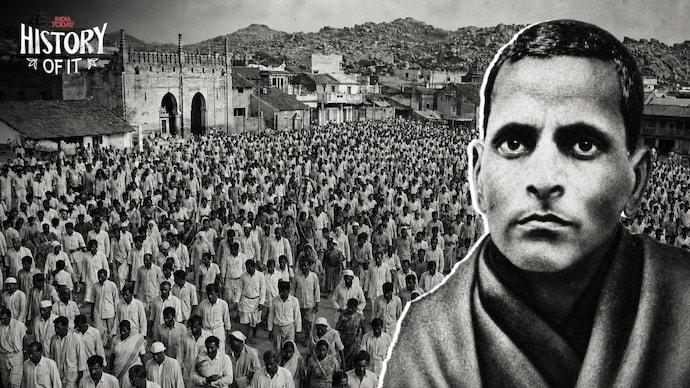
"If only I have 11 more followers, like Sriramulu, I will win freedom in a year," Mohandas Karamchand Gandhi once said of Potti Sriramulu. Little did Gandhi know that his disciple would ultimately use the Gandhian weapon of fasting to alter the political map of independent India.
Just years after India attained Independence and became a Republic, Sriramulu began a fast unto death in October 1952, demanding a separate state for Telugu-speaking people.
Back then, the entire region was part of the Madras Presidency first (1947-1950), then the Madras State (1950 onwards). And India didn't have states on linguistic lines. Fifty-eight days into the fast, Sriramulu died without seeing that state he and his people struggled for. However, Sriramulu's death would ultimately give birth to an Andhra State.
Sriramulu's death triggered protests, violence and police firing across the Telugu-speaking districts of Madras. Four days after his death, Prime Minister Jawaharlal Nehru was forced to announce that a separate Andhra State would be created.
Sriramulu's fast and its consequences would make up for an interesting read as Ladakh-based educator and activist Sonam Wangchuk’s indefinite hunger strike at Delhi's Jantar Mantar entered its 20th day on Friday. Wangchuk, who is backing the Cockroach Janta Party's protest over the NEET-UG paper leak and is seeking the resignation of Education Minister Dharmendra Pradhan, has lost over 9 kg of body weight. The Delhi High Court has ordered regular medical examinations, observing that "life is precious", but Wangchuk has refused appeals from several quarters to end his fast.
"If I eat, what message will go? The message to the government will be that there is no need for accountability," said the 59-year-old activist, urging Indians to participate in the proposed "Chalo Sansad" march on July 20.
The two protests are separated by nearly 74 years and political circumstances. Wangchuk's current agitation seeks accountability and examination reforms within an established order. Sriramulu's, on the other hand, had to do with the internal map of India, which was unsettled since the Independence and Partition.
Sriramulu's fast wasn't the only factor that led to the birth of the Andhra State, but his death became the trigger.
The mass mobilisation behind the Andhra movement and the violent unrest following Sirramalu's death forced PM Jawaharlal Nehru, whose attitude "appeared too vague and evasive to the Andhras", to finally act and accept the people's will.
WAS PM NEHRU AGAINST THE FORMATION OF ANDHRA STATE?
The demand for an Andhra State predated Sriramulu, who, by the early 1950s, had participated in several satyagrahas, championed Dalit rights and emerged as a follower of Gandhi. The demand for a state of the Telugu people emerged from a decades-old movement seeking a separate political and administrative unit for Telugu speakers living within the massive Madras Presidency.
Historian Ramachandra Guha wrote in his book, India After Gandhi, that the Andhra Mahasabha had worked even under British rule to foster an identity among Telugu-speaking people, who believed they had been discriminated against by Tamils. Telugu, Guha noted, was spoken by more Indians than any language other than Hindi and possessed a rich literary heritage associated with memories of the Vijayanagara Empire.
The Congress had itself supported linguistic provinces from the 1920s. But Partition had changed the priorities of its leadership. With communal violence, refugee rehabilitation, Pakistan's war in Kashmir and the challenges of integration of princely states confronting the new republic, Nehru feared that reorganising provinces by language could encourage "disruptionist tendencies".
The JVP Committee, comprising Jawaharlal Nehru, Vallabhbhai Patel and Pattabhi Sitaramayya, retreated from the Congress's earlier commitment.
"This committee, known as the 'JVP Committee' after the initials of its members, revoked the seal of approval that the Congress had once put on the principle of linguistic provinces. It argued that 'language was not only a binding force but also a separating one'. Now, when the 'primary consideration must be the security, unity and economic prosperity of India', 'every separatist and disruptive tendency should be rigorously discouraged'," Guha wrote in his book.
A national consolidation was the first priority for PM Nehru at that time. Addressing Parliament on May 22, 1952, he said that although linguistic provinces might be desirable in some cases, "this would obviously be the wrong time".
"When the right time comes, let us have them by all means," he said.
But, according to author-scholar KV Narayana Rao, Nehru's position on the demand appeared "too vague and evasive to the Andhras".
"Nobody knew what the right time was and when it would come," added Rao.
So, impatient for a definite answer, the Andhra districts intensified their agitation, and Sriramulu soon emerged as its defining figure. First a bit about who Potti Sriramulu was and how an engineer from Nellore became a Gandhian, and went on to lead the protests.
THE ENGINEER WHO BECAME GANDHI'S DISCIPLE
Born in 1901, Potti Sriramulu studied sanitary engineering and found employment with the railways. His life changed after a personal tragedy in 1928, when his wife and newborn child died. In 1930, he resigned from his job and joined Gandhi's Salt Satyagraha. He later lived at the Sabarmati Ashram and spent 18 months in prison during the Individual Satyagraha campaign of 1940-41, during the Quit India Movement.
Sriramulu's activism was not initially centred on linguistics. He worked for Dalit welfare and sought the opening of temples to communities then treated as "untouchable".
In November 1946, he began a fast unto death demanding that temples in Madras province be opened to Dalits. Congress leaders urged him to stop, but he relented only after Gandhi intervened.
Gandhi subsequently wrote to Andhra leader T Prakasam that he was "glad that the fast of Sreeramulu ended in the happy manner".
"I know he is a solid worker, though a little eccentric," Gandhi added.
Guha, in his book, noted that "eccentric" was capacious enough also to mean "determined". In 1946, Gandhi was alive to persuade his disciple to stop. By 1952, the Mahatma was gone, and Sriramulu was prepared to carry his fast to its end.
By then, the Andhra movement had gathered political force. Telugu legislators cutting across party lines supported a separate state for Telugus. Congress politician-turned-swami Sitaram had undertaken a five-week fast in 1951 before ending it at Vinoba Bhave's request. Nehru was met by black flags and cries of "We want Andhra" during an election tour.
The 1952 Madras Assembly results delivered another warning. The Congress won just 43 of the 145 seats from the Telugu-speaking region, while parties supporting Andhra statehood took most of the remainder. The Communists, who advocated for "Visalandhra", alone secured 41 of the seats.
While the question of a separate state was becoming difficult for New Delhi to ignore, another contention was widening the fault lines.
THE QUESTION OF MADRAS CITY
Another sticking point was the demand by the Andhras that Madras city (present-day Chennai, and then capital of the Madras State) be part of the demanded Telugu state.
Telugu leaders cited their demographic, cultural and economic presence in the city and pressed their claim with the slogan "Madras manade", or Madras is ours. Nehru and Madras Chief Minister C Rajagopalachari were equally clear that even if an Andhra state were conceded, Madras city wouldn't be part of it.
Three years before Sriramulu's final fast, according to Time Magazine, a separation proposal had collapsed because Telugu and Tamil leaders could not agree over the city.
Against this backdrop, Sriramulu began his fast at the Madras home of Maharshi Bulusu Sambamurti on October 19, 1952. He had the support of Swami Sitaram and thousands of Telugu-speaking people. However, the Andhra Congress leadership did not endorse his method.
As Sriramulu went without food, public support grew. Hartals were held in several towns. Distinguished sociologist Andre Beteille, then travelling from Calcutta (now Kolkata) to Madras, recalled his train being stopped in Vizag by a crowd shouting slogans against Nehru and Rajagopalachari.
Nehru initially refused to yield. On December 3, when Sriramulu had already fasted for about six weeks, the Prime Minister wrote to Rajagopalachari, "Some kind of fast is going on for the Andhra Province and I get frantic telegrams."
"I am totally unmoved by this and I propose to ignore it completely," Nehru wrote.
On the 52nd day, Time reported, Nehru warned that "This method of fasting to achieve administrative or political changes will [put] an end to democratic government."
But the agitation expanding by the day made the Andhra demand increasingly difficult for Nehru to disregard. On December 12, Nehru wrote to Rajagopalachari that the time had come to accept it.
"Otherwise, complete frustration will grow among the Andhras, and we will not be able to catch up with it," he said.
But the government made no formal announcement, and Sriramulu continued his fast. By the time New Delhi moved towards accepting the Andhra demand, Sriramulu's condition had deteriorated beyond recovery.
SRIRAMULU'S DEATH SET ANDHRA DISTRICTS ABLAZE
By the 58th day, Sriramulu's condition had deteriorated drastically. The Time Magazine reported that his eyes had sunk, his skin had turned pale and his throat was so inflamed that he could no longer swallow water. He was continuously hiccupping and had vomited blood.
When a doctor suggested ending the fast, Sriramulu had lost the ability to speak. He reportedly raised a hand and slowly placed a finger on his lips. This signalled his refusal. He died on December 15, 1952. He was 51.
His body was seated upright on a pedestal, covered in garlands and taken through Madras in a funeral procession. Telugu schoolboys carried black flags, beat their chests and cried, "Madras city is ours," according to Time magazine's December 29, 1952 report, titled 'Fast and Win'.
News of Sriramulu's death sent the Telugu-speaking districts into turmoil. Government offices were attacked, trains were stopped and damaged, railway property was burned, and telegraph wires were cut. The damage ran into crores of rupees, and several protesters were killed when police opened fire.
Guha wrote that Nehru had once maintained that "facts, not fasts" would decide the issue. But the prospect of widespread and uncontrollable unrest changed the political calculation. On December 19, four days after Sriramulu's death, Nehru announced that a separate Andhra State would be formed. Though, he did not concede Madras city to the proposed state.
The distinction is important to note that Sriramulu's fast did not immediately create today's Andhra Pradesh. It led first to Andhra State, comprising Telugu-speaking districts separated from Madras State. It formally came into existence on October 1, 1953, with Kurnool as its capital.
Three years later, in November 1956, Andhra State was merged with the Telugu-speaking Telangana region of the former Hyderabad State to create Andhra Pradesh. Telangana would separate again in 2014, leaving Andhra Pradesh on India's eastern coast in its present form.
HOW SRIRAMULU'S FAST REDREW INDIA
The consequences of Sriramulu's fast and his death defined India's political territories beyond Andhra. Once the Centre accepted the Telugu demand, movements in Maharashtra, Karnataka, Kerala and other linguistic states gained strength.
Nehru recognised and acknowledged the risk. "We have disturbed the hornet's nest and I believe most of us are likely to be badly stung," said Nehru, according to Jawaharlal Nehru: A Biography, vol. 2.
The Centre appointed the States Reorganisation Commission, whose members visited 104 towns and cities, interviewed more than 9,000 people and received 1,52,250 written submissions. Its work culminated in the large-scale reorganisation of India's states in 1956.
What the national leadership, led by Nehru, had feared might divide India eventually helped accommodate regional identities within the Indian Union. As Guha argued, linguistic reorganisation became a "largely constructive channel for provincial pride". It allowed a person to be Telugu, Tamil, Kannada or Marathi while remaining Indian, he added.
That was Sriramulu's larger imprint on Andhra State that later became Andhra Pradesh. His fast did not by itself settle every territorial claim, and his death was followed by violence that sat uneasily with his Gandhian method. But his death made further delay on the Andhra demand politically impossible. The government was compelled to appoint the States Reorganisation Commission.
"If Jawaharlal Nehru was the Maker of Modern India," Guha wrote, "then perhaps Potti Sriramulu should be named its Mercator."
"If only I have 11 more followers, like Sriramulu, I will win freedom in a year," Mohandas Karamchand Gandhi once said of Potti Sriramulu. Little did Gandhi know that his disciple would ultimately use the Gandhian weapon of fasting to alter the political map of independent India.
Just years after India attained Independence and became a Republic, Sriramulu began a fast unto death in October 1952, demanding a separate state for Telugu-speaking people.
Back then, the entire region was part of the Madras Presidency first (1947-1950), then the Madras State (1950 onwards). And India didn't have states on linguistic lines. Fifty-eight days into the fast, Sriramulu died without seeing that state he and his people struggled for. However, Sriramulu's death would ultimately give birth to an Andhra State.
Sriramulu's death triggered protests, violence and police firing across the Telugu-speaking districts of Madras. Four days after his death, Prime Minister Jawaharlal Nehru was forced to announce that a separate Andhra State would be created.
Sriramulu's fast and its consequences would make up for an interesting read as Ladakh-based educator and activist Sonam Wangchuk’s indefinite hunger strike at Delhi's Jantar Mantar entered its 20th day on Friday. Wangchuk, who is backing the Cockroach Janta Party's protest over the NEET-UG paper leak and is seeking the resignation of Education Minister Dharmendra Pradhan, has lost over 9 kg of body weight. The Delhi High Court has ordered regular medical examinations, observing that "life is precious", but Wangchuk has refused appeals from several quarters to end his fast.
"If I eat, what message will go? The message to the government will be that there is no need for accountability," said the 59-year-old activist, urging Indians to participate in the proposed "Chalo Sansad" march on July 20.
The two protests are separated by nearly 74 years and political circumstances. Wangchuk's current agitation seeks accountability and examination reforms within an established order. Sriramulu's, on the other hand, had to do with the internal map of India, which was unsettled since the Independence and Partition.
Sriramulu's fast wasn't the only factor that led to the birth of the Andhra State, but his death became the trigger.
The mass mobilisation behind the Andhra movement and the violent unrest following Sirramalu's death forced PM Jawaharlal Nehru, whose attitude "appeared too vague and evasive to the Andhras", to finally act and accept the people's will.
WAS PM NEHRU AGAINST THE FORMATION OF ANDHRA STATE?
The demand for an Andhra State predated Sriramulu, who, by the early 1950s, had participated in several satyagrahas, championed Dalit rights and emerged as a follower of Gandhi. The demand for a state of the Telugu people emerged from a decades-old movement seeking a separate political and administrative unit for Telugu speakers living within the massive Madras Presidency.
Historian Ramachandra Guha wrote in his book, India After Gandhi, that the Andhra Mahasabha had worked even under British rule to foster an identity among Telugu-speaking people, who believed they had been discriminated against by Tamils. Telugu, Guha noted, was spoken by more Indians than any language other than Hindi and possessed a rich literary heritage associated with memories of the Vijayanagara Empire.
The Congress had itself supported linguistic provinces from the 1920s. But Partition had changed the priorities of its leadership. With communal violence, refugee rehabilitation, Pakistan's war in Kashmir and the challenges of integration of princely states confronting the new republic, Nehru feared that reorganising provinces by language could encourage "disruptionist tendencies".
The JVP Committee, comprising Jawaharlal Nehru, Vallabhbhai Patel and Pattabhi Sitaramayya, retreated from the Congress's earlier commitment.
"This committee, known as the 'JVP Committee' after the initials of its members, revoked the seal of approval that the Congress had once put on the principle of linguistic provinces. It argued that 'language was not only a binding force but also a separating one'. Now, when the 'primary consideration must be the security, unity and economic prosperity of India', 'every separatist and disruptive tendency should be rigorously discouraged'," Guha wrote in his book.
A national consolidation was the first priority for PM Nehru at that time. Addressing Parliament on May 22, 1952, he said that although linguistic provinces might be desirable in some cases, "this would obviously be the wrong time".
"When the right time comes, let us have them by all means," he said.
But, according to author-scholar KV Narayana Rao, Nehru's position on the demand appeared "too vague and evasive to the Andhras".
"Nobody knew what the right time was and when it would come," added Rao.
So, impatient for a definite answer, the Andhra districts intensified their agitation, and Sriramulu soon emerged as its defining figure. First a bit about who Potti Sriramulu was and how an engineer from Nellore became a Gandhian, and went on to lead the protests.
THE ENGINEER WHO BECAME GANDHI'S DISCIPLE
Born in 1901, Potti Sriramulu studied sanitary engineering and found employment with the railways. His life changed after a personal tragedy in 1928, when his wife and newborn child died. In 1930, he resigned from his job and joined Gandhi's Salt Satyagraha. He later lived at the Sabarmati Ashram and spent 18 months in prison during the Individual Satyagraha campaign of 1940-41, during the Quit India Movement.
Sriramulu's activism was not initially centred on linguistics. He worked for Dalit welfare and sought the opening of temples to communities then treated as "untouchable".
In November 1946, he began a fast unto death demanding that temples in Madras province be opened to Dalits. Congress leaders urged him to stop, but he relented only after Gandhi intervened.
Gandhi subsequently wrote to Andhra leader T Prakasam that he was "glad that the fast of Sreeramulu ended in the happy manner".
"I know he is a solid worker, though a little eccentric," Gandhi added.
Guha, in his book, noted that "eccentric" was capacious enough also to mean "determined". In 1946, Gandhi was alive to persuade his disciple to stop. By 1952, the Mahatma was gone, and Sriramulu was prepared to carry his fast to its end.
By then, the Andhra movement had gathered political force. Telugu legislators cutting across party lines supported a separate state for Telugus. Congress politician-turned-swami Sitaram had undertaken a five-week fast in 1951 before ending it at Vinoba Bhave's request. Nehru was met by black flags and cries of "We want Andhra" during an election tour.
The 1952 Madras Assembly results delivered another warning. The Congress won just 43 of the 145 seats from the Telugu-speaking region, while parties supporting Andhra statehood took most of the remainder. The Communists, who advocated for "Visalandhra", alone secured 41 of the seats.
While the question of a separate state was becoming difficult for New Delhi to ignore, another contention was widening the fault lines.
THE QUESTION OF MADRAS CITY
Another sticking point was the demand by the Andhras that Madras city (present-day Chennai, and then capital of the Madras State) be part of the demanded Telugu state.
Telugu leaders cited their demographic, cultural and economic presence in the city and pressed their claim with the slogan "Madras manade", or Madras is ours. Nehru and Madras Chief Minister C Rajagopalachari were equally clear that even if an Andhra state were conceded, Madras city wouldn't be part of it.
Three years before Sriramulu's final fast, according to Time Magazine, a separation proposal had collapsed because Telugu and Tamil leaders could not agree over the city.
Against this backdrop, Sriramulu began his fast at the Madras home of Maharshi Bulusu Sambamurti on October 19, 1952. He had the support of Swami Sitaram and thousands of Telugu-speaking people. However, the Andhra Congress leadership did not endorse his method.
As Sriramulu went without food, public support grew. Hartals were held in several towns. Distinguished sociologist Andre Beteille, then travelling from Calcutta (now Kolkata) to Madras, recalled his train being stopped in Vizag by a crowd shouting slogans against Nehru and Rajagopalachari.
Nehru initially refused to yield. On December 3, when Sriramulu had already fasted for about six weeks, the Prime Minister wrote to Rajagopalachari, "Some kind of fast is going on for the Andhra Province and I get frantic telegrams."
"I am totally unmoved by this and I propose to ignore it completely," Nehru wrote.
On the 52nd day, Time reported, Nehru warned that "This method of fasting to achieve administrative or political changes will [put] an end to democratic government."
But the agitation expanding by the day made the Andhra demand increasingly difficult for Nehru to disregard. On December 12, Nehru wrote to Rajagopalachari that the time had come to accept it.
"Otherwise, complete frustration will grow among the Andhras, and we will not be able to catch up with it," he said.
But the government made no formal announcement, and Sriramulu continued his fast. By the time New Delhi moved towards accepting the Andhra demand, Sriramulu's condition had deteriorated beyond recovery.
SRIRAMULU'S DEATH SET ANDHRA DISTRICTS ABLAZE
By the 58th day, Sriramulu's condition had deteriorated drastically. The Time Magazine reported that his eyes had sunk, his skin had turned pale and his throat was so inflamed that he could no longer swallow water. He was continuously hiccupping and had vomited blood.
When a doctor suggested ending the fast, Sriramulu had lost the ability to speak. He reportedly raised a hand and slowly placed a finger on his lips. This signalled his refusal. He died on December 15, 1952. He was 51.
His body was seated upright on a pedestal, covered in garlands and taken through Madras in a funeral procession. Telugu schoolboys carried black flags, beat their chests and cried, "Madras city is ours," according to Time magazine's December 29, 1952 report, titled 'Fast and Win'.
News of Sriramulu's death sent the Telugu-speaking districts into turmoil. Government offices were attacked, trains were stopped and damaged, railway property was burned, and telegraph wires were cut. The damage ran into crores of rupees, and several protesters were killed when police opened fire.
Guha wrote that Nehru had once maintained that "facts, not fasts" would decide the issue. But the prospect of widespread and uncontrollable unrest changed the political calculation. On December 19, four days after Sriramulu's death, Nehru announced that a separate Andhra State would be formed. Though, he did not concede Madras city to the proposed state.
The distinction is important to note that Sriramulu's fast did not immediately create today's Andhra Pradesh. It led first to Andhra State, comprising Telugu-speaking districts separated from Madras State. It formally came into existence on October 1, 1953, with Kurnool as its capital.
Three years later, in November 1956, Andhra State was merged with the Telugu-speaking Telangana region of the former Hyderabad State to create Andhra Pradesh. Telangana would separate again in 2014, leaving Andhra Pradesh on India's eastern coast in its present form.
HOW SRIRAMULU'S FAST REDREW INDIA
The consequences of Sriramulu's fast and his death defined India's political territories beyond Andhra. Once the Centre accepted the Telugu demand, movements in Maharashtra, Karnataka, Kerala and other linguistic states gained strength.
Nehru recognised and acknowledged the risk. "We have disturbed the hornet's nest and I believe most of us are likely to be badly stung," said Nehru, according to Jawaharlal Nehru: A Biography, vol. 2.
The Centre appointed the States Reorganisation Commission, whose members visited 104 towns and cities, interviewed more than 9,000 people and received 1,52,250 written submissions. Its work culminated in the large-scale reorganisation of India's states in 1956.
What the national leadership, led by Nehru, had feared might divide India eventually helped accommodate regional identities within the Indian Union. As Guha argued, linguistic reorganisation became a "largely constructive channel for provincial pride". It allowed a person to be Telugu, Tamil, Kannada or Marathi while remaining Indian, he added.
That was Sriramulu's larger imprint on Andhra State that later became Andhra Pradesh. His fast did not by itself settle every territorial claim, and his death was followed by violence that sat uneasily with his Gandhian method. But his death made further delay on the Andhra demand politically impossible. The government was compelled to appoint the States Reorganisation Commission.
"If Jawaharlal Nehru was the Maker of Modern India," Guha wrote, "then perhaps Potti Sriramulu should be named its Mercator."
"If only I have 11 more followers, like Sriramulu, I will win freedom in a year," Mohandas Karamchand Gandhi once said of Potti Sriramulu. Little did Gandhi know that his disciple would ultimately use the Gandhian weapon of fasting to alter the political map of independent India.
Just years after India attained Independence and became a Republic, Sriramulu began a fast unto death in October 1952, demanding a separate state for Telugu-speaking people.
Back then, the entire region was part of the Madras Presidency first (1947-1950), then the Madras State (1950 onwards). And India didn't have states on linguistic lines. Fifty-eight days into the fast, Sriramulu died without seeing that state he and his people struggled for. However, Sriramulu's death would ultimately give birth to an Andhra State.
Sriramulu's death triggered protests, violence and police firing across the Telugu-speaking districts of Madras. Four days after his death, Prime Minister Jawaharlal Nehru was forced to announce that a separate Andhra State would be created.
Sriramulu's fast and its consequences would make up for an interesting read as Ladakh-based educator and activist Sonam Wangchuk’s indefinite hunger strike at Delhi's Jantar Mantar entered its 20th day on Friday. Wangchuk, who is backing the Cockroach Janta Party's protest over the NEET-UG paper leak and is seeking the resignation of Education Minister Dharmendra Pradhan, has lost over 9 kg of body weight. The Delhi High Court has ordered regular medical examinations, observing that "life is precious", but Wangchuk has refused appeals from several quarters to end his fast.
"If I eat, what message will go? The message to the government will be that there is no need for accountability," said the 59-year-old activist, urging Indians to participate in the proposed "Chalo Sansad" march on July 20.
The two protests are separated by nearly 74 years and political circumstances. Wangchuk's current agitation seeks accountability and examination reforms within an established order. Sriramulu's, on the other hand, had to do with the internal map of India, which was unsettled since the Independence and Partition.
Sriramulu's fast wasn't the only factor that led to the birth of the Andhra State, but his death became the trigger.
The mass mobilisation behind the Andhra movement and the violent unrest following Sirramalu's death forced PM Jawaharlal Nehru, whose attitude "appeared too vague and evasive to the Andhras", to finally act and accept the people's will.
WAS PM NEHRU AGAINST THE FORMATION OF ANDHRA STATE?
The demand for an Andhra State predated Sriramulu, who, by the early 1950s, had participated in several satyagrahas, championed Dalit rights and emerged as a follower of Gandhi. The demand for a state of the Telugu people emerged from a decades-old movement seeking a separate political and administrative unit for Telugu speakers living within the massive Madras Presidency.
Historian Ramachandra Guha wrote in his book, India After Gandhi, that the Andhra Mahasabha had worked even under British rule to foster an identity among Telugu-speaking people, who believed they had been discriminated against by Tamils. Telugu, Guha noted, was spoken by more Indians than any language other than Hindi and possessed a rich literary heritage associated with memories of the Vijayanagara Empire.
The Congress had itself supported linguistic provinces from the 1920s. But Partition had changed the priorities of its leadership. With communal violence, refugee rehabilitation, Pakistan's war in Kashmir and the challenges of integration of princely states confronting the new republic, Nehru feared that reorganising provinces by language could encourage "disruptionist tendencies".
The JVP Committee, comprising Jawaharlal Nehru, Vallabhbhai Patel and Pattabhi Sitaramayya, retreated from the Congress's earlier commitment.
"This committee, known as the 'JVP Committee' after the initials of its members, revoked the seal of approval that the Congress had once put on the principle of linguistic provinces. It argued that 'language was not only a binding force but also a separating one'. Now, when the 'primary consideration must be the security, unity and economic prosperity of India', 'every separatist and disruptive tendency should be rigorously discouraged'," Guha wrote in his book.
A national consolidation was the first priority for PM Nehru at that time. Addressing Parliament on May 22, 1952, he said that although linguistic provinces might be desirable in some cases, "this would obviously be the wrong time".
"When the right time comes, let us have them by all means," he said.
But, according to author-scholar KV Narayana Rao, Nehru's position on the demand appeared "too vague and evasive to the Andhras".
"Nobody knew what the right time was and when it would come," added Rao.
So, impatient for a definite answer, the Andhra districts intensified their agitation, and Sriramulu soon emerged as its defining figure. First a bit about who Potti Sriramulu was and how an engineer from Nellore became a Gandhian, and went on to lead the protests.
THE ENGINEER WHO BECAME GANDHI'S DISCIPLE
Born in 1901, Potti Sriramulu studied sanitary engineering and found employment with the railways. His life changed after a personal tragedy in 1928, when his wife and newborn child died. In 1930, he resigned from his job and joined Gandhi's Salt Satyagraha. He later lived at the Sabarmati Ashram and spent 18 months in prison during the Individual Satyagraha campaign of 1940-41, during the Quit India Movement.
Sriramulu's activism was not initially centred on linguistics. He worked for Dalit welfare and sought the opening of temples to communities then treated as "untouchable".
In November 1946, he began a fast unto death demanding that temples in Madras province be opened to Dalits. Congress leaders urged him to stop, but he relented only after Gandhi intervened.
Gandhi subsequently wrote to Andhra leader T Prakasam that he was "glad that the fast of Sreeramulu ended in the happy manner".
"I know he is a solid worker, though a little eccentric," Gandhi added.
Guha, in his book, noted that "eccentric" was capacious enough also to mean "determined". In 1946, Gandhi was alive to persuade his disciple to stop. By 1952, the Mahatma was gone, and Sriramulu was prepared to carry his fast to its end.
By then, the Andhra movement had gathered political force. Telugu legislators cutting across party lines supported a separate state for Telugus. Congress politician-turned-swami Sitaram had undertaken a five-week fast in 1951 before ending it at Vinoba Bhave's request. Nehru was met by black flags and cries of "We want Andhra" during an election tour.
The 1952 Madras Assembly results delivered another warning. The Congress won just 43 of the 145 seats from the Telugu-speaking region, while parties supporting Andhra statehood took most of the remainder. The Communists, who advocated for "Visalandhra", alone secured 41 of the seats.
While the question of a separate state was becoming difficult for New Delhi to ignore, another contention was widening the fault lines.
THE QUESTION OF MADRAS CITY
Another sticking point was the demand by the Andhras that Madras city (present-day Chennai, and then capital of the Madras State) be part of the demanded Telugu state.
Telugu leaders cited their demographic, cultural and economic presence in the city and pressed their claim with the slogan "Madras manade", or Madras is ours. Nehru and Madras Chief Minister C Rajagopalachari were equally clear that even if an Andhra state were conceded, Madras city wouldn't be part of it.
Three years before Sriramulu's final fast, according to Time Magazine, a separation proposal had collapsed because Telugu and Tamil leaders could not agree over the city.
Against this backdrop, Sriramulu began his fast at the Madras home of Maharshi Bulusu Sambamurti on October 19, 1952. He had the support of Swami Sitaram and thousands of Telugu-speaking people. However, the Andhra Congress leadership did not endorse his method.
As Sriramulu went without food, public support grew. Hartals were held in several towns. Distinguished sociologist Andre Beteille, then travelling from Calcutta (now Kolkata) to Madras, recalled his train being stopped in Vizag by a crowd shouting slogans against Nehru and Rajagopalachari.
Nehru initially refused to yield. On December 3, when Sriramulu had already fasted for about six weeks, the Prime Minister wrote to Rajagopalachari, "Some kind of fast is going on for the Andhra Province and I get frantic telegrams."
"I am totally unmoved by this and I propose to ignore it completely," Nehru wrote.
On the 52nd day, Time reported, Nehru warned that "This method of fasting to achieve administrative or political changes will [put] an end to democratic government."
But the agitation expanding by the day made the Andhra demand increasingly difficult for Nehru to disregard. On December 12, Nehru wrote to Rajagopalachari that the time had come to accept it.
"Otherwise, complete frustration will grow among the Andhras, and we will not be able to catch up with it," he said.
But the government made no formal announcement, and Sriramulu continued his fast. By the time New Delhi moved towards accepting the Andhra demand, Sriramulu's condition had deteriorated beyond recovery.
SRIRAMULU'S DEATH SET ANDHRA DISTRICTS ABLAZE
By the 58th day, Sriramulu's condition had deteriorated drastically. The Time Magazine reported that his eyes had sunk, his skin had turned pale and his throat was so inflamed that he could no longer swallow water. He was continuously hiccupping and had vomited blood.
When a doctor suggested ending the fast, Sriramulu had lost the ability to speak. He reportedly raised a hand and slowly placed a finger on his lips. This signalled his refusal. He died on December 15, 1952. He was 51.
His body was seated upright on a pedestal, covered in garlands and taken through Madras in a funeral procession. Telugu schoolboys carried black flags, beat their chests and cried, "Madras city is ours," according to Time magazine's December 29, 1952 report, titled 'Fast and Win'.
News of Sriramulu's death sent the Telugu-speaking districts into turmoil. Government offices were attacked, trains were stopped and damaged, railway property was burned, and telegraph wires were cut. The damage ran into crores of rupees, and several protesters were killed when police opened fire.
Guha wrote that Nehru had once maintained that "facts, not fasts" would decide the issue. But the prospect of widespread and uncontrollable unrest changed the political calculation. On December 19, four days after Sriramulu's death, Nehru announced that a separate Andhra State would be formed. Though, he did not concede Madras city to the proposed state.
The distinction is important to note that Sriramulu's fast did not immediately create today's Andhra Pradesh. It led first to Andhra State, comprising Telugu-speaking districts separated from Madras State. It formally came into existence on October 1, 1953, with Kurnool as its capital.
Three years later, in November 1956, Andhra State was merged with the Telugu-speaking Telangana region of the former Hyderabad State to create Andhra Pradesh. Telangana would separate again in 2014, leaving Andhra Pradesh on India's eastern coast in its present form.
HOW SRIRAMULU'S FAST REDREW INDIA
The consequences of Sriramulu's fast and his death defined India's political territories beyond Andhra. Once the Centre accepted the Telugu demand, movements in Maharashtra, Karnataka, Kerala and other linguistic states gained strength.
Nehru recognised and acknowledged the risk. "We have disturbed the hornet's nest and I believe most of us are likely to be badly stung," said Nehru, according to Jawaharlal Nehru: A Biography, vol. 2.
The Centre appointed the States Reorganisation Commission, whose members visited 104 towns and cities, interviewed more than 9,000 people and received 1,52,250 written submissions. Its work culminated in the large-scale reorganisation of India's states in 1956.
What the national leadership, led by Nehru, had feared might divide India eventually helped accommodate regional identities within the Indian Union. As Guha argued, linguistic reorganisation became a "largely constructive channel for provincial pride". It allowed a person to be Telugu, Tamil, Kannada or Marathi while remaining Indian, he added.
That was Sriramulu's larger imprint on Andhra State that later became Andhra Pradesh. His fast did not by itself settle every territorial claim, and his death was followed by violence that sat uneasily with his Gandhian method. But his death made further delay on the Andhra demand politically impossible. The government was compelled to appoint the States Reorganisation Commission.
"If Jawaharlal Nehru was the Maker of Modern India," Guha wrote, "then perhaps Potti Sriramulu should be named its Mercator."

