SpaceX scrubs Starship Super Heavy's 13th test launch due to technical reasons
SpaceX was set to launch Starship Flight 13 from Starbase with 20 V3 Starlink satellites and a series of in-flight tests. The mission would assess satellite deployment, engine restart and heat shield upgrades for future reusable Moon and Mars flights.
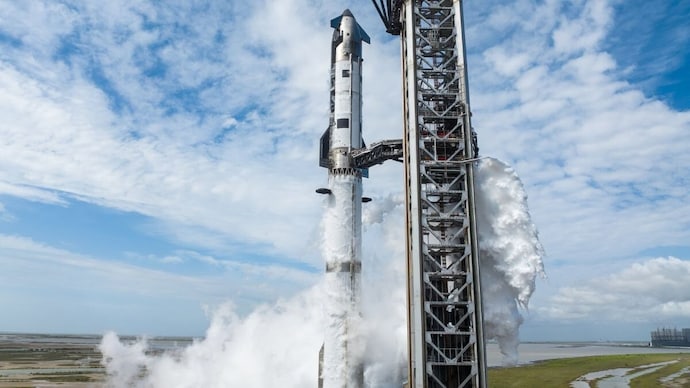
SpaceX aborted the launch of its Starship rocket during the final moments of the countdown early Friday after an automated system halted the mission just as the Super Heavy booster began igniting its 33 engines.
The 13th integrated flight test, one of the company's most ambitious Starship missions yet, was intended to validate key technologies for future lunar and Mars missions.
WATCH SPACEX STARSHIP SUPER HEAVY LAUNCH LIVE
Unlike previous test flights, Flight 13 was set to attempt the first-ever deployment of operational third-generation (V3) Starlink satellites using Starship. The rocket was to release 20 Starlink V3 satellites, which would have extended their solar arrays, deployed communication antennas and attempted to establish laser links with the existing Starlink constellation.
Since this was to be a demonstration mission, the satellites would have remained on the same suborbital trajectory as Starship and were expected to burn up during atmospheric re-entry about 20 minutes after deployment.
Six of the satellites were to carry special cameras that would have photographed Starship's heat shield during flight. Engineers planned to use these images to evaluate the condition of thermal protection tiles after re-entry.
To make the inspection easier, SpaceX had intentionally painted several heat shield tiles white to simulate missing tiles and create visual reference points.
Another major objective was to test a Raptor engine restart in space, a capability essential for future orbital missions, satellite deployment, lunar landings and eventually missions to Mars.
Successfully reigniting the engine would have demonstrated that Starship can perform complex manoeuvres after reaching space.
The mission was also set to test upgraded heat shield technologies, including improved tile attachment methods, metallic heat shield tiles on the aft flaps and instrumented tiles capable of measuring mechanical stresses during ascent and re-entry. These upgrades are aimed at making Starship fully reusable.
On the Super Heavy booster side, SpaceX had hoped to validate improvements made after Flight 12, when five of the booster's Raptor engines failed to relight during the boostback burn.
Engineers had modified engine startup sequences, upgraded hardware and improved onboard fault detection systems to increase reliability.
If successful, the booster was expected to complete launch, stage separation, boostback, landing burn and a controlled splashdown in the Gulf.
For SpaceX, Flight 13 was about much more than a successful launch. It was intended to be another step toward building a fully reusable rocket system capable of dramatically reducing launch costs, deploying larger Starlink satellites, supporting NASA's Artemis lunar programme and eventually transporting humans to Mars.
Each planned objective was expected to bring Starship closer to becoming the backbone of SpaceX's future space transportation system.
SpaceX aborted the launch of its Starship rocket during the final moments of the countdown early Friday after an automated system halted the mission just as the Super Heavy booster began igniting its 33 engines.
The 13th integrated flight test, one of the company's most ambitious Starship missions yet, was intended to validate key technologies for future lunar and Mars missions.
WATCH SPACEX STARSHIP SUPER HEAVY LAUNCH LIVE
Unlike previous test flights, Flight 13 was set to attempt the first-ever deployment of operational third-generation (V3) Starlink satellites using Starship. The rocket was to release 20 Starlink V3 satellites, which would have extended their solar arrays, deployed communication antennas and attempted to establish laser links with the existing Starlink constellation.
Since this was to be a demonstration mission, the satellites would have remained on the same suborbital trajectory as Starship and were expected to burn up during atmospheric re-entry about 20 minutes after deployment.
Six of the satellites were to carry special cameras that would have photographed Starship's heat shield during flight. Engineers planned to use these images to evaluate the condition of thermal protection tiles after re-entry.
To make the inspection easier, SpaceX had intentionally painted several heat shield tiles white to simulate missing tiles and create visual reference points.
Another major objective was to test a Raptor engine restart in space, a capability essential for future orbital missions, satellite deployment, lunar landings and eventually missions to Mars.
Successfully reigniting the engine would have demonstrated that Starship can perform complex manoeuvres after reaching space.
The mission was also set to test upgraded heat shield technologies, including improved tile attachment methods, metallic heat shield tiles on the aft flaps and instrumented tiles capable of measuring mechanical stresses during ascent and re-entry. These upgrades are aimed at making Starship fully reusable.
On the Super Heavy booster side, SpaceX had hoped to validate improvements made after Flight 12, when five of the booster's Raptor engines failed to relight during the boostback burn.
Engineers had modified engine startup sequences, upgraded hardware and improved onboard fault detection systems to increase reliability.
If successful, the booster was expected to complete launch, stage separation, boostback, landing burn and a controlled splashdown in the Gulf.
For SpaceX, Flight 13 was about much more than a successful launch. It was intended to be another step toward building a fully reusable rocket system capable of dramatically reducing launch costs, deploying larger Starlink satellites, supporting NASA's Artemis lunar programme and eventually transporting humans to Mars.
Each planned objective was expected to bring Starship closer to becoming the backbone of SpaceX's future space transportation system.
SpaceX aborted the launch of its Starship rocket during the final moments of the countdown early Friday after an automated system halted the mission just as the Super Heavy booster began igniting its 33 engines.
The 13th integrated flight test, one of the company's most ambitious Starship missions yet, was intended to validate key technologies for future lunar and Mars missions.
WATCH SPACEX STARSHIP SUPER HEAVY LAUNCH LIVE
Unlike previous test flights, Flight 13 was set to attempt the first-ever deployment of operational third-generation (V3) Starlink satellites using Starship. The rocket was to release 20 Starlink V3 satellites, which would have extended their solar arrays, deployed communication antennas and attempted to establish laser links with the existing Starlink constellation.
Since this was to be a demonstration mission, the satellites would have remained on the same suborbital trajectory as Starship and were expected to burn up during atmospheric re-entry about 20 minutes after deployment.
Six of the satellites were to carry special cameras that would have photographed Starship's heat shield during flight. Engineers planned to use these images to evaluate the condition of thermal protection tiles after re-entry.
To make the inspection easier, SpaceX had intentionally painted several heat shield tiles white to simulate missing tiles and create visual reference points.
Another major objective was to test a Raptor engine restart in space, a capability essential for future orbital missions, satellite deployment, lunar landings and eventually missions to Mars.
Successfully reigniting the engine would have demonstrated that Starship can perform complex manoeuvres after reaching space.
The mission was also set to test upgraded heat shield technologies, including improved tile attachment methods, metallic heat shield tiles on the aft flaps and instrumented tiles capable of measuring mechanical stresses during ascent and re-entry. These upgrades are aimed at making Starship fully reusable.
On the Super Heavy booster side, SpaceX had hoped to validate improvements made after Flight 12, when five of the booster's Raptor engines failed to relight during the boostback burn.
Engineers had modified engine startup sequences, upgraded hardware and improved onboard fault detection systems to increase reliability.
If successful, the booster was expected to complete launch, stage separation, boostback, landing burn and a controlled splashdown in the Gulf.
For SpaceX, Flight 13 was about much more than a successful launch. It was intended to be another step toward building a fully reusable rocket system capable of dramatically reducing launch costs, deploying larger Starlink satellites, supporting NASA's Artemis lunar programme and eventually transporting humans to Mars.
Each planned objective was expected to bring Starship closer to becoming the backbone of SpaceX's future space transportation system.

