How Sunil Dutt saved the Bandra slum suburbia, built a Congress vote bank
As Mumbai demolishes slums from Garib Nagar to Goregaon, an old debate has returned. Did Sunil Dutt protect the poor, or help institutionalise Mumbai's slum politics? Here's a look at how Dutt's Partition trauma, Congress's patronage and suburban migration reshaped Bandra, and Mumbai's politics itself.
In the opening scene of the Oscar-winning film Slumdog Millionaire (2008), a group of children sprints barefoot through the labyrinths of Mumbai's slums, darting past garbage, sewage and railway tracks. Among them are two child actors who play the younger versions of the film's lead characters. Those children, Azharuddin Mohammed Ismail and Rubina Ali Qureshi, were cast by director Danny Boyle from Bandra's Garib Nagar, where the British filmmaker spent considerable time while filming the movie.
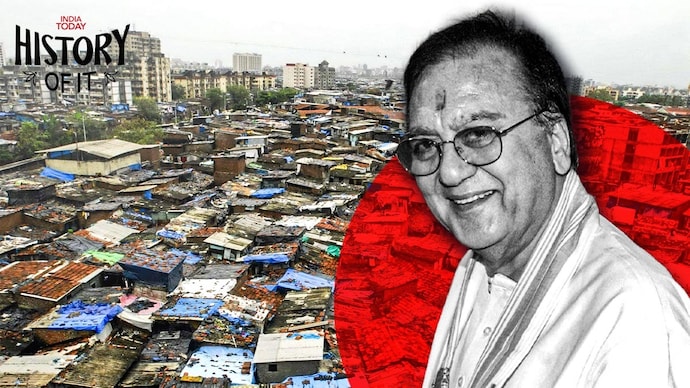
Dharavi and Garib Nagar would eventually become a part of cinema's most cult portrayals of Mumbai's dark underbelly. But the slum cluster had another connection to cinema, one that is far more political. Just a short distance away, in the western suburb of Bandra lived Sunil Dutt. The actor-turned-politician became one of the most influential names in the suburb's slums and protected them from being razed over the decades.
"We were safe only because we voted for Sunil Dutt." The remark, made by a resident of Mumbai's Garib Nagar during the massive demolition drive carried out by the Western Railway in May, captured more than panic. It carried the memory of an older Mumbai, and a leader. Slums already existed in Mumbai in the 1980s, but had not yet expanded into the behemoth-sized sprawl as today, which houses half the population of Maximum City.
Mumbai is like an organism. Its organs are contradictory. Slums, stench, struggle, strongmen, and showbiz, stitched it together. Cinema gave it a soul. And it was a celebrity from cinema who protected the slums in the suburbs of Bandra, leaving the city with a metaphorical scar, even as he offered thousands a chance at survival in the City of Dreams. That man was Sunil Dutt.
The demolition at Garib Nagar in Bandra East — one of the city's most densely packed informal settlements, not far from Dharavi, reopened a debate that had died with the passing of Dutt, a veteran actor and Congress leader.
Reports from the early 2000s suggest that there were times when Dutt would stand before bulldozers, even lie down in front of heavy earthmovers, to stop slums from being razed. He even led marches to the collector's office to stop the razing of slums.
Since his entry into politics in the early 1980s, Dutt was not just a regular Congress MP. For decades, apart from being a film star, he was seen as a protector of slum dwellers, especially in the Bandra suburb. Among the poor, particularly Muslim migrants and slum dwellers, he became something close to a guardian figure.
However, among sections of the middle class in Mumbai, he was often blamed for encouraging encroachments and shielding illegal settlements for electoral gains.
Today, as authorities in Mumbai are going on a demolition drive across slum pockets, from Garib Nagar to Malad and Goregaon, on railway land and infrastructure corridors, the chatter around Dutt's legacy has returned with force.
And nowhere is that legacy more visible than around Bandra Terminus itself, which was built in the early 1990s. The irony is difficult to miss. Mumbai's Bandra Terminus is not actually near the suburban Bandra station, built in 1888. It sits awkwardly deep inside Bandra East, disconnected from the city's main suburban interchange. It is anywhere between 1.5 km to 2.5 km, depending on the route you take.
Urban planners and residents have long argued that the station's far away location was partly the result of decades of slum proliferation and political protection in the surrounding areas, which made expansion around the main Bandra station nearly impossible.
Many directly blame Dutt and the Congress ecosystem around him for allowing the unchecked growth of hutments in Bandra East and Kherwadi, eventually forcing railway infrastructure to be built farther away.
But Dutt's politics was not unidimensional. It came from Partition trauma.
TRAUMA OF PARTITION, AND THE STAR WHO PROTECTED THE GARIB. FOR VOTES?
Sunil Dutt, born Balraj Raghunath Dutt in 1929 in Khurd village (now in Pakistan) in undivided Punjab, carried the scars and lessons of the Partition throughout his life.
Sunil Dutt's family lived in a Muslim-majority area. He lost his father when he was just five. During the upheaval of 1947, it was a Muslim friend of his father who saved his family.
In an interview with Rediff in 2005, Dutt said, "During Partition, my entire family was saved by a Muslim. His name was Yakub — a friend of my father who lived a mile-and-a-half away from our village. He helped us escape to the main city, Jhelum."
That experience, he said, "stayed with him permanently, and the act of humanity shaped his world-view".
The scar of Partition influenced Dutt's politics too. When he entered politics through the Congress party in the 1980s, Mumbai was transforming rapidly. Textile mills were collapsing, migration into the city was surging, and land prices were exploding. The suburbs of Bandra, Khar, Santacruz and Kurla were where migrants found cheaper housing compared to South Mumbai. Slums started proliferating in these suburbs.
It was these suburbs that became Dutt's home ground.
Though Bandra fell within the Mumbai North Central constituency, Sunil Dutt, a Bandra resident himself, wielded enormous influence there. Dutt won five consecutive terms as a Lok Sabha MP from the neighbouring Mumbai North West seat, but his political shadow stretched deep into Bandra and its slum clusters.
Mumbai North Central, a swing constituency, frequently oscillated between the Congress and the Shiv Sena until Dutt's death. From 1984 until 2005, the Congress won the seat four out of seven times in Lok Sabha elections. After Dutt's death, his daughter Priya Dutt went on to win the constituency.
SANJAY DUTT ALSO STUDIED THE SLUMS OF BANDRA
The politics of Mumbai's slums ran so deep within the Dutt household that even Sanjay Dutt, during his short-lived political stint, became a "walking-talking directory" of the city's slums, studying their demographics and electoral weight, according to a 2010 report by The Times of India.
Even today, the seat remains with the Congress, represented by Varsha Gaikwad, who is also known for her work in Dharavi's slums. She has been constantly vocal about Dharavi redevelopment, terming it a "scam".
It is this legacy of Sunil Dutt's intervention in settlements like Garib Nagar that still lingers over Mumbai's suburban politics, especially in Bandra. Dutt's carefully cultivated image as a protector of the poor helped cement a support base in Mumbai's slum clusters, allowing him to repeatedly withstand middle-class anger in the Bandra-Khar-Juhu belt.
For a man who had himself been displaced during Partition and saved by a Muslim family friend, the politics of protection appeared to carry deeply personal meaning.
AFFORDABLE HOUSING HAS BEEN A LONGSTANDING PROBLEM IN MUMBAI
The state has failed miserably to build affordable housing at scale in Mumbai. Into that vacuum emerged the slum-politician nexus. Dutt mastered it better than most.
Unlike the Shiv Sena, which often approached urban politics through sons-of-the-soil identity and aggressive street mobilisation, Dutt cultivated a softer, paternal image. He visited settlements personally, intervened in demolitions, and spoke the language of dignity for the poor.
For many slum residents, especially Muslims after the 1992-93 riots, Dutt became one of the few mainstream leaders they trusted. His relief work during the riots and later during the 1993 bomb blasts significantly strengthened that bond.
An India Today Magazine report from January 1993 mentions that Sunil Dutt compared the Babri Masjid riots in Mumbai with his own experience in 1947.
But critics argued that humanitarian politics gradually turned into vote-bank politics.
A 2004 report in The Times of India captured the resentment brewing among middle-class and affluent residents in the suburbs. People have long complained that their multi-million homes offered sweeping views of the sea, but also an eyesore of the sprawling slums before it.
Citizens' groups accused Dutt of focussing almost exclusively on slum dwellers while ignoring illegal encroachments, vanishing public spaces and collapsing civic infrastructure, said a 2004 report in The Times of India.
Activists complained that gardens, pavements and open plots were being overtaken. Residents accused Congress workers of looking away as illegal structures mushroomed across Bandra and Khar. Dutt's critics argue, even today, that every election only deepened the political incentive to protect hutments rather than regulate them. Long before the recent Garib Nagar demolitions, posts on X routinely blamed Sunil Dutt for the unchecked proliferation of slums in upscale suburbs like Bandra, with similar accusations surfacing repeatedly in posts from 2019 and 2020.
Yet, Dutt rarely apologised for his approach.
In fact, Dutt himself led a morcha of slum dwellers to the Bandra collector's office, demanding protection for hutments built on central government land, including land owned by the Airports Authority of India, according to a report in The Times of India from 2005.
At the time, airport authorities wanted settlements near the runway cleared, arguing they posed a serious security threat.
Dutt, instead, demanded that demolitions stop until residents were given photo passes and rehabilitation protections.
To supporters, it was compassion. To critics, it was populism.
But the political arithmetic behind it was undeniable.
DID SUNIL DUTT INSTITUTIONALISE POLITICS OF SLUMS IN MUMBAI?
By the 1990s and early 2000s, politicians started depending heavily on slum clusters. Settlements across Bandra East, Behrampada, Kherwadi, Garib Nagar and Vakola became crucial Congress strongholds.
Local leaders like Baba Siddique, and later Priya Dutt, inherited the vote bank.
Baba Siddique, who emerged as one of Mumbai Congress's most influential Muslim faces, built a powerful grassroots machinery across Bandra's informal settlements. His political style mirrored Dutt's. He had hyper-local access, constantly intervened in civic disputes like Slum Rehabilitation Authority projects, and directly engaged with slum communities. Even after the Congress weakened elsewhere in Mumbai, these pockets have remained electorally loyal.
After Dutt's death in 2005, his daughter Priya Dutt retained substantial support among slum populations, especially among Muslim and lower-income voters in Bandra East and adjoining areas. Like her father, she often positioned herself as an accessible MP focused on rehabilitation and welfare.
The politics worked. But Mumbai kept paying the price. Garib Nagar was a prime example of this strategy.
Situated beside the Bandra railway tracks and squeezed between transport corridors, the settlement grew over decades into a dense urban maze. Residents worked across the city's informal economy — tailoring, domestic work, driving, vending, construction labour. Many families had lived there for generations.
But basic infrastructure lagged behind. Drainage remained poor. Fires were frequent. Access roads stayed narrow. Rehabilitation promises moved slowly. More importantly, demolition threats constantly hovered.
Slum politics normalised this strange arrangement.
Even Nargis Dutt Nagar, named after Sunil Dutt's actor wife Nargis, reflected this politics. The settlement's very name carried the aura of the Dutt family, but it is one of the most terrible places to live in Mumbai.
The slum residents are trapped between two eras. Of protection, and demolition.
Older residents still remember Sunil Dutt, who protected them. Younger residents face a city that speaks the language of redevelopment and land recovery.
In the opening scene of the Oscar-winning film Slumdog Millionaire (2008), a group of children sprints barefoot through the labyrinths of Mumbai's slums, darting past garbage, sewage and railway tracks. Among them are two child actors who play the younger versions of the film's lead characters. Those children, Azharuddin Mohammed Ismail and Rubina Ali Qureshi, were cast by director Danny Boyle from Bandra's Garib Nagar, where the British filmmaker spent considerable time while filming the movie.
Dharavi and Garib Nagar would eventually become a part of cinema's most cult portrayals of Mumbai's dark underbelly. But the slum cluster had another connection to cinema, one that is far more political. Just a short distance away, in the western suburb of Bandra lived Sunil Dutt. The actor-turned-politician became one of the most influential names in the suburb's slums and protected them from being razed over the decades.
"We were safe only because we voted for Sunil Dutt." The remark, made by a resident of Mumbai's Garib Nagar during the massive demolition drive carried out by the Western Railway in May, captured more than panic. It carried the memory of an older Mumbai, and a leader. Slums already existed in Mumbai in the 1980s, but had not yet expanded into the behemoth-sized sprawl as today, which houses half the population of Maximum City.
Mumbai is like an organism. Its organs are contradictory. Slums, stench, struggle, strongmen, and showbiz, stitched it together. Cinema gave it a soul. And it was a celebrity from cinema who protected the slums in the suburbs of Bandra, leaving the city with a metaphorical scar, even as he offered thousands a chance at survival in the City of Dreams. That man was Sunil Dutt.
The demolition at Garib Nagar in Bandra East — one of the city's most densely packed informal settlements, not far from Dharavi, reopened a debate that had died with the passing of Dutt, a veteran actor and Congress leader.
Reports from the early 2000s suggest that there were times when Dutt would stand before bulldozers, even lie down in front of heavy earthmovers, to stop slums from being razed. He even led marches to the collector's office to stop the razing of slums.
Since his entry into politics in the early 1980s, Dutt was not just a regular Congress MP. For decades, apart from being a film star, he was seen as a protector of slum dwellers, especially in the Bandra suburb. Among the poor, particularly Muslim migrants and slum dwellers, he became something close to a guardian figure.
However, among sections of the middle class in Mumbai, he was often blamed for encouraging encroachments and shielding illegal settlements for electoral gains.
Today, as authorities in Mumbai are going on a demolition drive across slum pockets, from Garib Nagar to Malad and Goregaon, on railway land and infrastructure corridors, the chatter around Dutt's legacy has returned with force.
And nowhere is that legacy more visible than around Bandra Terminus itself, which was built in the early 1990s. The irony is difficult to miss. Mumbai's Bandra Terminus is not actually near the suburban Bandra station, built in 1888. It sits awkwardly deep inside Bandra East, disconnected from the city's main suburban interchange. It is anywhere between 1.5 km to 2.5 km, depending on the route you take.
Urban planners and residents have long argued that the station's far away location was partly the result of decades of slum proliferation and political protection in the surrounding areas, which made expansion around the main Bandra station nearly impossible.
Many directly blame Dutt and the Congress ecosystem around him for allowing the unchecked growth of hutments in Bandra East and Kherwadi, eventually forcing railway infrastructure to be built farther away.
But Dutt's politics was not unidimensional. It came from Partition trauma.
TRAUMA OF PARTITION, AND THE STAR WHO PROTECTED THE GARIB. FOR VOTES?
Sunil Dutt, born Balraj Raghunath Dutt in 1929 in Khurd village (now in Pakistan) in undivided Punjab, carried the scars and lessons of the Partition throughout his life.
Sunil Dutt's family lived in a Muslim-majority area. He lost his father when he was just five. During the upheaval of 1947, it was a Muslim friend of his father who saved his family.
In an interview with Rediff in 2005, Dutt said, "During Partition, my entire family was saved by a Muslim. His name was Yakub — a friend of my father who lived a mile-and-a-half away from our village. He helped us escape to the main city, Jhelum."
That experience, he said, "stayed with him permanently, and the act of humanity shaped his world-view".
The scar of Partition influenced Dutt's politics too. When he entered politics through the Congress party in the 1980s, Mumbai was transforming rapidly. Textile mills were collapsing, migration into the city was surging, and land prices were exploding. The suburbs of Bandra, Khar, Santacruz and Kurla were where migrants found cheaper housing compared to South Mumbai. Slums started proliferating in these suburbs.
It was these suburbs that became Dutt's home ground.
Though Bandra fell within the Mumbai North Central constituency, Sunil Dutt, a Bandra resident himself, wielded enormous influence there. Dutt won five consecutive terms as a Lok Sabha MP from the neighbouring Mumbai North West seat, but his political shadow stretched deep into Bandra and its slum clusters.
Mumbai North Central, a swing constituency, frequently oscillated between the Congress and the Shiv Sena until Dutt's death. From 1984 until 2005, the Congress won the seat four out of seven times in Lok Sabha elections. After Dutt's death, his daughter Priya Dutt went on to win the constituency.
SANJAY DUTT ALSO STUDIED THE SLUMS OF BANDRA
The politics of Mumbai's slums ran so deep within the Dutt household that even Sanjay Dutt, during his short-lived political stint, became a "walking-talking directory" of the city's slums, studying their demographics and electoral weight, according to a 2010 report by The Times of India.
Even today, the seat remains with the Congress, represented by Varsha Gaikwad, who is also known for her work in Dharavi's slums. She has been constantly vocal about Dharavi redevelopment, terming it a "scam".
It is this legacy of Sunil Dutt's intervention in settlements like Garib Nagar that still lingers over Mumbai's suburban politics, especially in Bandra. Dutt's carefully cultivated image as a protector of the poor helped cement a support base in Mumbai's slum clusters, allowing him to repeatedly withstand middle-class anger in the Bandra-Khar-Juhu belt.
For a man who had himself been displaced during Partition and saved by a Muslim family friend, the politics of protection appeared to carry deeply personal meaning.
AFFORDABLE HOUSING HAS BEEN A LONGSTANDING PROBLEM IN MUMBAI
The state has failed miserably to build affordable housing at scale in Mumbai. Into that vacuum emerged the slum-politician nexus. Dutt mastered it better than most.
Unlike the Shiv Sena, which often approached urban politics through sons-of-the-soil identity and aggressive street mobilisation, Dutt cultivated a softer, paternal image. He visited settlements personally, intervened in demolitions, and spoke the language of dignity for the poor.
For many slum residents, especially Muslims after the 1992-93 riots, Dutt became one of the few mainstream leaders they trusted. His relief work during the riots and later during the 1993 bomb blasts significantly strengthened that bond.
An India Today Magazine report from January 1993 mentions that Sunil Dutt compared the Babri Masjid riots in Mumbai with his own experience in 1947.
But critics argued that humanitarian politics gradually turned into vote-bank politics.
A 2004 report in The Times of India captured the resentment brewing among middle-class and affluent residents in the suburbs. People have long complained that their multi-million homes offered sweeping views of the sea, but also an eyesore of the sprawling slums before it.
Citizens' groups accused Dutt of focussing almost exclusively on slum dwellers while ignoring illegal encroachments, vanishing public spaces and collapsing civic infrastructure, said a 2004 report in The Times of India.
Activists complained that gardens, pavements and open plots were being overtaken. Residents accused Congress workers of looking away as illegal structures mushroomed across Bandra and Khar. Dutt's critics argue, even today, that every election only deepened the political incentive to protect hutments rather than regulate them. Long before the recent Garib Nagar demolitions, posts on X routinely blamed Sunil Dutt for the unchecked proliferation of slums in upscale suburbs like Bandra, with similar accusations surfacing repeatedly in posts from 2019 and 2020.
Yet, Dutt rarely apologised for his approach.
In fact, Dutt himself led a morcha of slum dwellers to the Bandra collector's office, demanding protection for hutments built on central government land, including land owned by the Airports Authority of India, according to a report in The Times of India from 2005.
At the time, airport authorities wanted settlements near the runway cleared, arguing they posed a serious security threat.
Dutt, instead, demanded that demolitions stop until residents were given photo passes and rehabilitation protections.
To supporters, it was compassion. To critics, it was populism.
But the political arithmetic behind it was undeniable.
DID SUNIL DUTT INSTITUTIONALISE POLITICS OF SLUMS IN MUMBAI?
By the 1990s and early 2000s, politicians started depending heavily on slum clusters. Settlements across Bandra East, Behrampada, Kherwadi, Garib Nagar and Vakola became crucial Congress strongholds.
Local leaders like Baba Siddique, and later Priya Dutt, inherited the vote bank.
Baba Siddique, who emerged as one of Mumbai Congress's most influential Muslim faces, built a powerful grassroots machinery across Bandra's informal settlements. His political style mirrored Dutt's. He had hyper-local access, constantly intervened in civic disputes like Slum Rehabilitation Authority projects, and directly engaged with slum communities. Even after the Congress weakened elsewhere in Mumbai, these pockets have remained electorally loyal.
After Dutt's death in 2005, his daughter Priya Dutt retained substantial support among slum populations, especially among Muslim and lower-income voters in Bandra East and adjoining areas. Like her father, she often positioned herself as an accessible MP focused on rehabilitation and welfare.
The politics worked. But Mumbai kept paying the price. Garib Nagar was a prime example of this strategy.
Situated beside the Bandra railway tracks and squeezed between transport corridors, the settlement grew over decades into a dense urban maze. Residents worked across the city's informal economy — tailoring, domestic work, driving, vending, construction labour. Many families had lived there for generations.
But basic infrastructure lagged behind. Drainage remained poor. Fires were frequent. Access roads stayed narrow. Rehabilitation promises moved slowly. More importantly, demolition threats constantly hovered.
Slum politics normalised this strange arrangement.
Even Nargis Dutt Nagar, named after Sunil Dutt's actor wife Nargis, reflected this politics. The settlement's very name carried the aura of the Dutt family, but it is one of the most terrible places to live in Mumbai.
The slum residents are trapped between two eras. Of protection, and demolition.
Older residents still remember Sunil Dutt, who protected them. Younger residents face a city that speaks the language of redevelopment and land recovery.

