On the temple trail in Goa
Goa's origins are steeped in divinity, and its magnificent temples showcase a facet of the state often overlooked by tourists
Goa has long been fabled as the land of sun and sea, the proverbial melting pot marked by an intermingling of cultures. What many do not know is that the beginnings of Goa, locally termed as Goemkarponn, is deeply rooted in divinity. According to mythology, Parashuram, the warrior-sage and the sixth avatar of Lord Vishnu, created the Sahyadri range by throwing his divine axe (parashu) to reclaim land from the sea. This act of the sage created the entire western coast, known as the Konkan belt, with Goa (Gomantak) being a significant part of it.
Thus, legend has it that Goa is Parashuram Bhoomi, a sacred land created by a divine figure. To sanctify the land, Parashuram apparently invited a few Brahmin families to settle there, initiating religious practices and temple traditions that continue to this day.
The country’s smallest state has hundreds of temples in the various traditions of Hinduism. The Goa tourism department has of late started an ‘Ekadasha Teertha’, or ‘Eleven Places of Transformation’, a spiritual pilgrimage circuit featuring 11 significant temples that reflect the state’s rich spiritual heritage. The initiative aims to promote spiritual and regenerative tourism by offering tourists a deeper connection to the local culture, history and spiritual traditions. Here are the five most prominent temples in Goa.
MANGESHI TEMPLE
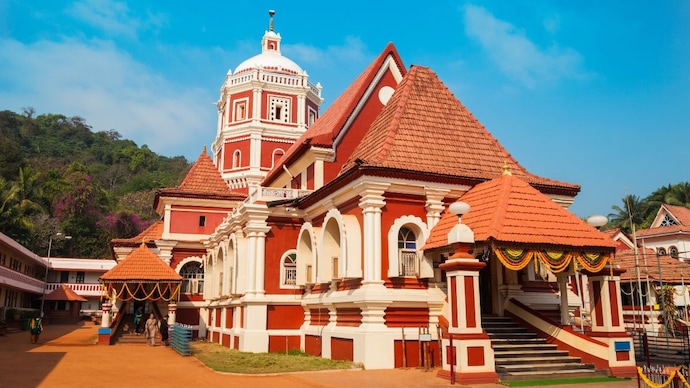
One of the oldest temples in the Gomantak region, the Mangeshi Temple (also called Mangueshi) dedicated to Lord Manguesh (pictured above), an incarnation of Lord Shiva, was originally located in Kushastali (Cortalim). It shifted to Mangeshi village in the mid-16th century following Portuguese persecution. The temple’s architecture is an Indo-Portuguese melange, with Goan baroque as well as Dravidian elements. It is famed for its seven-storeyed deepastambha (lamp column) and holy water tank.
Where: Dinanath Mangeshkar Road, Mangeshi Village, Ponda, Mardol
Main event: Annual Magh Purnima Jatra, a three-day festival held in February
SHANTA DURGA TEMPLE, Ponda
Originally based in Keloshi, the Shri Shantadurga Mandir moved to its present location in Kavlem in the 18th century much after the Portuguese destroyed the original temple in 1566. Dedicated to goddess Durga, the temple also has Lord Shiva and Lord Vishnu as part of the reigning deities. According to legend, Durga acted as a peacekeeper between Shiva and Vishnu during their quarrel. The temple, also known as the Shree Shantadurga Saunsthan, was built in the Saraswat style of architecture but incorporates many Portuguese features—there are shikharas jutting out of the roof of the building, a distinct identifier of some Hindu temples, as well as stained-glass panes on arched windows, a characteristic of Goan churches.
Where: Kapileswari-Kavlem Road, Donshiwado, Ponda
Main event: Annual Shantadurga Kavlem Temple Jatra (held in January or February)
MAHADEV TEMPLE in Tambdi Surla
Located in a small clearing in the forest at the foothills of the scenic mountain pass, Anmod Ghat, this 12th-century Mahadev Temple at Tambdi Surla was built by the Kadamba dynasty and is the only surviving specimen of the Kadamba-Yadava architecture. The temple gets its name from the red (Tambdi) soil and rocks present around it and the Surla River flowing near the temple. The temple is a nirandhara (no pradakshina path or circumambulation) temple facing east and is also known for its slanting roof and 10 pillars in Mukhamandapa. The temple is an Archaeological Survey of India (ASI)-protected monument.
Where: Near Bhagwan Mahavir Wildlife Sanctuary, Tambdi Surla, Sanguem, South Goa
Main event: Mahashivratri (usually held in February)
SHRI SAPTAKOTESHWAR TEMPLE
Dedicated to Lord Shiva, it is considered to be one of the six great Shaivite temples in the Konkan region. Saptakoteshwar, a version of Shiva, was one of the chief deities of the kings of the Kadamba dynasty. It was built around the 12th century by the king for his wife Kamaldevi, a staunch Shiva devotee. According to folklore, Shri Krishna is said to have worshipped at the temple during the Dvapara Yuga. It is after worshipping Lord Shiva here that Krishna went on to establish his kingdom at Dwarka.
Where: Temple Road, Narve, Maem
Main event: Gokulashtami (Janmashtami)
LAIRAI TEMPLE
Dedicated to goddess Lairai, who is believed to be an incarnation of goddess Parvati, the temple is a symbol of religious harmony, with local Hindus and Catholics regarding Lairai Devi and the Virgin Mary of Mapusa as divine sisters. The Lairai Temple Trail is at the heart of the folklore about the ‘Seven Sisters and a Brother’ who arrived in Goa riding an elephant. The temple trail consists of Lairai in Shirgaon, Kelbai in Mulgaon, Mahamayi in Mayem, Mirabai or Mirabalis in Mapusa, Morjai in Morjim, Ajidipa at Anjidipa Island near Karwar (no temple remains now) and the Shitlai who went to pataal (the netherworld) and has no temple dedicated to her. On the side of the temple is a 240-year-old painting of Devi in which she is depicted as a woman wearing a green sari within the confines of a kalash (sacred pot). The temple architecture is a combination of the northern and southern styles.
Where: Shirgao, Bicholim, North Goa
Main event: Lairai Jatra, also known as Shirgao Jatra, usually held in early May
MUST-SEE: 77 FT STATUE OF LORD RAM in South Goa
Head to South Goa to see the 77foot bronze statue of Lord Ram at the Shree Samsthan Gokarn Partagali Jeevottam Math in Partagali. The statue was installed to mark the 550th year celebration of the Math of the Gaud Saraswat Brahmins.
MUST-SEE: PARASHURAM, The creator of Goa
A large statue of Lord Parashuram, known as Gomantbhumi Janak Parashuram, stands tall in Campal, Panjim (near the Mandovi river), celebrating him as the creator of Goa. You can also visit the Parashuram Temple in Poinguinim village (Canacona taluka).
KAAVI ART
Goa’s oldest storytelling tradition, it is etched into its temples, churches and homes. The ancient mural art—made using a unique blend of lime and laterite—is native to the Konkan region and depicts mythological stories from the Ramayana and Mahabharata.
Subscribe to India Today Magazine
Goa has long been fabled as the land of sun and sea, the proverbial melting pot marked by an intermingling of cultures. What many do not know is that the beginnings of Goa, locally termed as Goemkarponn, is deeply rooted in divinity. According to mythology, Parashuram, the warrior-sage and the sixth avatar of Lord Vishnu, created the Sahyadri range by throwing his divine axe (parashu) to reclaim land from the sea. This act of the sage created the entire western coast, known as the Konkan belt, with Goa (Gomantak) being a significant part of it.
Thus, legend has it that Goa is Parashuram Bhoomi, a sacred land created by a divine figure. To sanctify the land, Parashuram apparently invited a few Brahmin families to settle there, initiating religious practices and temple traditions that continue to this day.
The country’s smallest state has hundreds of temples in the various traditions of Hinduism. The Goa tourism department has of late started an ‘Ekadasha Teertha’, or ‘Eleven Places of Transformation’, a spiritual pilgrimage circuit featuring 11 significant temples that reflect the state’s rich spiritual heritage. The initiative aims to promote spiritual and regenerative tourism by offering tourists a deeper connection to the local culture, history and spiritual traditions. Here are the five most prominent temples in Goa.
MANGESHI TEMPLE
One of the oldest temples in the Gomantak region, the Mangeshi Temple (also called Mangueshi) dedicated to Lord Manguesh (pictured above), an incarnation of Lord Shiva, was originally located in Kushastali (Cortalim). It shifted to Mangeshi village in the mid-16th century following Portuguese persecution. The temple’s architecture is an Indo-Portuguese melange, with Goan baroque as well as Dravidian elements. It is famed for its seven-storeyed deepastambha (lamp column) and holy water tank.
Where: Dinanath Mangeshkar Road, Mangeshi Village, Ponda, Mardol
Main event: Annual Magh Purnima Jatra, a three-day festival held in February
SHANTA DURGA TEMPLE, Ponda
Originally based in Keloshi, the Shri Shantadurga Mandir moved to its present location in Kavlem in the 18th century much after the Portuguese destroyed the original temple in 1566. Dedicated to goddess Durga, the temple also has Lord Shiva and Lord Vishnu as part of the reigning deities. According to legend, Durga acted as a peacekeeper between Shiva and Vishnu during their quarrel. The temple, also known as the Shree Shantadurga Saunsthan, was built in the Saraswat style of architecture but incorporates many Portuguese features—there are shikharas jutting out of the roof of the building, a distinct identifier of some Hindu temples, as well as stained-glass panes on arched windows, a characteristic of Goan churches.
Where: Kapileswari-Kavlem Road, Donshiwado, Ponda
Main event: Annual Shantadurga Kavlem Temple Jatra (held in January or February)
MAHADEV TEMPLE in Tambdi Surla
Located in a small clearing in the forest at the foothills of the scenic mountain pass, Anmod Ghat, this 12th-century Mahadev Temple at Tambdi Surla was built by the Kadamba dynasty and is the only surviving specimen of the Kadamba-Yadava architecture. The temple gets its name from the red (Tambdi) soil and rocks present around it and the Surla River flowing near the temple. The temple is a nirandhara (no pradakshina path or circumambulation) temple facing east and is also known for its slanting roof and 10 pillars in Mukhamandapa. The temple is an Archaeological Survey of India (ASI)-protected monument.
Where: Near Bhagwan Mahavir Wildlife Sanctuary, Tambdi Surla, Sanguem, South Goa
Main event: Mahashivratri (usually held in February)
SHRI SAPTAKOTESHWAR TEMPLE
Dedicated to Lord Shiva, it is considered to be one of the six great Shaivite temples in the Konkan region. Saptakoteshwar, a version of Shiva, was one of the chief deities of the kings of the Kadamba dynasty. It was built around the 12th century by the king for his wife Kamaldevi, a staunch Shiva devotee. According to folklore, Shri Krishna is said to have worshipped at the temple during the Dvapara Yuga. It is after worshipping Lord Shiva here that Krishna went on to establish his kingdom at Dwarka.
Where: Temple Road, Narve, Maem
Main event: Gokulashtami (Janmashtami)
LAIRAI TEMPLE
Dedicated to goddess Lairai, who is believed to be an incarnation of goddess Parvati, the temple is a symbol of religious harmony, with local Hindus and Catholics regarding Lairai Devi and the Virgin Mary of Mapusa as divine sisters. The Lairai Temple Trail is at the heart of the folklore about the ‘Seven Sisters and a Brother’ who arrived in Goa riding an elephant. The temple trail consists of Lairai in Shirgaon, Kelbai in Mulgaon, Mahamayi in Mayem, Mirabai or Mirabalis in Mapusa, Morjai in Morjim, Ajidipa at Anjidipa Island near Karwar (no temple remains now) and the Shitlai who went to pataal (the netherworld) and has no temple dedicated to her. On the side of the temple is a 240-year-old painting of Devi in which she is depicted as a woman wearing a green sari within the confines of a kalash (sacred pot). The temple architecture is a combination of the northern and southern styles.
Where: Shirgao, Bicholim, North Goa
Main event: Lairai Jatra, also known as Shirgao Jatra, usually held in early May
MUST-SEE: 77 FT STATUE OF LORD RAM in South Goa
Head to South Goa to see the 77foot bronze statue of Lord Ram at the Shree Samsthan Gokarn Partagali Jeevottam Math in Partagali. The statue was installed to mark the 550th year celebration of the Math of the Gaud Saraswat Brahmins.
MUST-SEE: PARASHURAM, The creator of Goa
A large statue of Lord Parashuram, known as Gomantbhumi Janak Parashuram, stands tall in Campal, Panjim (near the Mandovi river), celebrating him as the creator of Goa. You can also visit the Parashuram Temple in Poinguinim village (Canacona taluka).
KAAVI ART
Goa’s oldest storytelling tradition, it is etched into its temples, churches and homes. The ancient mural art—made using a unique blend of lime and laterite—is native to the Konkan region and depicts mythological stories from the Ramayana and Mahabharata.
Subscribe to India Today Magazine
Goa has long been fabled as the land of sun and sea, the proverbial melting pot marked by an intermingling of cultures. What many do not know is that the beginnings of Goa, locally termed as Goemkarponn, is deeply rooted in divinity. According to mythology, Parashuram, the warrior-sage and the sixth avatar of Lord Vishnu, created the Sahyadri range by throwing his divine axe (parashu) to reclaim land from the sea. This act of the sage created the entire western coast, known as the Konkan belt, with Goa (Gomantak) being a significant part of it.
Thus, legend has it that Goa is Parashuram Bhoomi, a sacred land created by a divine figure. To sanctify the land, Parashuram apparently invited a few Brahmin families to settle there, initiating religious practices and temple traditions that continue to this day.
The country’s smallest state has hundreds of temples in the various traditions of Hinduism. The Goa tourism department has of late started an ‘Ekadasha Teertha’, or ‘Eleven Places of Transformation’, a spiritual pilgrimage circuit featuring 11 significant temples that reflect the state’s rich spiritual heritage. The initiative aims to promote spiritual and regenerative tourism by offering tourists a deeper connection to the local culture, history and spiritual traditions. Here are the five most prominent temples in Goa.
MANGESHI TEMPLE
One of the oldest temples in the Gomantak region, the Mangeshi Temple (also called Mangueshi) dedicated to Lord Manguesh (pictured above), an incarnation of Lord Shiva, was originally located in Kushastali (Cortalim). It shifted to Mangeshi village in the mid-16th century following Portuguese persecution. The temple’s architecture is an Indo-Portuguese melange, with Goan baroque as well as Dravidian elements. It is famed for its seven-storeyed deepastambha (lamp column) and holy water tank.
Where: Dinanath Mangeshkar Road, Mangeshi Village, Ponda, Mardol
Main event: Annual Magh Purnima Jatra, a three-day festival held in February
SHANTA DURGA TEMPLE, Ponda
Originally based in Keloshi, the Shri Shantadurga Mandir moved to its present location in Kavlem in the 18th century much after the Portuguese destroyed the original temple in 1566. Dedicated to goddess Durga, the temple also has Lord Shiva and Lord Vishnu as part of the reigning deities. According to legend, Durga acted as a peacekeeper between Shiva and Vishnu during their quarrel. The temple, also known as the Shree Shantadurga Saunsthan, was built in the Saraswat style of architecture but incorporates many Portuguese features—there are shikharas jutting out of the roof of the building, a distinct identifier of some Hindu temples, as well as stained-glass panes on arched windows, a characteristic of Goan churches.
Where: Kapileswari-Kavlem Road, Donshiwado, Ponda
Main event: Annual Shantadurga Kavlem Temple Jatra (held in January or February)
MAHADEV TEMPLE in Tambdi Surla
Located in a small clearing in the forest at the foothills of the scenic mountain pass, Anmod Ghat, this 12th-century Mahadev Temple at Tambdi Surla was built by the Kadamba dynasty and is the only surviving specimen of the Kadamba-Yadava architecture. The temple gets its name from the red (Tambdi) soil and rocks present around it and the Surla River flowing near the temple. The temple is a nirandhara (no pradakshina path or circumambulation) temple facing east and is also known for its slanting roof and 10 pillars in Mukhamandapa. The temple is an Archaeological Survey of India (ASI)-protected monument.
Where: Near Bhagwan Mahavir Wildlife Sanctuary, Tambdi Surla, Sanguem, South Goa
Main event: Mahashivratri (usually held in February)
SHRI SAPTAKOTESHWAR TEMPLE
Dedicated to Lord Shiva, it is considered to be one of the six great Shaivite temples in the Konkan region. Saptakoteshwar, a version of Shiva, was one of the chief deities of the kings of the Kadamba dynasty. It was built around the 12th century by the king for his wife Kamaldevi, a staunch Shiva devotee. According to folklore, Shri Krishna is said to have worshipped at the temple during the Dvapara Yuga. It is after worshipping Lord Shiva here that Krishna went on to establish his kingdom at Dwarka.
Where: Temple Road, Narve, Maem
Main event: Gokulashtami (Janmashtami)
LAIRAI TEMPLE
Dedicated to goddess Lairai, who is believed to be an incarnation of goddess Parvati, the temple is a symbol of religious harmony, with local Hindus and Catholics regarding Lairai Devi and the Virgin Mary of Mapusa as divine sisters. The Lairai Temple Trail is at the heart of the folklore about the ‘Seven Sisters and a Brother’ who arrived in Goa riding an elephant. The temple trail consists of Lairai in Shirgaon, Kelbai in Mulgaon, Mahamayi in Mayem, Mirabai or Mirabalis in Mapusa, Morjai in Morjim, Ajidipa at Anjidipa Island near Karwar (no temple remains now) and the Shitlai who went to pataal (the netherworld) and has no temple dedicated to her. On the side of the temple is a 240-year-old painting of Devi in which she is depicted as a woman wearing a green sari within the confines of a kalash (sacred pot). The temple architecture is a combination of the northern and southern styles.
Where: Shirgao, Bicholim, North Goa
Main event: Lairai Jatra, also known as Shirgao Jatra, usually held in early May
MUST-SEE: 77 FT STATUE OF LORD RAM in South Goa
Head to South Goa to see the 77foot bronze statue of Lord Ram at the Shree Samsthan Gokarn Partagali Jeevottam Math in Partagali. The statue was installed to mark the 550th year celebration of the Math of the Gaud Saraswat Brahmins.
MUST-SEE: PARASHURAM, The creator of Goa
A large statue of Lord Parashuram, known as Gomantbhumi Janak Parashuram, stands tall in Campal, Panjim (near the Mandovi river), celebrating him as the creator of Goa. You can also visit the Parashuram Temple in Poinguinim village (Canacona taluka).
KAAVI ART
Goa’s oldest storytelling tradition, it is etched into its temples, churches and homes. The ancient mural art—made using a unique blend of lime and laterite—is native to the Konkan region and depicts mythological stories from the Ramayana and Mahabharata.
Subscribe to India Today Magazine

