- Tamilakam drew its own map: Part 4
- Name Games: Part 5
- Empires, Elites & Europeans: Part 6
- Dravida to Dravidian: Part 7
- The Caldwell Conundrum: Part 8
- Pundit's Paradoxical Passion: Part 9
- Gods, Kings & Grammar: Part 10
- Tolkappiyar: Part 11
- Valluvar: Part 12
- T’rupparam-Kundram: Part 13
- Epic Clash of Faiths: Part 14
- Tamilakam's Epic Counter: Part 15
- Vaishnavism: Part 16
- Tamil and Sanskrit: Part 17
- Anti-Brahminism: Part 18
- Rise & Rifts Part 19
- Bearded Beginning Part 20
- Alliances & Animosities Part 21
- The Thundering Thandhai Part 22
- Shadows and Succession Part 23
- Anna Arch Part 24
- Agitation Alchemy Part 25
- Anna’s CM Crown Part 26
- The Tricolour Twilight: Part 27
- Karunanidhi’s Coronation: Part 28
- Era of Scams & Defiance: Part 29
- Maximum Guarantee Ramachandran: Part 30
- MGR's 'Thottam' Theatre: Part 31
- The Second Show: Part 32
- Accord, Acrimony, Assaults: Part 33
- DMK’s Tiger-Riding: Part 34
- Jayalalithaa’s Crown: Part 35
- The JJ Juggernaut: Part 36
- Karunanidhi Springs: Part 37
- Role Reversal: Part 38
- Mercury Rises in Poes: Part 39
- Amma’s Comeback: Part 40
- An Arresting Personality: Part 41
- Sandalwood Sunset: Part 42
- Back to Future: Part 43
- Thirumangalam: Part 44
- Sangam, Spectrum: Part 45
- The Lady’s Challenge: Part 46
- Jayalalithaa’s Arc: Part 47
- Kalaignar’s Tryst with Tomb: Part 48
- Dravidian Defiance: Part 49
- Tamil Nadu Through Time: Part 50
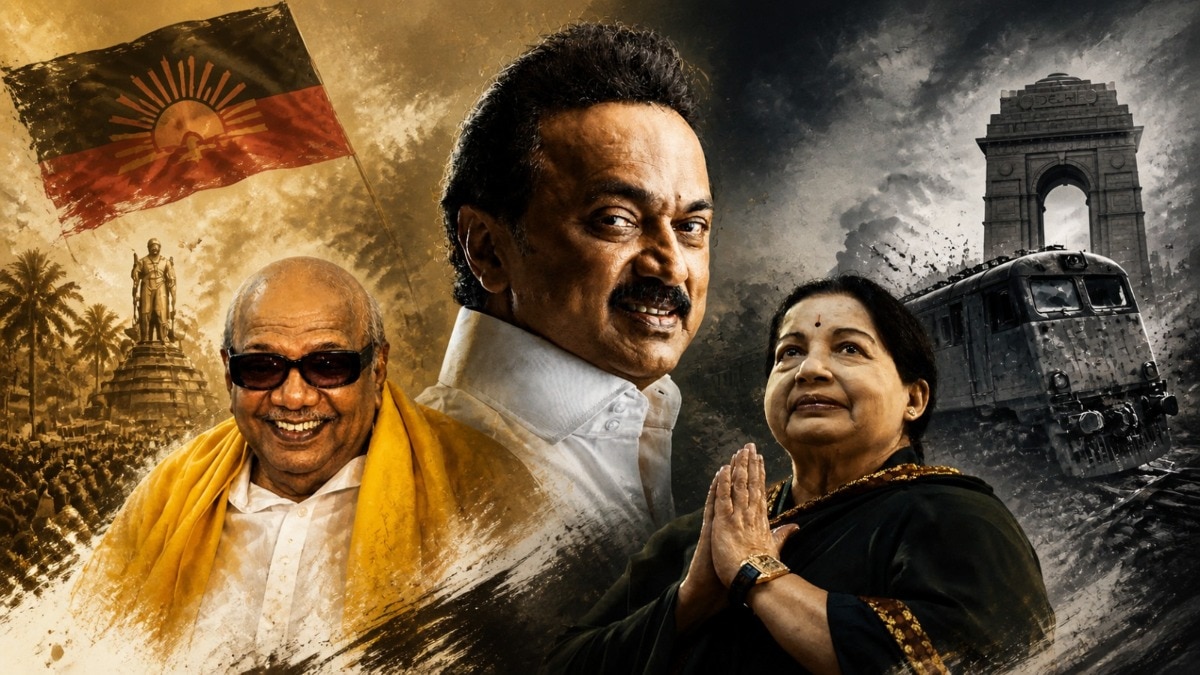
Dravidian Defiance, Delhi's Derailed Dreams
After Karunanidhi was laid to rest on the Marina in August 2018, Tamil Nadu did not merely close a political chapter; it folded away an entire grammar of public life. Within less than two years, both towering figures who had defined the state’s modern imagination—Jayalalithaa and Karunanidhi—had passed into memory. What followed was not collapse, but recalibration: a long, uneven transition from command to continuity, from personality to process, from political theatre to managerial endurance.
It was a period where the high-decibel drama of the titans was replaced by the low-frequency hum of administrative machinery. The state had lived for decades under leaders who were institutions unto themselves. It would now learn to operate under leaders who had to build those institutions again. The era of the solitary oak was over; the season of the collective orchard had begun.
Stalin Slows the Tempo

For MK Stalin, the transition from heir to head was neither dramatic nor accidental. It had been prepared over decades of waiting, apprenticeship and quiet positioning. If Karunanidhi had been a master of improvisation — a political virtuoso equally at ease in celluloid, literature and legislative combat — Stalin represented a different political temperament altogether. He was the quintessential waiter at the feast who had finally been handed the chair, but he brought with him a menu of method rather than a script of magic.
His style was deliberate. Meetings were structured. Messaging was controlled. Party functionaries found themselves operating within systems rather than moods. Where Karunanidhi could pivot an entire narrative with a sharp phrase or a lyrical leap, Stalin preferred to construct it over time, through repetition and administrative reinforcement. This was the arrival of the bureaucratic baritone in a land accustomed to the operatic tenor.
It was not charisma in the traditional Dravidian mould, but clinical execution; and In the immediate aftermath of Karunanidhi’s death, this difference mattered. The DMK did not attempt to replace its former leader’s aura. It replaced his unpredictability with stability. In a state emerging from decades of personality-driven volatility, this new-found stability began to feel like a reassurance, a pragmatic shelter from the storm of succession.
The Vindicating Parliamentary Wave
The 2019 Lok Sabha elections provided the first decisive verdict on this transition. The DMK-led alliance swept Tamil Nadu with overwhelming clarity. Constituencies aligned with striking uniformity, and the scale of the victory went beyond routine anti-incumbency against the Centre. It was a tidal wave of tribalism—the Dravidian kind—that surged against the perceived overreach of a Central national monolith. The verdict was a clinical rejection of the saffron script, a linguistic and logical wall that the Modi-wave could not breach.
For Stalin, the victory was transformative. He was no longer an inheritor managing a legacy. He had demonstrated the ability to lead it. He had successfully performed a political rebranding, turning the son of the sun into a star in his own right. For the AIADMK, aligned with the BJP, the election exposed structural vulnerabilities that no amount of arithmetic could hide. The absence of Jayalalithaa was not merely symbolic; it was operational. The party retained its organisation, but it had lost its emotional energy. Its alliance with the BJP did not add numbers but instead subtracted from its instinctive acceptance among a political culture wary of an overt central imprint.
For the BJP, the message was unmistakable. Its expanding national reach, built on strong leadership and ideological clarity, met a stubborn resistance in Tamil Nadu. One could forcefully argue that Modi’s expanding national reach stalled at Tamil Nadu’s border by the Lady’s ghost. Jayalalithaa had, in her own time, absorbed and neutralised religious sentiment within a Dravidian political frame. In her absence, that memory continued to resist external appropriation, acting as a spiritual barricade against the Central force.
That the BJP rooted in overt religio-political articulation struggled against a DMK formation that historically emphasised rationalist and often, aggressive atheistic traditions—in a state dense with temples and devotional practices—remains one of the enduring ironies of Indian politics.
EPS: Survival as Strategy

If Stalin’s rise was expected, Edappadi K. Palanisami’s survival was not. Initially viewed as a compromise figure - another stopgap wrapped in karai veshti - EPS gradually established himself as the functional centre of the AIADMK. His leadership lacked the dramatic appeal of the screen, but it possessed a different strength: calibration. He was the administrative clerk who ended up owning the company through sheer attendance and an unblinking gaze.
He balanced regional and caste equations with the precision of a jeweller, maintaining administrative continuity while avoiding unnecessary confrontation with the powers in Delhi. He ensured a mutually beneficial powering sharing formula that helped keep internal heavyweights silent and satisfied.
He did not attempt to replicate Jayalalithaa’s absolute authority. He focused instead on preserving the party’s structure, turning the AIADMK into a management board rather than a monolithic court. In doing so, he transformed perception. From a temporary arrangement, he became a durable one. In a post-charismatic environment, durability itself became a form of legitimacy.
Fading of the Inner Circle
Around EPS, the earlier claimants to Jayalalithaa’s legacy gradually receded into the shadows of irrelevance. O. Panneerselvam, whose emotional appeal and meditative stints at the samadhi had once resonated strongly, found that symbolism could not sustain long-term influence. His dramatic interventions did not translate into organisational strength; he remained a leader of the moment but not a master of the machine.
Sasikala, upon her release from the Bengaluru prison, attempted to re-enter the political field with a flourish. But the party had reconfigured itself. Her proximity to Jayalalithaa no longer translated into authority. The Garden had been gated, and the key had been changed besides changing hands, thanks to courts. The kinship network that once defined the power structure was now a liability, and her attempts to reclaim her stature were met with a clinical, institutional silence.
TTV Dhinakaran, who had briefly unsettled the AIADMK through the RK Nagar electoral disruption, retained pockets of influence but did not emerge as a central figure. The succession struggle did not end in a resolution; it settled into a slow, grinding irrelevance, proving that in the new AIADMK, the office was now more powerful than the aura.
Pollachi and Exposure of Vulnerability
The Pollachi sexual assault case in 2019 exposed a disturbing undercurrent beneath Tamil Nadu’s political surface. The revelations shocked the public consciousness, peeling back the layers of a systemic exploitation that seemed to thrive under the cover of political patronage.
What began as a whisper about a few victims soon unspooled into a horrific digital dragnet that had allegedly snared over two hundred women over seven long, predatory years. The depth of the ugliness was found in the cold, calculated mechanics of the trap: befriending women on social media, luring them to secluded spots, and then using the pixels of perversion—recorded videos of assault—as a lethal blackmail tool for money and further forced encounters.
This was not a localised lapse but a coil of crime in the coir city, where a gang of youth operated with a chilling sense of impunity. The scale of the perversion, combined with the initial administrative hesitation—marked by the police’s fatal leak of a victim's identity—triggered a widespread anger that transcended party lines. It was a societal rupture, a moment where the safety of the soil felt compromised by the very people sworn to protect it.
For the state, it was a reminder that governance is not merely about policy or performance. It is about response — especially when trust is shaken by the dark edges of power. The Pollachi wound became a permanent scar on the EPS administration, a proof that even the most durable of leaders could be vulnerable to the stench of a local scandal that smelled of political shield. It reinforced the idea that in a land of devotees, the protection of the sisterhood is a mandate that no politician can afford to ignore, lest the digital demons of the era devour the state’s moral authority.
Pandemic Governance: When Politics Paused
The arrival of COVID-19 in 2020 fundamentally altered the rhythm of governance, turning the Secretariat into a war room and the chief minister into a crisis manager. Tamil Nadu, like the rest of the country, entered an unprecedented phase where political activity receded and administrative response became the only currency. Healthcare infrastructure, testing capacity, and containment strategies defined the government’s performance, moving the conversation from slogans to syringes.
The EPS administration approached the crisis with a mixture of caution and coordination. Tamil Nadu’s relatively strong health system — a legacy of decades of Dravidian welfare — provided a crucial advantage, but the scale of the pandemic demanded constant adaptation.
At the same time, the crisis exposed structural challenges that had long been ignored: urban vulnerability in the slums of Chennai, the distress of the migrant workforce, and the fragility of informal labour networks. Governance was no longer an abstract debate on federalism; it was immediate, visible, and deeply personal. The pandemic was a trial by fire that tested the managerial muscle of the state.
Sathankulam: A State Confronts Itself
In June 2020, the custodial deaths of a father and son in Sathankulam forced Tamil Nadu to confront the darker, more brutal face of state authority. The incident triggered a global outrage, as the details of police highhandedness surfaced on the digital bazaars. It was not merely about a localized policing failure; it was about absolute accountability. For a political culture that had often valued strong administration, the episode served as a searing warning against unchecked power.
The response from the government was eventually swift, with the case being handed to the CBI, but the memory lingered as a cautionary tale. It reinforced a simple truth: governance must not only function; it must answer to the conscience of the people. Sathankulam proved that an instrument of the state can easily turn into a lead pipe if not restrained by the rule of law. It was a moment where the state had to look into the mirror and reckon with the violence it housed within its own machinery.
2021: The Return of the DMK
The 2021 Assembly elections marked the next decisive shift in the Tamil script.

The victory completed a generational transition that had been building since Karunanidhi’s final years, proving that the apprentice had finally mastered the art of the win.
Stalin’s governance approach emphasised continuity with a managerial refinement. Welfare programmes continued, but with a new emphasis on digital delivery and administrative responsiveness. The concept of the Dravidian Model emerged not just as a policy framework, but as a political statement—a counter-narrative to the Gujarat Model - and prioritised social justice, education, women and healthcare as the primary engines of Tamil Nadu's growth. The shift was not dramatic; it was a deliberate, steady ascent that sought to institutionalise the gains of the past while preparing for the challenges of the future.
Jaya Death: Inquiry and Indictments
The Justice A. Arumughaswamy Commission, after 608 days of forensic digging into the Mystery of the Ward, vis-a-vis Jayalalithaa’s death, submitted its 600-page dossier on August 27, 2022. It was a clinical indictment of the sanctified inner circle, a post-mortem of a protocol that pointed a finger at a conspiracy of silence. The commission recommended an investigation into VK Sasikala, the personal doctor KS Sivakumar, then Health Secretary J Radhakrishnan, and former Health Minister C Vijayabaskar.
The most damning detail was the "no angioplasty" decision; despite explicit advice from international heavyweights like Dr Richard Beale of the UK and specialists from the US, the life-saving procedure was allegedly deferred or denied. The commission even hinted at a "chronological discrepancy" in her actual timing of death—suggesting the great lady’s light might have flickered out as early as the afternoon of December 4, far earlier than the official midnight bulletin of December 5. Reason why we had alluded earlier to the subtle semantic shift between dead and declared dead!
When the report was tabled in the Assembly in October 2022, it triggered a political tremor, but the legal reality encountered forensic friction. An AIIMS medical board, acting as a parallel evaluator, issued a medical shield to Apollo Hospitals, deeming the treatment appropriate and the death natural. While the AIIMS findings offered a sanctuary for the doctors, the Arumughaswamy report stood as a political pike, accusing the hospital of being a facilitator for a facade where the shadow secretariat controlled the ward while the public was fed a diet of idlis and improvement.
Jaya is gone, but her ghost remains caught in a legal limbo—a mandate for malice that ensures the mystery of the ward remains the permanent background static of the Tamil soul.
Governor vs Government: A Familiar Contest
The relationship between the Stalin government and Governor RN Ravi became a recurring point of high-frequency friction. Legislation was delayed in the Raj Bhavan corridors, speeches were surgically altered during the assembly address, and proceedings became sites of visible constitutional combat. The chief minister reading out the omitted portions of the Governor’s address in the very presence of the constitutional head became a defining image of this phase—a dramatic assertion of state sovereignty over central oversight.
The disagreements extended to every major issue: the NEET exemption, the status of the Tamil language, appointment of ministers and university vice-chancellors and the limits of federal authority. Each side framed its actions within a rigid constitutional logic, but the conflict carried the unmistakable undertones of a national vs regional proxy political war. It was an old argument in a new, sharper tone—a battle between the mandate of the ballot and the appointment of the centre.
This friction has become the permanent background noise of the current administration, a constant reminder that Tamil Nadu remains a defiant fortress against Delhi interference.
Vijayakanth: The Alternative That Faltered
The passing of Vijayakanth in December 2023 closed a distinctive and poignant chapter of the alternative arrangement. He had entered the political theatre promising a disruption, offering himself as a raw, honest replacement to the entrenched duopoly. For a time, he succeeded, becoming the kingmaker who briefly blocked the passage to the fort.
But sustaining that challenge in the face of health issues, organisational limitations, and the sheer weight of the two giants proved impossible. His presence had altered electoral equations and introduced a much-needed unpredictability to the Dravidian drama, but his trajectory was slowed by the very system he sought to dismantle.
Yet his role remains significant; he demonstrated that the duopoly could be challenged by sheer willpower and mass appeal, even if it could not be permanently displaced. His departure left behind a vacuum in the third space that new actors are now scrambling to fill.
BJP Push and the Limits of Expansion
Under the aggressive leadership of Annamalai, the BJP intensified its efforts to find a foothold in the Tamil soil. The strategy was loud, media-driven, and relentlessly confrontational. Corruption allegations, ideological messaging, and targeted yatras became the primary tools of a party that sought to replace the AIADMK as the primary opposition. It was a digital blitzkrieg that aimed to disrupt the long-standing Dravidian narrative.
But the state’s political culture remained stubbornly resistant. The BJP’s outreach, often seen as a reflection of central cultural values, encountered a ceiling that visibility alone could not break. While the saffron presence grew in the media events and the digital domains, it struggled to translate into the arithmetic of the booth. The Dravidian roots were too deep, and the linguistic pride too fierce, for a purely ideological expansion to succeed. The BJP found that in Tamil Nadu, the saffron flag often gets tangled in the black-and-red fabric of the local soil.
Alliance Breakdown and Political Overhaul
As the 2024 Lok Sabha elections approached, the AIADMK–BJP alliance finally unravelled, ending a partnership that had always felt like a forced marriage where neither party liked the wedding photos. In 2019 and 2021, the duo was huddled together like penguins in a polar storm — a cosy, if desperate, poll-pantry of promises where the BJP wanted a toehold and the AIADMK wanted Delhi’s protection. But the honeymoon was a mirage, and the subsequent breakup was a study in toxic acrimony.
Differences that had simmered since the 2019 rout became explicit and sharp. EPS sought to reclaim his party’s autonomy, realising that the BJP’s presence was a dispensable variable in the Dravidian equation. The Saffron-soaked somersault had cost the AIADMK dearly; party veterans openly grumbled that the 2021 Assembly loss was a minority meltdown directly attributable to the BJP link. The rank and file claimed that traditional Muslim and Christian votes had evaporated into the DMK’s bucket because of the Delhi dictation. And many suddenly recalled Amma’s diktats against aligning with the BJP.
The entry of Annamalai with his verbal flamethrower changed the tone from diplomatic to devastating. The BJP began branding both Dravidian houses as "corrupt giants" and "evil siblings," with Annamalai even dragging Periyar into the crosshairs to please his Central base — a move that was a red rag to the Dravidian bull. EPS responded with acerbic acidity, delivering a "never ever with you" verdict that resonated in every tea-stall. The Dravidian divorcee was no longer interested in being the BJP’s junior partner.
A three-cornered theatre of the absurd ensued. The breakup was the culmination of an accumulated discomfort, a realisation that the regional and central scripts were simply written in different languages. The PM’s frequent visits and roadshows generated significant attention, but in the end, the touted charismatic halo couldn't melt the hardened Tamil ice. The optics were strong, the crowds were there, and the national media was convinced the Dravidian wall has been breached. But the outcome remained a clinical zero in terms of seats.
2024: The Verdict Repeats
The 2024 Lok Sabha elections reaffirmed a familiar and formidable pattern. The DMK-led alliance swept Tamil Nadu once again, securing a comprehensive victory that silenced every critic of the Stalin administration. The verdict reflected a total continuity — of political instinct, of ideological alignment, and of electoral behaviour. It was a resounding rejection of the Central national monolith; a third wave of regionalism that proved that 2014 and 2019 results were no flukes but a perfected pattern of finality.
The AIADMK remained present in terms of vote share but was diminished in terms of impact, struggling to find its voice without the alliance or the aura. The BJP, despite its massive media push and the high-decibel campaign of Annamalai, encountered the same structural resistance that has haunted it for decades. The state remained a fortress of federalism, a land where the national wave always breaks into harmless spray against the Dravidian rocks.
The Final Reckoning
By mid-2024, Tamil Nadu’s political landscape had stabilised into a new, managerial reality. The giants were gone, the heirs had taken charge, and the structures endured. The DMK governed with authority, the AIADMK functioned as a professional opposition, and the BJP persisted without a breakthrough. The state has moved from the era of the orator to the age of the Administrator, but the underlying instinct remains unchanged.
As the Lok Sabha polls concluded, Tamil Nadu once again asserted its autonomy — deliberate, distinct and resistant to absorption. The Congress had abandoned and abdicated electoral eons ago, reduced to a junior partner in a house it once owned. For the ruling BJP, after three major bids from 2014 to 2024 in succession, the result remained a stark and sobering reminder of the regional wall.
In the end, for all the attention, ambition and attempts directed at it by Delhi, the state remained what it had long declared itself to be. It is a land, nay island, where the staff of the centre cannot reach, and where the script of the soil is the only one that truly matters: A forbidden land.
Next | Tamil Nadu Through Time: From Memory To Mandate
About
Tamil Nadu is the graveyard of national political parties. It buried the Congress at its peak then in 1967. The BJP, also at its peak now, has been pregnant with possibilities but has failed to deliver. Never a serious player in the state before the dawn of the Modi-era, the BJP has been humbled in every election since his arrival in 2014 (2019, 2021 and 2024).
Pundits and laypersons, Tamil Nadu confounds everybody alike. What makes it the strongest citadel of regionalism in contemporary politics that is now soaked in nationalism? Why is it a unique entity even among its culturally similar southern states? All these states are also fiercely proud of their cultural moorings, but none practices antagonism to national parties as a principle of state policy, so to say. What makes it stand out and stand apart? Is it true that a monolithic national narrative suppresses or seeks to suppress the state's distinct Tamilakam (Tamil Nadu of yore) identity and ancient glory? Or, do the state's Dravidian parties deliberately stoke the sense of cultivated alienation and grievance to perpetuate their careers? What has Dravidian politics delivered that the state does not want a taste of any other model? What is the collective angst of the Tamils? Is it justified? Why can't the rest of India fathom it? As another grand electoral spectacle looms in 2026, these are some of the myriad questions that need to be addressed. Not to predict winners and losers, but just to understand why Tamil Nadu is the way it is.
In this new series, that is what Chennai-based senior journalist, TR Jawahar, will attempt to do. He will dig deep into history and heritage, arts and archaeology, language and literature, cinema and culture, kingdoms and conquests, castes and communities, religion and race and, of course, politics and pelf, to paint a picture of the state that might help you understand whatever happens when it happens.