Force being unfairly portrayed: Retired cops defend police over student protest
Retired officers defended pellet guns as a non-lethal option and said police personnel should not be expected to publicly respond to criticism due to service rules.
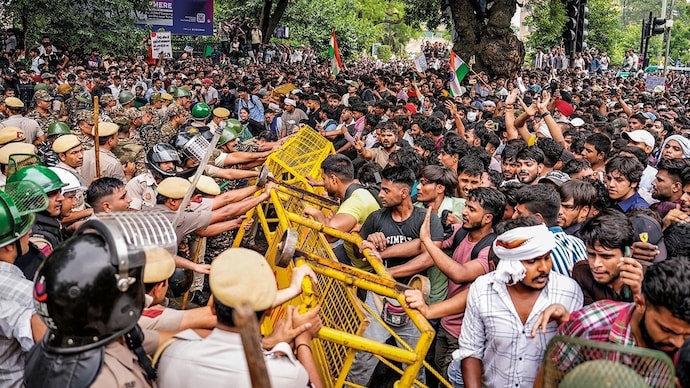
A group of retired police officers has defended the Delhi Police's handling of the July 20 march to Parliament, saying the debate around the violence had become "one-sided" and did not acknowledge the injuries suffered by policemen.
They said the force was being unfairly portrayed despite working in a difficult law-and-order situation.
Addressing a press conference at the Press Club of India, the Delhi Police Retired Non-Gazetted Officers' Association expressed solidarity with serving personnel and their families.
The former officers said criticism of the police had overshadowed the injuries sustained by 128 police personnel during the violence.
Former Uttar Pradesh DGP and Rajya Sabha MP Brij Lal said, "In nearly 38 years of service, I have handled numerous law-and-order situations. Everybody is questioning what the police did, but nobody is asking who assaulted the 128 police personnel. Discussions rarely mention police training, the standard operating procedures or the sequence in which force is used."
Lal said police personnel are trained to follow a graded response while dealing with violent crowds.
Explaining that process, Lal said, "There is a sequence. We first use water cannons, then tear gas, and only thereafter a lathi charge. Even during a baton charge, personnel are trained not to strike the vital parts of the body. Non-lethal weapons come later."
He added police action should be seen in the context of established crowd-control procedures.
Lal also defended the use of pellet guns, saying "a lot of hype" had been created around them despite their being a non-lethal crowd-control option meant to reduce casualties.
"A pellet gun is a 12-bore shotgun. It was introduced so that police do not have to resort to rifles. It has been unnecessarily turned into a villain," he said, adding that the Supreme Court had upheld the legality of such non-lethal weapons.
The retired personnel also appealed to young people to recognise the sacrifices made by police personnel. Retired ACP Rajender Pathania, who said he had served his entire career in the Delhi Police, said police personnel were "not fragile" but deserved greater public understanding.
"I request the younger generation to also recognise the role the police play in maintaining law and order and safeguarding the unity of the country," he said.
The former officers said they had no objection to peaceful student protests, but questioned how police personnel were expected to distinguish between genuine students and "criminal elements" during violent demonstrations.
They also said serving police personnel cannot publicly protest or defend themselves because of service conduct rules, even as they continue to face criticism.
In sum, the retired officers said the police response to the march should be viewed alongside the injuries to personnel, the procedures followed during crowd control and the limits faced by serving officers in responding publicly.
A group of retired police officers has defended the Delhi Police's handling of the July 20 march to Parliament, saying the debate around the violence had become "one-sided" and did not acknowledge the injuries suffered by policemen.
They said the force was being unfairly portrayed despite working in a difficult law-and-order situation.
Addressing a press conference at the Press Club of India, the Delhi Police Retired Non-Gazetted Officers' Association expressed solidarity with serving personnel and their families.
The former officers said criticism of the police had overshadowed the injuries sustained by 128 police personnel during the violence.
Former Uttar Pradesh DGP and Rajya Sabha MP Brij Lal said, "In nearly 38 years of service, I have handled numerous law-and-order situations. Everybody is questioning what the police did, but nobody is asking who assaulted the 128 police personnel. Discussions rarely mention police training, the standard operating procedures or the sequence in which force is used."
Lal said police personnel are trained to follow a graded response while dealing with violent crowds.
Explaining that process, Lal said, "There is a sequence. We first use water cannons, then tear gas, and only thereafter a lathi charge. Even during a baton charge, personnel are trained not to strike the vital parts of the body. Non-lethal weapons come later."
He added police action should be seen in the context of established crowd-control procedures.
Lal also defended the use of pellet guns, saying "a lot of hype" had been created around them despite their being a non-lethal crowd-control option meant to reduce casualties.
"A pellet gun is a 12-bore shotgun. It was introduced so that police do not have to resort to rifles. It has been unnecessarily turned into a villain," he said, adding that the Supreme Court had upheld the legality of such non-lethal weapons.
The retired personnel also appealed to young people to recognise the sacrifices made by police personnel. Retired ACP Rajender Pathania, who said he had served his entire career in the Delhi Police, said police personnel were "not fragile" but deserved greater public understanding.
"I request the younger generation to also recognise the role the police play in maintaining law and order and safeguarding the unity of the country," he said.
The former officers said they had no objection to peaceful student protests, but questioned how police personnel were expected to distinguish between genuine students and "criminal elements" during violent demonstrations.
They also said serving police personnel cannot publicly protest or defend themselves because of service conduct rules, even as they continue to face criticism.
In sum, the retired officers said the police response to the march should be viewed alongside the injuries to personnel, the procedures followed during crowd control and the limits faced by serving officers in responding publicly.
A group of retired police officers has defended the Delhi Police's handling of the July 20 march to Parliament, saying the debate around the violence had become "one-sided" and did not acknowledge the injuries suffered by policemen.
They said the force was being unfairly portrayed despite working in a difficult law-and-order situation.
Addressing a press conference at the Press Club of India, the Delhi Police Retired Non-Gazetted Officers' Association expressed solidarity with serving personnel and their families.
The former officers said criticism of the police had overshadowed the injuries sustained by 128 police personnel during the violence.
Former Uttar Pradesh DGP and Rajya Sabha MP Brij Lal said, "In nearly 38 years of service, I have handled numerous law-and-order situations. Everybody is questioning what the police did, but nobody is asking who assaulted the 128 police personnel. Discussions rarely mention police training, the standard operating procedures or the sequence in which force is used."
Lal said police personnel are trained to follow a graded response while dealing with violent crowds.
Explaining that process, Lal said, "There is a sequence. We first use water cannons, then tear gas, and only thereafter a lathi charge. Even during a baton charge, personnel are trained not to strike the vital parts of the body. Non-lethal weapons come later."
He added police action should be seen in the context of established crowd-control procedures.
Lal also defended the use of pellet guns, saying "a lot of hype" had been created around them despite their being a non-lethal crowd-control option meant to reduce casualties.
"A pellet gun is a 12-bore shotgun. It was introduced so that police do not have to resort to rifles. It has been unnecessarily turned into a villain," he said, adding that the Supreme Court had upheld the legality of such non-lethal weapons.
The retired personnel also appealed to young people to recognise the sacrifices made by police personnel. Retired ACP Rajender Pathania, who said he had served his entire career in the Delhi Police, said police personnel were "not fragile" but deserved greater public understanding.
"I request the younger generation to also recognise the role the police play in maintaining law and order and safeguarding the unity of the country," he said.
The former officers said they had no objection to peaceful student protests, but questioned how police personnel were expected to distinguish between genuine students and "criminal elements" during violent demonstrations.
They also said serving police personnel cannot publicly protest or defend themselves because of service conduct rules, even as they continue to face criticism.
In sum, the retired officers said the police response to the march should be viewed alongside the injuries to personnel, the procedures followed during crowd control and the limits faced by serving officers in responding publicly.

