5,000 personnel, water cannons: Delhi Police's plan for CJP Parliament march
As the CJP prepares for its 'Chalo Sansad' march on the opening day of Parliament's Monsoon Session, the Delhi Police has mounted a massive security operation, deploying over 5,000 personnel and placing the high-security district under heightened surveillance.
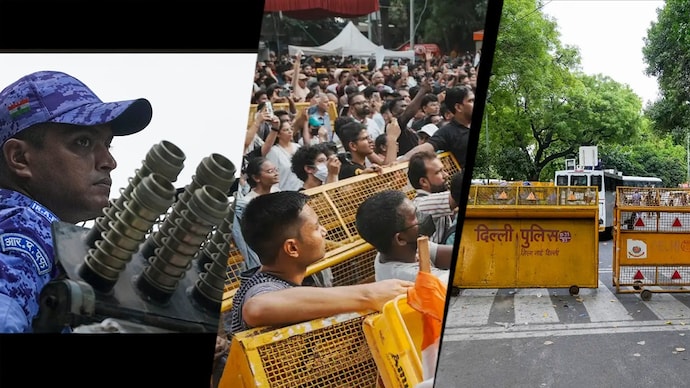
The Delhi Police has drawn up an extensive security plan ahead of the Cockroach Janta Party's (CJP) Parliament march on Monday, deploying more than 5,000 personnel, tightening access to the national capital's high-security zone and placing key installations under heightened surveillance.
The CJP has called for a 'Chalo Sansad' march from Jantar Mantar to Parliament to press for education reforms and demand the resignation of Union Education Minister Dharmendra Pradhan over alleged irregularities in the NEET examination. The proposed march coincides with the opening day of the Monsoon Session of Parliament.
According to information acccessed by India Today TV, the Delhi Police, in coordination with intelligence agencies, has formulated a comprehensive action plan to prevent any breach of security or law and order. Intelligence agencies and the Delhi Police Special Branch are sharing hourly updates with senior officers on the number of protesters arriving, leaving and staying at the Jantar Mantar protest site to assess crowd strength and make real-time deployment decisions.
Police personnel across the capital are on high alert from 4 am on Monday, with more than 5,000 Delhi Police and paramilitary personnel deployed across the New Delhi district. In addition, over 25 battalions of the Central Armed Police Forces (CAPF), including women personnel, are stationed at strategic locations to reinforce the security grid.
As part of the operational plan, New Delhi has been divided into 15 security zones, each under the supervision of senior officers. Special Commissioners of Police, Joint Commissioners and Deputy Commissioners of Police have been assigned specific responsibilities to monitor deployments and coordinate responses on the ground.
Sources said officers have been instructed to take strict action against any anti-social elements and deal firmly with incidents of vandalism, looting, arson or any attempt to disrupt public order during the proposed march.
Several high-security locations have been declared out of bounds for any gathering or demonstration. These include Vijay Chowk, Parliament Street, the Prime Minister's residence, Seva Tirtha, Selfie Point, Transport Bhawan, Rashtrapati Bhavan, India Gate and surrounding areas, where no protests or assemblies will be permitted.
Police "Vajra" anti-riot vehicles, water cannons and other specialised equipment have been deployed across sensitive points. Rapid response teams and reserve forces have also been kept on standby to respond to any contingency.
According to sources, all Metro stations in the New Delhi district will remain under close watch and authorities may temporarily close stations if the security situation demands. Nearby hospitals have also been placed on alert to respond to any emergency.
Security has also been tightened at the BJP headquarters and other vital installations in the national capital.
Police have intensified vehicle screening at all entry points leading into the New Delhi district, with every incoming vehicle likely to undergo thorough checking. Multi-layered barricades, anti-sabotage checks, CCTV surveillance and round-the-clock patrolling have been strengthened across New Delhi, Central Delhi and parts of North Delhi.
The enhanced deployment comes despite the Delhi Police maintaining that no permission has been sought or granted for the proposed Parliament march.
Deputy Commissioner of Police (New Delhi) Sachin Sharma said prohibitory orders under Section 163 of the Bharatiya Nagarik Suraksha Sanhita (BNSS) remain in force across the New Delhi district.
According to the police advisory, protest marches, processions, demonstrations and assemblies of five or more persons are prohibited, except at the designated protest site at Jantar Mantar with prior permission. Police have warned that violators could face legal action under the Bharatiya Nyaya Sanhita and other applicable laws.
Meanwhile, the protest at Jantar Mantar continued on Sunday, with opposition leaders, actors and supporters gathering in solidarity ahead of Monday's proposed mobilisation.
Activist Sonam Wangchuk, who was shifted to Safdarjung Hospital after his health deteriorated during a hunger strike, appealed through a message to supporters to make the Parliament march peaceful and successful. CJP founder Abhijeet Dipke, who has begun an indefinite fast, also urged protesters to remain peaceful and follow police guidelines.
CJP leaders claimed that thousands of supporters had already gathered in and around Jantar Mantar ahead of Monday's mobilisation, while the party appealed to protesters not to respond to any provocation.
The Delhi Police has drawn up an extensive security plan ahead of the Cockroach Janta Party's (CJP) Parliament march on Monday, deploying more than 5,000 personnel, tightening access to the national capital's high-security zone and placing key installations under heightened surveillance.
The CJP has called for a 'Chalo Sansad' march from Jantar Mantar to Parliament to press for education reforms and demand the resignation of Union Education Minister Dharmendra Pradhan over alleged irregularities in the NEET examination. The proposed march coincides with the opening day of the Monsoon Session of Parliament.
According to information acccessed by India Today TV, the Delhi Police, in coordination with intelligence agencies, has formulated a comprehensive action plan to prevent any breach of security or law and order. Intelligence agencies and the Delhi Police Special Branch are sharing hourly updates with senior officers on the number of protesters arriving, leaving and staying at the Jantar Mantar protest site to assess crowd strength and make real-time deployment decisions.
Police personnel across the capital are on high alert from 4 am on Monday, with more than 5,000 Delhi Police and paramilitary personnel deployed across the New Delhi district. In addition, over 25 battalions of the Central Armed Police Forces (CAPF), including women personnel, are stationed at strategic locations to reinforce the security grid.
As part of the operational plan, New Delhi has been divided into 15 security zones, each under the supervision of senior officers. Special Commissioners of Police, Joint Commissioners and Deputy Commissioners of Police have been assigned specific responsibilities to monitor deployments and coordinate responses on the ground.
Sources said officers have been instructed to take strict action against any anti-social elements and deal firmly with incidents of vandalism, looting, arson or any attempt to disrupt public order during the proposed march.
Several high-security locations have been declared out of bounds for any gathering or demonstration. These include Vijay Chowk, Parliament Street, the Prime Minister's residence, Seva Tirtha, Selfie Point, Transport Bhawan, Rashtrapati Bhavan, India Gate and surrounding areas, where no protests or assemblies will be permitted.
Police "Vajra" anti-riot vehicles, water cannons and other specialised equipment have been deployed across sensitive points. Rapid response teams and reserve forces have also been kept on standby to respond to any contingency.
According to sources, all Metro stations in the New Delhi district will remain under close watch and authorities may temporarily close stations if the security situation demands. Nearby hospitals have also been placed on alert to respond to any emergency.
Security has also been tightened at the BJP headquarters and other vital installations in the national capital.
Police have intensified vehicle screening at all entry points leading into the New Delhi district, with every incoming vehicle likely to undergo thorough checking. Multi-layered barricades, anti-sabotage checks, CCTV surveillance and round-the-clock patrolling have been strengthened across New Delhi, Central Delhi and parts of North Delhi.
The enhanced deployment comes despite the Delhi Police maintaining that no permission has been sought or granted for the proposed Parliament march.
Deputy Commissioner of Police (New Delhi) Sachin Sharma said prohibitory orders under Section 163 of the Bharatiya Nagarik Suraksha Sanhita (BNSS) remain in force across the New Delhi district.
According to the police advisory, protest marches, processions, demonstrations and assemblies of five or more persons are prohibited, except at the designated protest site at Jantar Mantar with prior permission. Police have warned that violators could face legal action under the Bharatiya Nyaya Sanhita and other applicable laws.
Meanwhile, the protest at Jantar Mantar continued on Sunday, with opposition leaders, actors and supporters gathering in solidarity ahead of Monday's proposed mobilisation.
Activist Sonam Wangchuk, who was shifted to Safdarjung Hospital after his health deteriorated during a hunger strike, appealed through a message to supporters to make the Parliament march peaceful and successful. CJP founder Abhijeet Dipke, who has begun an indefinite fast, also urged protesters to remain peaceful and follow police guidelines.
CJP leaders claimed that thousands of supporters had already gathered in and around Jantar Mantar ahead of Monday's mobilisation, while the party appealed to protesters not to respond to any provocation.
The Delhi Police has drawn up an extensive security plan ahead of the Cockroach Janta Party's (CJP) Parliament march on Monday, deploying more than 5,000 personnel, tightening access to the national capital's high-security zone and placing key installations under heightened surveillance.
The CJP has called for a 'Chalo Sansad' march from Jantar Mantar to Parliament to press for education reforms and demand the resignation of Union Education Minister Dharmendra Pradhan over alleged irregularities in the NEET examination. The proposed march coincides with the opening day of the Monsoon Session of Parliament.
According to information acccessed by India Today TV, the Delhi Police, in coordination with intelligence agencies, has formulated a comprehensive action plan to prevent any breach of security or law and order. Intelligence agencies and the Delhi Police Special Branch are sharing hourly updates with senior officers on the number of protesters arriving, leaving and staying at the Jantar Mantar protest site to assess crowd strength and make real-time deployment decisions.
Police personnel across the capital are on high alert from 4 am on Monday, with more than 5,000 Delhi Police and paramilitary personnel deployed across the New Delhi district. In addition, over 25 battalions of the Central Armed Police Forces (CAPF), including women personnel, are stationed at strategic locations to reinforce the security grid.
As part of the operational plan, New Delhi has been divided into 15 security zones, each under the supervision of senior officers. Special Commissioners of Police, Joint Commissioners and Deputy Commissioners of Police have been assigned specific responsibilities to monitor deployments and coordinate responses on the ground.
Sources said officers have been instructed to take strict action against any anti-social elements and deal firmly with incidents of vandalism, looting, arson or any attempt to disrupt public order during the proposed march.
Several high-security locations have been declared out of bounds for any gathering or demonstration. These include Vijay Chowk, Parliament Street, the Prime Minister's residence, Seva Tirtha, Selfie Point, Transport Bhawan, Rashtrapati Bhavan, India Gate and surrounding areas, where no protests or assemblies will be permitted.
Police "Vajra" anti-riot vehicles, water cannons and other specialised equipment have been deployed across sensitive points. Rapid response teams and reserve forces have also been kept on standby to respond to any contingency.
According to sources, all Metro stations in the New Delhi district will remain under close watch and authorities may temporarily close stations if the security situation demands. Nearby hospitals have also been placed on alert to respond to any emergency.
Security has also been tightened at the BJP headquarters and other vital installations in the national capital.
Police have intensified vehicle screening at all entry points leading into the New Delhi district, with every incoming vehicle likely to undergo thorough checking. Multi-layered barricades, anti-sabotage checks, CCTV surveillance and round-the-clock patrolling have been strengthened across New Delhi, Central Delhi and parts of North Delhi.
The enhanced deployment comes despite the Delhi Police maintaining that no permission has been sought or granted for the proposed Parliament march.
Deputy Commissioner of Police (New Delhi) Sachin Sharma said prohibitory orders under Section 163 of the Bharatiya Nagarik Suraksha Sanhita (BNSS) remain in force across the New Delhi district.
According to the police advisory, protest marches, processions, demonstrations and assemblies of five or more persons are prohibited, except at the designated protest site at Jantar Mantar with prior permission. Police have warned that violators could face legal action under the Bharatiya Nyaya Sanhita and other applicable laws.
Meanwhile, the protest at Jantar Mantar continued on Sunday, with opposition leaders, actors and supporters gathering in solidarity ahead of Monday's proposed mobilisation.
Activist Sonam Wangchuk, who was shifted to Safdarjung Hospital after his health deteriorated during a hunger strike, appealed through a message to supporters to make the Parliament march peaceful and successful. CJP founder Abhijeet Dipke, who has begun an indefinite fast, also urged protesters to remain peaceful and follow police guidelines.
CJP leaders claimed that thousands of supporters had already gathered in and around Jantar Mantar ahead of Monday's mobilisation, while the party appealed to protesters not to respond to any provocation.

