Jantar Mantar protest videography is for safety, not surveillance: Centre to HC
The Centre told the Delhi High Court that videography at the Jantar Mantar protest is meant for safety and public order. The plea argues that such monitoring violates protesters' privacy and needs strict legal limits.
Solicitor General Tushar Mehta told the Delhi High Court on Monday that video-recording of the protest at Jantar Mantar over alleged irregularities in examinations was being done for law-and-order and safety reasons, and not for "snooping" or surveillance. The court was hearing a public interest litigation filed by former Jawaharlal Nehru University Students' Union president Aishe Ghosh against the Centre and the Delhi Police.
A bench of Chief Justice D K Upadhyaya and Justice Tejas Karia posted the matter for hearing on Tuesday and asked Mehta to inform the court whether the police had framed any guidelines to regulate protests, as required under a Supreme Court judgment. On behalf of the petitioner, senior counsel Nandita Rao argued that the surveillance of student protesters was intrusive and unlawful, and that the right to privacy was not given up even in public spaces.
Appearing for the authorities, Mehta told the court that protests at Jantar Mantar are always videographed. "At Jantar Mantar, some or the other protest is going on, (and) it is always recorded.... This is only for law and order and safety. There is no snooping. There is no surveillance," he submitted. He also said, "As a matter of fact, in this protest, daily hundreds of people are seen making video films and making reels and making them viral." Mehta further described the PIL as "luxury litigation".
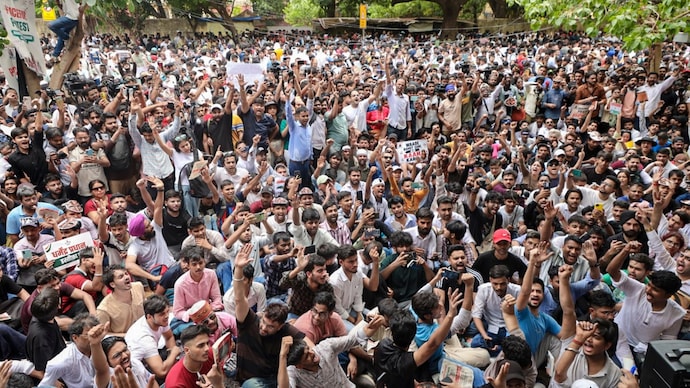
The protest in question has been organised by the Cockroach Janta Party (CJP) at Jantar Mantar since June 20. The group is demanding the resignation of Union Education Minister Dharmendra Pradhan over alleged irregularities in examinations, including the National Eligibility-cum-Entrance Test (NEET). Activist Sonam Wangchuk joined the agitation on June 28 and has been on an indefinite fast since then.
The PIL, filed through lawyer Subhash Chandran K R, has sought a declaration that "continuous and intrusive mass surveillance" of peaceful protesters is constitutionally impermissible, disproportionate and cannot be justified in the name of maintaining public order or national security. It has also sought directions to immediately stop mass photography, videography and surveillance at Jantar Mantar unless there is a "proximate, real and imminent threat to public order" that justifies such action.
The plea said the petitioner had photographs showing a permanent surveillance tower and continuous photography and videography by police personnel, which, according to her, showed the pervasive and intrusive nature of the monitoring. It further alleged that the surveillance was indiscriminate, covering every person at the protest site regardless of any suspicion of unlawful conduct, and extending beyond acts of protest to daily activities such as eating, resting, seeking medical assistance and other personal activities.
The case will now come up before the Delhi High Court on Tuesday, with the authorities maintaining that videography at Jantar Mantar is a routine law-and-order measure and the petitioner pressing her challenge to what she has called intrusive and indiscriminate surveillance of peaceful protesters.
Solicitor General Tushar Mehta told the Delhi High Court on Monday that video-recording of the protest at Jantar Mantar over alleged irregularities in examinations was being done for law-and-order and safety reasons, and not for "snooping" or surveillance. The court was hearing a public interest litigation filed by former Jawaharlal Nehru University Students' Union president Aishe Ghosh against the Centre and the Delhi Police.
A bench of Chief Justice D K Upadhyaya and Justice Tejas Karia posted the matter for hearing on Tuesday and asked Mehta to inform the court whether the police had framed any guidelines to regulate protests, as required under a Supreme Court judgment. On behalf of the petitioner, senior counsel Nandita Rao argued that the surveillance of student protesters was intrusive and unlawful, and that the right to privacy was not given up even in public spaces.
Appearing for the authorities, Mehta told the court that protests at Jantar Mantar are always videographed. "At Jantar Mantar, some or the other protest is going on, (and) it is always recorded.... This is only for law and order and safety. There is no snooping. There is no surveillance," he submitted. He also said, "As a matter of fact, in this protest, daily hundreds of people are seen making video films and making reels and making them viral." Mehta further described the PIL as "luxury litigation".
The protest in question has been organised by the Cockroach Janta Party (CJP) at Jantar Mantar since June 20. The group is demanding the resignation of Union Education Minister Dharmendra Pradhan over alleged irregularities in examinations, including the National Eligibility-cum-Entrance Test (NEET). Activist Sonam Wangchuk joined the agitation on June 28 and has been on an indefinite fast since then.
The PIL, filed through lawyer Subhash Chandran K R, has sought a declaration that "continuous and intrusive mass surveillance" of peaceful protesters is constitutionally impermissible, disproportionate and cannot be justified in the name of maintaining public order or national security. It has also sought directions to immediately stop mass photography, videography and surveillance at Jantar Mantar unless there is a "proximate, real and imminent threat to public order" that justifies such action.
The plea said the petitioner had photographs showing a permanent surveillance tower and continuous photography and videography by police personnel, which, according to her, showed the pervasive and intrusive nature of the monitoring. It further alleged that the surveillance was indiscriminate, covering every person at the protest site regardless of any suspicion of unlawful conduct, and extending beyond acts of protest to daily activities such as eating, resting, seeking medical assistance and other personal activities.
The case will now come up before the Delhi High Court on Tuesday, with the authorities maintaining that videography at Jantar Mantar is a routine law-and-order measure and the petitioner pressing her challenge to what she has called intrusive and indiscriminate surveillance of peaceful protesters.
Solicitor General Tushar Mehta told the Delhi High Court on Monday that video-recording of the protest at Jantar Mantar over alleged irregularities in examinations was being done for law-and-order and safety reasons, and not for "snooping" or surveillance. The court was hearing a public interest litigation filed by former Jawaharlal Nehru University Students' Union president Aishe Ghosh against the Centre and the Delhi Police.
A bench of Chief Justice D K Upadhyaya and Justice Tejas Karia posted the matter for hearing on Tuesday and asked Mehta to inform the court whether the police had framed any guidelines to regulate protests, as required under a Supreme Court judgment. On behalf of the petitioner, senior counsel Nandita Rao argued that the surveillance of student protesters was intrusive and unlawful, and that the right to privacy was not given up even in public spaces.
Appearing for the authorities, Mehta told the court that protests at Jantar Mantar are always videographed. "At Jantar Mantar, some or the other protest is going on, (and) it is always recorded.... This is only for law and order and safety. There is no snooping. There is no surveillance," he submitted. He also said, "As a matter of fact, in this protest, daily hundreds of people are seen making video films and making reels and making them viral." Mehta further described the PIL as "luxury litigation".
The protest in question has been organised by the Cockroach Janta Party (CJP) at Jantar Mantar since June 20. The group is demanding the resignation of Union Education Minister Dharmendra Pradhan over alleged irregularities in examinations, including the National Eligibility-cum-Entrance Test (NEET). Activist Sonam Wangchuk joined the agitation on June 28 and has been on an indefinite fast since then.
The PIL, filed through lawyer Subhash Chandran K R, has sought a declaration that "continuous and intrusive mass surveillance" of peaceful protesters is constitutionally impermissible, disproportionate and cannot be justified in the name of maintaining public order or national security. It has also sought directions to immediately stop mass photography, videography and surveillance at Jantar Mantar unless there is a "proximate, real and imminent threat to public order" that justifies such action.
The plea said the petitioner had photographs showing a permanent surveillance tower and continuous photography and videography by police personnel, which, according to her, showed the pervasive and intrusive nature of the monitoring. It further alleged that the surveillance was indiscriminate, covering every person at the protest site regardless of any suspicion of unlawful conduct, and extending beyond acts of protest to daily activities such as eating, resting, seeking medical assistance and other personal activities.
The case will now come up before the Delhi High Court on Tuesday, with the authorities maintaining that videography at Jantar Mantar is a routine law-and-order measure and the petitioner pressing her challenge to what she has called intrusive and indiscriminate surveillance of peaceful protesters.

