Instant noodles are a guilty pleasure Millennials and Gen Z refuse to give up
Health-conscious Millennials and Gen Z in India continue to buy instant noodles despite knowing their nutritional drawbacks. The reason? Let's find out.
Oh my god! This does not have protein!
This is too high in sodium. Let’s not take this.
17 gm of sugar per serving? God, are they trying to kill us or what?
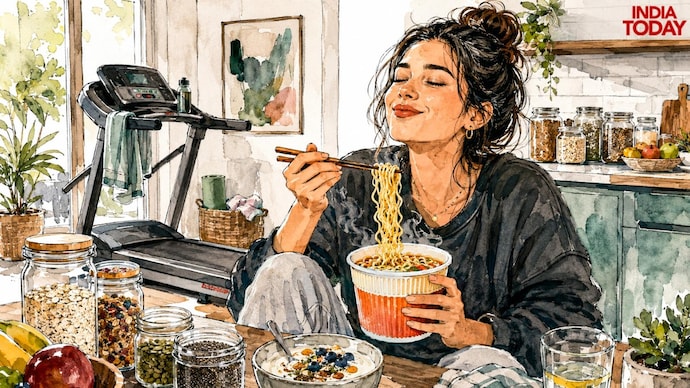
That’s the average Millennial and Gen Z conversation these days. Everyone is obsessed with what they put in their body, and rightly so. Protein-packed breakfasts. Gut-friendly foods. Seed cycling. Intermittent fasting. Air-fried snacks. India has never been more health conscious.
And yet, tucked away in kitchen cabinets, hostel rooms, office pantries and supermarket shelves, there is one food that refuses to lose its grip on consumers: instant noodles.
In CNN's article, Instant noodles have a bad reputation, Maggie Hiufu Wong writes, "...it’s no secret that instant noodles aren’t healthy. Every so often, new studies emerge explaining how they increase the risk of dementia, heart disease and hormonal imbalances."
For all the conversations around clean eating and mindful consumption, a hot bowl of Maggi on a rainy evening, a late-night packet of ramen after work, or a fiery Korean noodle challenge with friends continues to hold a special place in the hearts and stomachs of Millennials and Gen Z.
The numbers tell the same story.
India's instant noodles market is currently valued at roughly $1.8 billion and continues to grow. While traditional masala noodles still dominate sales, newer premium and Korean-style variants have rapidly carved out their own space, especially among younger consumers.
The rise of health consciousness, it seems, has not managed to kill India's love affair with instant noodles.
Maggi isn't just food. It's an emotion
For 32-year-old Ashmita Mishra, instant noodles are deeply tied to memories. "You can never imagine anything but pahadon wail Maggi when you're in a hill station," she says.
"A trip to the mountains feels incomplete without sitting somewhere with a view and eating a hot plate of Maggi. Even on a cold rainy day, nothing complements the weather better."
And she isn't alone.
For an entire generation, Maggi has transcended the category of food. It is nostalgia served in a yellow packet. It reminds people of after-school hunger pangs, hostel rooms, train journeys, sleepovers and the first meal they learnt to cook independently. Perhaps that's why even one of the biggest crises in the brand's history failed to dent its popularity permanently.
In 2015, Maggi was temporarily banned nationwide after concerns over alleged high levels of lead and undeclared monosodium glutamate (MSG). The controversy dominated headlines and sparked debates about food safety.
Yet when the product returned to shelves, consumers returned too. Its market share climbed steadily after re-entry, demonstrating just how emotionally invested Indians were in the brand. Few packaged foods have managed to inspire that kind of loyalty.
Then came the Korean wave
If Millennials grew up with Maggi, Gen Z found its own noodle obsession. The Korean wave did not arrive in India carrying just K-pop and K-dramas. It also brought an entire food culture with it. Suddenly, dishes such as bibimbap, kimchi fried rice and japchae were becoming familiar names. Alongside them came Korean instant noodles.
Among the biggest winners was Samyang's Buldak ramen, which gained viral popularity thanks to social media challenges, reaction videos and its reputation for intense heat.
"When Buldak came to India, it was a novelty," says 27-year-old Tanaya.
"I knew my spice tolerance wasn't great, but I still wanted to try it. It was addictive. I bought it around the Covid period and not just me, even my parents ended up enjoying it."
Tanaya considers herself health conscious. She goes to the gym multiple times a week and regularly does calisthenics. Yet she sees no contradiction in occasionally reaching for a packet of instant noodles.
"I work out and try to stay fit, but I can't deny I still indulge once in a while."
The demand has been so strong that Korean noodles have evolved into a market of their own. Industry estimates suggest the category has grown into a Rs 300 crore sub-segment in India, accounting for roughly a third of instant noodle sales on quick-commerce platforms. Brands such as Samyang and Nongshim dominate the space, while Indian manufacturers have rushed to create their own Korean-inspired variants.
It's a phenomenon not unlike what happened with Dubai chocolate. Once demand exploded, everyone wanted their own version.
Convenience always wins
Nostalgia may explain one part of the instant noodle story. Convenience explains the rest. For students, young professionals and people living away from home, instant noodles often represent something far more practical than indulgence.
"It's true that noodles are unhealthy and not the best choice if you're trying to maintain a healthy lifestyle," says 24-year-old Rishabh Choudhary.
"But what do you do when you're living away from home and don't have the privilege of ordering food every day?"
A packet costs very little, takes only a few minutes to prepare and requires minimal effort. "I usually add vegetables, eggs or some form of protein to make it better," he says. "But the point is that it's convenient and affordable."
In a country where millions of students and young professionals live independently, those two factors remain difficult to beat and to some extent, its global allure also lies in this fact.
The health dilemma
Of course, nutrition experts are unlikely to recommend instant noodles as a dietary staple. A standard 70-gram packet of masala noodles typically contains around 310-350 calories. It is largely made up of refined carbohydrates and tends to be high in sodium while offering relatively little fibre and protein.
The numbers become even more dramatic with some premium Korean variants.
A single packet of Samyang Buldak 2x Spicy ramen can deliver well over 500 calories and upwards of 1,200 milligrams of sodium in one sitting. Not to mention the after effects of having spicy noodles on your gut.
At a time when consumers are obsessing over protein intake, gut health and calorie tracking, many are still unwilling to completely give up instant noodles, and that perhaps is the irony.
Oh my god! This does not have protein!
This is too high in sodium. Let’s not take this.
17 gm of sugar per serving? God, are they trying to kill us or what?
That’s the average Millennial and Gen Z conversation these days. Everyone is obsessed with what they put in their body, and rightly so. Protein-packed breakfasts. Gut-friendly foods. Seed cycling. Intermittent fasting. Air-fried snacks. India has never been more health conscious.
And yet, tucked away in kitchen cabinets, hostel rooms, office pantries and supermarket shelves, there is one food that refuses to lose its grip on consumers: instant noodles.
In CNN's article, Instant noodles have a bad reputation, Maggie Hiufu Wong writes, "...it’s no secret that instant noodles aren’t healthy. Every so often, new studies emerge explaining how they increase the risk of dementia, heart disease and hormonal imbalances."
For all the conversations around clean eating and mindful consumption, a hot bowl of Maggi on a rainy evening, a late-night packet of ramen after work, or a fiery Korean noodle challenge with friends continues to hold a special place in the hearts and stomachs of Millennials and Gen Z.
The numbers tell the same story.
India's instant noodles market is currently valued at roughly $1.8 billion and continues to grow. While traditional masala noodles still dominate sales, newer premium and Korean-style variants have rapidly carved out their own space, especially among younger consumers.
The rise of health consciousness, it seems, has not managed to kill India's love affair with instant noodles.
Maggi isn't just food. It's an emotion
For 32-year-old Ashmita Mishra, instant noodles are deeply tied to memories. "You can never imagine anything but pahadon wail Maggi when you're in a hill station," she says.
"A trip to the mountains feels incomplete without sitting somewhere with a view and eating a hot plate of Maggi. Even on a cold rainy day, nothing complements the weather better."
And she isn't alone.
For an entire generation, Maggi has transcended the category of food. It is nostalgia served in a yellow packet. It reminds people of after-school hunger pangs, hostel rooms, train journeys, sleepovers and the first meal they learnt to cook independently. Perhaps that's why even one of the biggest crises in the brand's history failed to dent its popularity permanently.
In 2015, Maggi was temporarily banned nationwide after concerns over alleged high levels of lead and undeclared monosodium glutamate (MSG). The controversy dominated headlines and sparked debates about food safety.
Yet when the product returned to shelves, consumers returned too. Its market share climbed steadily after re-entry, demonstrating just how emotionally invested Indians were in the brand. Few packaged foods have managed to inspire that kind of loyalty.
Then came the Korean wave
If Millennials grew up with Maggi, Gen Z found its own noodle obsession. The Korean wave did not arrive in India carrying just K-pop and K-dramas. It also brought an entire food culture with it. Suddenly, dishes such as bibimbap, kimchi fried rice and japchae were becoming familiar names. Alongside them came Korean instant noodles.
Among the biggest winners was Samyang's Buldak ramen, which gained viral popularity thanks to social media challenges, reaction videos and its reputation for intense heat.
"When Buldak came to India, it was a novelty," says 27-year-old Tanaya.
"I knew my spice tolerance wasn't great, but I still wanted to try it. It was addictive. I bought it around the Covid period and not just me, even my parents ended up enjoying it."
Tanaya considers herself health conscious. She goes to the gym multiple times a week and regularly does calisthenics. Yet she sees no contradiction in occasionally reaching for a packet of instant noodles.
"I work out and try to stay fit, but I can't deny I still indulge once in a while."
The demand has been so strong that Korean noodles have evolved into a market of their own. Industry estimates suggest the category has grown into a Rs 300 crore sub-segment in India, accounting for roughly a third of instant noodle sales on quick-commerce platforms. Brands such as Samyang and Nongshim dominate the space, while Indian manufacturers have rushed to create their own Korean-inspired variants.
It's a phenomenon not unlike what happened with Dubai chocolate. Once demand exploded, everyone wanted their own version.
Convenience always wins
Nostalgia may explain one part of the instant noodle story. Convenience explains the rest. For students, young professionals and people living away from home, instant noodles often represent something far more practical than indulgence.
"It's true that noodles are unhealthy and not the best choice if you're trying to maintain a healthy lifestyle," says 24-year-old Rishabh Choudhary.
"But what do you do when you're living away from home and don't have the privilege of ordering food every day?"
A packet costs very little, takes only a few minutes to prepare and requires minimal effort. "I usually add vegetables, eggs or some form of protein to make it better," he says. "But the point is that it's convenient and affordable."
In a country where millions of students and young professionals live independently, those two factors remain difficult to beat and to some extent, its global allure also lies in this fact.
The health dilemma
Of course, nutrition experts are unlikely to recommend instant noodles as a dietary staple. A standard 70-gram packet of masala noodles typically contains around 310-350 calories. It is largely made up of refined carbohydrates and tends to be high in sodium while offering relatively little fibre and protein.
The numbers become even more dramatic with some premium Korean variants.
A single packet of Samyang Buldak 2x Spicy ramen can deliver well over 500 calories and upwards of 1,200 milligrams of sodium in one sitting. Not to mention the after effects of having spicy noodles on your gut.
At a time when consumers are obsessing over protein intake, gut health and calorie tracking, many are still unwilling to completely give up instant noodles, and that perhaps is the irony.

