From the Editor-in-Chief
ECI must ensure that every eligible citizen removed erroneously must be able to reclaim the right to vote
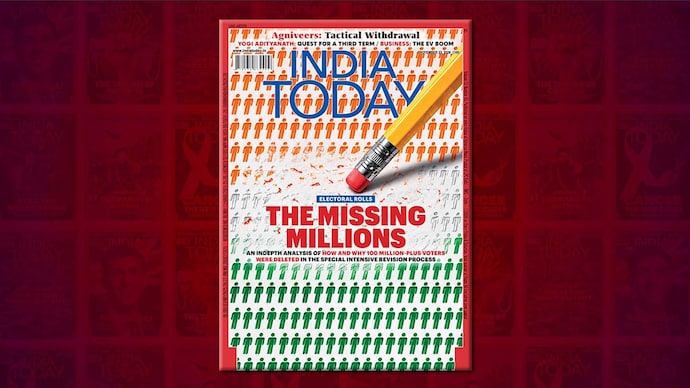
In January 2025, the Election Commission of India (ECI) put the country’s total voters at 991 million and even proudly declared that India would soon cross a billion voters. That billionth voter never came. Instead, after the ECI launched its Special Intensive Revision (SIR) of electoral rolls in June 2025, India’s overall electorate is likely to shrink considerably. Let’s be clear about the principle: a periodic SIR is a legitimate and necessary exercise. The last such clean-up was done in 2002-04. Anomalies had accumulated since then: dead voters still on the rolls, names registered in more than one location owing to change of residence. All these need to be eliminated with a fine-tooth comb. Non-Indians, too, have no place on the rolls, to flag an oft-repeated concern. But the ECI’s draft rolls for 31 states and Union Territories saw an astounding 133.9 million voters, or 14.1 per cent of the electorate, being dropped. That’s equivalent to an entire Bihar population vanishing off the map. Even allowing for faulty rolls, India’s electorate had always grown commensurately with its population. The ECI’s own figures show that an average of nearly 14 million voters were added annually between 2019 and 2024. Now, for the first time since elections were held in 1950, India’s electorate will show a decrease—a steep one at that.
The ECI has explanations, many seemingly valid. It classifies the missing 133.9 million into four categories, labelled ASDD: absent or untraceable (A), shifted residence (S), dead (D) or duplicated in other rolls (D). The last two, dead and duplicate, together make up 38.2 million of those deleted. Here, the ECI stands on firmer ground. The high number of absent, shifted and unclassified, together 95.7 million, awaits proper ascertaining. Of the 31 states and UTs covered by the SIR, 24 have got their final rolls. Pre-SIR, they had a combined original electorate of 714.6 million. That shrunk by 88.7 million in the draft rolls. After claims and disputes were settled, their final rolls recovered by a modest 12.2 million. Not all were deleted voters being restored; new voters were also added. The net figure of 638.1 million is still 76.5 million short of the old base, a shrinkage of 10.7 per cent, with actual deletions higher. How many of those missing millions are adequately and justly explained by ASDD is the issue.
The SIR’s first two phases covered 13 states and UTs. The ongoing third phase contains 19 more—11 are done, giving us the present tally of 24. The seven states and UTs where rolls have yet to be finalised had a total pre-SIR base of 236.3 million. The draft rolls knocked off 45.2 million. Going by the ratios restored till now, the net deletions in these territories could range from 32 to 41 million. In all, then the SIR will leave the old electorate of 950.9 million in these 31 states/UTs slimmer by 109-118 million. The SIR will later cover four more territories: Tripura, Jammu and Kashmir, Ladakh and Himachal Pradesh, together a voter base of 17.5 million. Applying the present pattern, a list of just about 850 million is expected once they are done. Add the 24.9 million voters of Assam, excluded from the SIR, we get all of India weighing in at 875 million. Well short of the 2025 projection of 1 billion.
The combined pressure from India’s citizenry, media and the Opposition, however, is beginning to tell. Even Uttar Pradesh chief minister Yogi Adityanath was heard remonstrating recently, pointing to 12.7 million missing Hindu voters who were still present in a recent panchayat record. He has asked the ECI to restore eligible names. Complaints came in from elsewhere too. In Telangana, 7.3 million of the total 33.8 electors, or 21.7 per cent, were missing from the draft rolls. In Hyderabad’s Malakpet and Yakutpura constituencies, deleted names exceeded the total votes cast in the 2023 assembly election. In Rajasthan, 182,440 of the 875,000 electors declared dead under SIR still appear alive on the panchayat rolls revised four days later. In West Bengal, close to 6 million cases went into adjudication; 3.27 million were found eligible, and the other 2.72 million have now filed appeals in tribunals.
In this week’s cover story, Managing Editor Kaushik Deka finds several reasons for the slippage. The first one is the breakneck speed. The last SIR was done over two and a half years when the electorate was 638 million; the present one is handling an additional 313 million but scoured through 96 per cent of the job in little over a year. The second is the online portal ECINET which had debarred statutory human adjudicators, a flaw only recently repaired. The third is the sheer scale. Over a million Booth Level Officers (BLOs), largely humble government employees, had to handle about 1,000 voters each. They were to do three rounds of door-to-door visits, distribute and collect forms, verify details against the 2002 rolls from whichever part of India the voter inhabited then, authenticate other eligible documents using ECINET. In short, ample scope for error. Serious misgivings within the ECI were brought to the fore by a media exposure: anomalies in procedures and the functioning of Chief Election Commissioner Gyanesh Kumar were flagged by his two peers. With the Supreme Court questioning the SIR more actively, the ECI has one task it cannot postpone. Every eligible citizen removed erroneously must be able to reclaim the right to vote that Article 326 of the Constitution guarantees.

