Kerala | A quick end to the honeymoon
CM Satheesan takes on all comers, ruffling feathers in his own party and causing discontent among allies
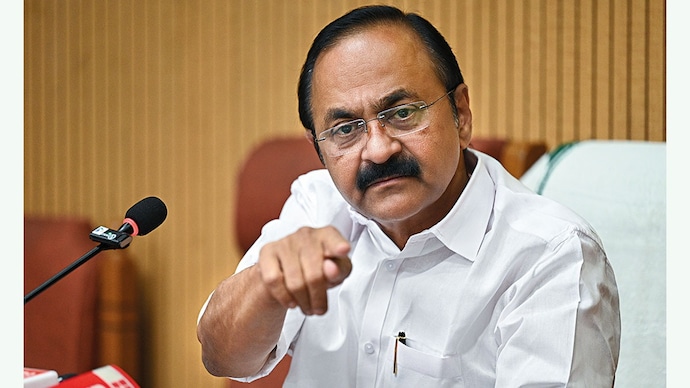
Kerala faces a real deluge, a recurring monsoon nightmare since 2017, but both sides of the state’s political binary are drowning in troubles writ by their own actions. Congress chief minister V.D. Satheeshan, who outsmarted everyone to get to his chair, may be bringing his honeymoon period to a quick end by opening up too many fronts. His combative, self-willed decision-making—a contrast to his endearing “Pookie CM” image in the public—risks alienating even segments who back him. The CPI(M), licking its wounds after a bruising defeat in the Left’s sole remaining citadel, finds itself adrift and still groping for ways to win friends and influence people—including its own cadre.
Kerala faces a real deluge, a recurring monsoon nightmare since 2017, but both sides of the state’s political binary are drowning in troubles writ by their own actions. Congress chief minister V.D. Satheeshan, who outsmarted everyone to get to his chair, may be bringing his honeymoon period to a quick end by opening up too many fronts. His combative, self-willed decision-making—a contrast to his endearing “Pookie CM” image in the public—risks alienating even segments who back him. The CPI(M), licking its wounds after a bruising defeat in the Left’s sole remaining citadel, finds itself adrift and still groping for ways to win friends and influence people—including its own cadre.
Kerala faces a real deluge, a recurring monsoon nightmare since 2017, but both sides of the state’s political binary are drowning in troubles writ by their own actions. Congress chief minister V.D. Satheeshan, who outsmarted everyone to get to his chair, may be bringing his honeymoon period to a quick end by opening up too many fronts. His combative, self-willed decision-making—a contrast to his endearing “Pookie CM” image in the public—risks alienating even segments who back him. The CPI(M), licking its wounds after a bruising defeat in the Left’s sole remaining citadel, finds itself adrift and still groping for ways to win friends and influence people—including its own cadre.
Both may find succour in the other’s predicament. The Left can watch with ironic satisfaction as Satheeshan’s own party leaders revolt against his “authoritarian” style. What brought on such a charge? A string of contentious decisions bearing his imprint. As finance minister, he halved excise duty on low alcohol drinks without consulting his party or the larger United Democratic Front (UDF). He also allocated Rs 100 crore for the Rare Earth and Critical Minerals Corridor, a joint central-state initiative. Then, as law minister, he appointed people of his choice as public prosecutors in the high court and pleaders in district courts—again without consulting the state unit or the UDF. What’s more, his list included many CPI(M), CPI and BJP loyalists.
RARE EARTH RADIATION
The excise duty cut upset those with a strong anti-liquor stand, like former state unit chief V.M. Sudheeran, who felt it went directly against the party manifesto. On the rare earth corridor, AICC general secretary K.C. Venugopal—VDS’s chief rival in the CM’s race and an MP from littoral Alappuzha—isn’t the only critic. The Latin Catholic Church and the fishing community say they won’t allow mining on Kerala’s coast, but the CM hasn’t yielded to their request to reconsider. And the leadership of the Kerala Student Union (KSU), the Congress student wing, is up in arms over prime legal posts being handed over to “political enemies” while many Congress lawyers stay sidelined.
Dr Aloshious Xavier, KSU chief, openly raised the banner of revolt. The CM went ahead regardless, saying his list was merit-based, drawn up with the advocate-general, and recommended by the state party’s lawyers’ wing. The latter promptly denied this, saying several appointees were not from their list. The CM’s response was pugnacious, unadorned by the usual wheedling. “They (KSU) have no business appointing public prosecutors or pleaders. It’s not their job,” he said. When Xavier sought an appointment with him, he refused. Later, when the KSU chief waited in a crowd of college alumni to meet the CM at a function on July 17, Satheeshan ignored him and walked away.
The CM copped the most cutting slur in Kerala’s secular polity as Congress spokesperson V.R. Anoop, speaking to india today, pointed out that the CM had “found time to meet Hindu United Forum leaders at his office at short notice”. That line of critique deepened when the A-G filed an affidavit supporting petitions—including one from the BJP—that challenged the Kerala Waqf Board as ‘invalid’ since it excluded non-Muslims. On that basis, the high court on July 15 restrained the board’s activities. The Indian Union Muslim League, whose support was key to Satheesan becoming CM, is seething, as are other Muslim wings.
WHO OPENED THE GATES?
The charge of being soft on the BJP, curiously, has come up against the CPI(M) too—from its own central committee, which met in Delhi on July 11-13 to discuss the Kerala loss. Its report was mostly on expected lines: lapses in candidate selection, a campaign centering Pinarayi Vijayan as the sole leader, a complacent ‘Who Else But LDF’ plank.
But ascribing the dip in the CPI(M)’s vote share to its “lowest in 40 years” to minority angst, it flagged a strange episode: UP CM Yogi Adityanath’s message being read out at the Global Ayyappa Meet in Pampa on September 20, 2025, by a then minister, a state secretariat member at that. “(That) was a major embarrassment to the party’s secular image,” the CC report said. “Such an act sent a wrong message to the people and conveyed an impression that we are soft towards Hindutva communal forces,” it added. That image was further bolstered, it said, with the state leadership’s weak counters to the anti-Muslim utterances of Vellappally Natesan, leader of the influential Ezhava outfit SNDP.
The CC’s intervention is viewed as an attempt to regain the cadre’s confidence. But the central leadership is seen as having remained a mute spectator in the affairs of Kerala, allowing a free run to Pinarayi for three decades—unwilling to intervene and content as long as the state was paying its bills.
“It’s a damage control exercise that may not help the CPI(M) regain its past glory in Kerala,” says former party MP Dr Sebastian Paul. “They have to pin their hopes on blunders by the Congress.” The good part for now, there may be no dearth of that.

