MLC elections | Warning from the ballots
Legislative council elections were perhaps never watched so closely. But four states leave some questions—written on ballot paper—for the BJP
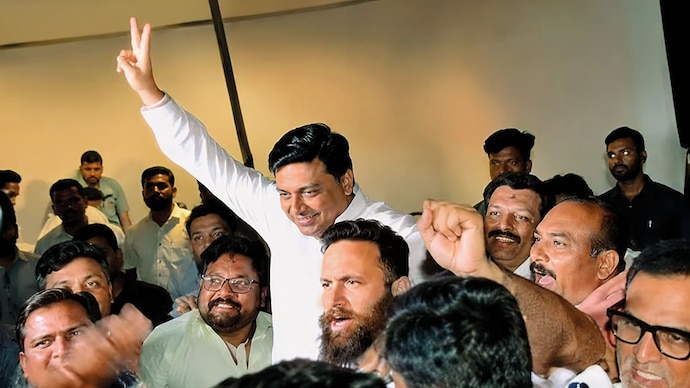
The counting in the Nagpur division graduates seat ran for over a tense 40 hours. The sitting Congress MLC, Abhijit Wanjarri, led by 927 votes on first preferences. Once transfers began, the BJP’s Sudhakar Kohale went ahead by about 4,300 votes after round two, and stayed in that zone for much of the count. The gap closed as later preferences were transferred. Late on October 28, with counting still on, Kohale conceded. “I congratulate them,” he told media. Wanjarri was declared winner early on October 29, by 3,271 votes. The cliffhanger, and how it swung, expressed a general truth.
The counting in the Nagpur division graduates seat ran for over a tense 40 hours. The sitting Congress MLC, Abhijit Wanjarri, led by 927 votes on first preferences. Once transfers began, the BJP’s Sudhakar Kohale went ahead by about 4,300 votes after round two, and stayed in that zone for much of the count. The gap closed as later preferences were transferred. Late on October 28, with counting still on, Kohale conceded. “I congratulate them,” he told media. Wanjarri was declared winner early on October 29, by 3,271 votes. The cliffhanger, and how it swung, expressed a general truth.
The counting in the Nagpur division graduates seat ran for over a tense 40 hours. The sitting Congress MLC, Abhijit Wanjarri, led by 927 votes on first preferences. Once transfers began, the BJP’s Sudhakar Kohale went ahead by about 4,300 votes after round two, and stayed in that zone for much of the count. The gap closed as later preferences were transferred. Late on October 28, with counting still on, Kohale conceded. “I congratulate them,” he told media. Wanjarri was declared winner early on October 29, by 3,271 votes. The cliffhanger, and how it swung, expressed a general truth.
The previous evening, with Nagpur still on the line, Prime Minister Narendra Modi had posted on X that elections had been held for 28 legislative council seats in four states, and asked how many the Congress had won. A rhetorical jab. For, at that point, the answer was zero. The polls use paper ballots, the very device the Congress has been pointedly saying bigger polls must return to. As Wanjarri won, it had a cross-punch ready: who won Nagpur?
The place naturally matters beyond an MLC seat. The BJP, and the Jana Sangh before it, held it for about 58 years until Wanjarri won it in 2020; Nitin Gadkari and Devendra Fadnavis’s father, the late Gangadharrao Fadnavis, have represented it. So, it’s home turf for the sitting chief minister as well as a top-tier Union minister. Above all, it’s a near-synonym for the Rashtriya Swayamsevak Sangh, the BJP’s ideological parent, whose century-old headquarters are here.
In all, the NDA won 16 seats out of 28, including 13 by the BJP. The Samajwadi Party (SP) won five, all in Uttar Pradesh. The NCP (Sharadchandra Pawar) won two; RJD, Jan Suraaj and Congress one each, and Independents two in Bihar.
This dashboard offers cues from a finite but complex electoral field. Only registered graduates or teachers vote—for scale, the electors in UP’s 11 seats totalled 1.48 million. Personal networks and teachers’ associations often count as much as party. Plus, voting follows Proportional Representation, with a Single Transferable Vote system. Electors don’t choose one name, they rank their choices on a preferential ballot. In tight fights, the second preferences of the lowest ranked names get transferred to those in play. So, paper ballots are a necessity—EVMs are built for First-Past-the-Post system that bigger polls follow.
This limits how far the results can be read as a guide to, say, the mood at the assembly level. Still, they offer a dipstick reading of the narratives running through an educated, politically engaged electorate. In UP, for instance, the headline tally was flat. Of 11 seats, BJP won six; SP five. Barely different from 2020, when it was BJP six, SP three, Independents two. But the details were less comfortable.
The BJP was a touch out of breath after retaining Gorakhpur-Faizabad Teachers in a close count against an Independent. That seat covers 17 districts within two divisions: one home turf for CM Yogi Adityanath, the other Ayodhya. Also, the SP retained both seats in Varanasi, the PM’s Lok Sabha constituency, And the one seat to pass from BJP to SP was Lucknow Graduates, in the state capital. The polls partly reflect anger among general castes over the contentious UGC rules, now under review.
A perfect zero
Early signs of anti-incumbency? With due caveats, that also applies to the Congress in Karnataka: BJP (3) and ally JD(S) won all four seats in play. In the first council polls since D.K. Shivakumar took over as CM and B.K. Hariprasad as state unit chief in June, the party’s tally answered PM Modi’s query: a perfect zero. A tone-setter for 2028, said BJP state chief B.Y. Vijayendra.
The NDA’s Bihar tally (4/8) isn’t a washout like Karnataka. But fifty-fifty may be seen as too middling for another new CM, Samrat Choudhary, after last year’s euphoria. Or a 50 per cent leap over the Bankipur rout in August. Overall, this is also the petridish after the Gen Z unrest. Choose one reading, or rank them, according to your preference.

