Decoding Ramayana's trailer score: How Zimmer and Rahman found its heartbeat
Director Nitesh Tiwari's Ramayana: Part 1 trailer gets an epic musical lift from Hans Zimmer and AR Rahman, whose score amplifies the scale, emotion and spiritual depth of Ram, Raavan and exile.
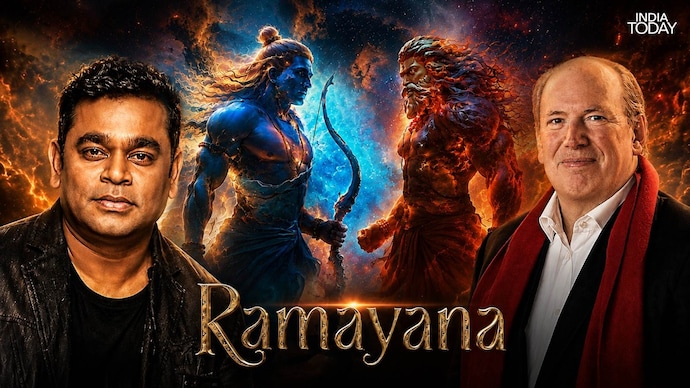
What happens when the man who made The Lion King roar, Gladiator march, Inception pulse and Interstellar soar turns his attention to the Indian epic The Ramayana? Add AR Rahman to that mix, and you have a soundtrack that was always going to be an event in itself. With the trailer for Nitesh Tiwari's Ramayana: Part 1 finally out, it's not just the grand visuals that have captured attention. The film's background score and music elevate every frame, adding emotional depth and making the epic's first glimpse all the more immersive.
Hans Zimmer and AR Rahman’s collaboration on Nitesh Tiwari’s Ramayana is significant not just because two Academy Award-winning composers are coming together, but because of what they are attempting to do with an epic that is already deeply ingrained in Indian culture.
Zimmer transformed the way audiences experience film music by crafting scores that are as memorable and emotionally commanding as the visuals. Rahman, on the other hand, takes on a different challenge with Ramayana – reimagining one of India's most cherished epics for a global audience without losing its cultural soul.
The trailer offers a compelling glimpse of that vision, blending Zimmer's cinematic scale with Rahman's distinctly Indian musical sensibilities.
The four minutes and nine seconds of Ramayana are undeniably massive, but it is the music that often makes the visuals feel the enormity of the film. The score knows when to thunder, when to pull back and, most importantly, when to let a moment breathe. It does not merely sit underneath the visuals; it appears to push the narrative forward.
Take Raavan’s entry.
The trailer begins with Yash’s Raavan walking into the frame with the kind of music that immediately establishes the presence of a mighty king. There is weight, menace and authority in the sound. And when he declares, “Tumhara naya raja Dev Lok, Prithvi Lok, Pataal Lok — teeno lokon mein ek hi raj hoga — Raavan raj” (Your new king. Across the heavens, the Earth and the netherworld, there will be only one rule – Raavan's rule), the swelling score and Yash's commanding screen presence make the dialogue land with far greater impact.
It feels like the arrival of someone who does not simply want a kingdom, he wants the three worlds. And that sensibility seems perfectly suited to a character as larger-than-life as Raavan.
The scene draws its power as much from the music as from the performances. Zimmer and Rahman's score heightens the emotion and scale, turning an already compelling sequence into one of the trailer's standout moments.
If Raavan gets the thunder, Ram gets something else entirely.
Ranbir Kapoor’s introduction as Lord Ram is quieter, more restrained. Riding a horse with a blindfold, Ram releases an arrow that cuts through the sound of a bell. The moment is striking on its own, but the background music mixed with tabla beats gives it another layer, turning a simple scene into something almost divine.
This contrast is something that is more interesting to watch in the trailer, especially on the big screens. While Raavan’s sound is built around power and dominance, Ram’s feels rooted in calm, control and purpose.
Then comes the vanvaas (exile) sequence.
The trailer captures Ram, Sita and Lakshman leaving for exile in a sequence steeped in emotion. The haunting chorus amplifies both the scale of the moment and the heartbreak it carries. Rather than merely telling us that Ram is leaving everything behind, the music makes us feel the weight of his sacrifice.
That is where Zimmer and Rahman's brilliance truly shines. Their music does more than complement the narrative—it deepens the emotion, heightens the drama and gives every scene a lasting resonance. In Ramayana, the score doesn't just accompany the visuals; it becomes an essential part of the storytelling.
Think of Zimmer’s Interstellar (2014), where the church organ becomes almost a character in itself, evoking both the vastness of space and the intimacy of human emotion. Tracks like Cornfield Chase and Mountains heightened the film’s themes of love, time and sacrifice without overpowering the visuals. Rahman has achieved something similar in Indian cinema, using music to give stories an emotional identity of their own, whether it was the haunting world of Roja (1992), the layered emotions of Bombay (1995), the nostalgia of Swades (2004) or the restless energy of Rockstar (2011).
Rahman's work in Mani Ratnam's Ponniyin Selvan films ranks among his most ambitious. Blending sweeping orchestral arrangements with traditional Indian instruments and evocative vocal compositions, he crafted a score that enriched the world of the Chola dynasty while lending the historical epic a sweeping sense of scale and grandeur.
That shared ability to make music an inseparable part of storytelling is what makes Zimmer and Rahman's collaboration on Ramayana so exciting. Zimmer has often relied on atmosphere, recurring motifs, deep bass, electronic textures and sweeping orchestral crescendos to create tension, awe and anticipation. Rahman, meanwhile, brings his distinct musical sensibility, merging Indian classical influences, rich melodies and spiritual undertones with modern soundscapes.
Together, they give Ramayana a musical language that can move between spectacle and spirituality without losing either.
While we have described all the moments, it would be unfair to omit the finale of the trailer, which takes the story a notch higher.
It is the portion featuring the song Dharti Hai Ambar alongside the Sanskrit chants. The voices rise, the score expands and suddenly the entire world of Ramayana feels larger, almost spiritual, reviving the Treta Yuga story on the big screen.
The Ramayana soundtrack, therefore, has the potential to occupy a fascinating space between the familiar and the new.
The 68-year-old Hollywood musician often says that film music isn’t there to tell you what is happening. It’s there to tell you why it matters. That’s why his music lingers long after the credits roll.
Whether Ramayana ultimately lives up to its towering ambitions will only be known when it reaches theatres. But if the trailer is any indication, Zimmer and Rahman have already achieved something remarkable. They have found a musical language that bridges East and West, spectacle and spirituality, turning a story that generations have grown up with into an experience that feels both timeless and new. In a trailer filled with breathtaking visuals, it is the music that leaves the deepest imprint.
What happens when the man who made The Lion King roar, Gladiator march, Inception pulse and Interstellar soar turns his attention to the Indian epic The Ramayana? Add AR Rahman to that mix, and you have a soundtrack that was always going to be an event in itself. With the trailer for Nitesh Tiwari's Ramayana: Part 1 finally out, it's not just the grand visuals that have captured attention. The film's background score and music elevate every frame, adding emotional depth and making the epic's first glimpse all the more immersive.
Hans Zimmer and AR Rahman’s collaboration on Nitesh Tiwari’s Ramayana is significant not just because two Academy Award-winning composers are coming together, but because of what they are attempting to do with an epic that is already deeply ingrained in Indian culture.
Zimmer transformed the way audiences experience film music by crafting scores that are as memorable and emotionally commanding as the visuals. Rahman, on the other hand, takes on a different challenge with Ramayana – reimagining one of India's most cherished epics for a global audience without losing its cultural soul.
The trailer offers a compelling glimpse of that vision, blending Zimmer's cinematic scale with Rahman's distinctly Indian musical sensibilities.
The four minutes and nine seconds of Ramayana are undeniably massive, but it is the music that often makes the visuals feel the enormity of the film. The score knows when to thunder, when to pull back and, most importantly, when to let a moment breathe. It does not merely sit underneath the visuals; it appears to push the narrative forward.
Take Raavan’s entry.
The trailer begins with Yash’s Raavan walking into the frame with the kind of music that immediately establishes the presence of a mighty king. There is weight, menace and authority in the sound. And when he declares, “Tumhara naya raja Dev Lok, Prithvi Lok, Pataal Lok — teeno lokon mein ek hi raj hoga — Raavan raj” (Your new king. Across the heavens, the Earth and the netherworld, there will be only one rule – Raavan's rule), the swelling score and Yash's commanding screen presence make the dialogue land with far greater impact.
It feels like the arrival of someone who does not simply want a kingdom, he wants the three worlds. And that sensibility seems perfectly suited to a character as larger-than-life as Raavan.
The scene draws its power as much from the music as from the performances. Zimmer and Rahman's score heightens the emotion and scale, turning an already compelling sequence into one of the trailer's standout moments.
If Raavan gets the thunder, Ram gets something else entirely.
Ranbir Kapoor’s introduction as Lord Ram is quieter, more restrained. Riding a horse with a blindfold, Ram releases an arrow that cuts through the sound of a bell. The moment is striking on its own, but the background music mixed with tabla beats gives it another layer, turning a simple scene into something almost divine.
This contrast is something that is more interesting to watch in the trailer, especially on the big screens. While Raavan’s sound is built around power and dominance, Ram’s feels rooted in calm, control and purpose.
Then comes the vanvaas (exile) sequence.
The trailer captures Ram, Sita and Lakshman leaving for exile in a sequence steeped in emotion. The haunting chorus amplifies both the scale of the moment and the heartbreak it carries. Rather than merely telling us that Ram is leaving everything behind, the music makes us feel the weight of his sacrifice.
That is where Zimmer and Rahman's brilliance truly shines. Their music does more than complement the narrative—it deepens the emotion, heightens the drama and gives every scene a lasting resonance. In Ramayana, the score doesn't just accompany the visuals; it becomes an essential part of the storytelling.
Think of Zimmer’s Interstellar (2014), where the church organ becomes almost a character in itself, evoking both the vastness of space and the intimacy of human emotion. Tracks like Cornfield Chase and Mountains heightened the film’s themes of love, time and sacrifice without overpowering the visuals. Rahman has achieved something similar in Indian cinema, using music to give stories an emotional identity of their own, whether it was the haunting world of Roja (1992), the layered emotions of Bombay (1995), the nostalgia of Swades (2004) or the restless energy of Rockstar (2011).
Rahman's work in Mani Ratnam's Ponniyin Selvan films ranks among his most ambitious. Blending sweeping orchestral arrangements with traditional Indian instruments and evocative vocal compositions, he crafted a score that enriched the world of the Chola dynasty while lending the historical epic a sweeping sense of scale and grandeur.
That shared ability to make music an inseparable part of storytelling is what makes Zimmer and Rahman's collaboration on Ramayana so exciting. Zimmer has often relied on atmosphere, recurring motifs, deep bass, electronic textures and sweeping orchestral crescendos to create tension, awe and anticipation. Rahman, meanwhile, brings his distinct musical sensibility, merging Indian classical influences, rich melodies and spiritual undertones with modern soundscapes.
Together, they give Ramayana a musical language that can move between spectacle and spirituality without losing either.
While we have described all the moments, it would be unfair to omit the finale of the trailer, which takes the story a notch higher.
It is the portion featuring the song Dharti Hai Ambar alongside the Sanskrit chants. The voices rise, the score expands and suddenly the entire world of Ramayana feels larger, almost spiritual, reviving the Treta Yuga story on the big screen.
The Ramayana soundtrack, therefore, has the potential to occupy a fascinating space between the familiar and the new.
The 68-year-old Hollywood musician often says that film music isn’t there to tell you what is happening. It’s there to tell you why it matters. That’s why his music lingers long after the credits roll.
Whether Ramayana ultimately lives up to its towering ambitions will only be known when it reaches theatres. But if the trailer is any indication, Zimmer and Rahman have already achieved something remarkable. They have found a musical language that bridges East and West, spectacle and spirituality, turning a story that generations have grown up with into an experience that feels both timeless and new. In a trailer filled with breathtaking visuals, it is the music that leaves the deepest imprint.
What happens when the man who made The Lion King roar, Gladiator march, Inception pulse and Interstellar soar turns his attention to the Indian epic The Ramayana? Add AR Rahman to that mix, and you have a soundtrack that was always going to be an event in itself. With the trailer for Nitesh Tiwari's Ramayana: Part 1 finally out, it's not just the grand visuals that have captured attention. The film's background score and music elevate every frame, adding emotional depth and making the epic's first glimpse all the more immersive.
Hans Zimmer and AR Rahman’s collaboration on Nitesh Tiwari’s Ramayana is significant not just because two Academy Award-winning composers are coming together, but because of what they are attempting to do with an epic that is already deeply ingrained in Indian culture.
Zimmer transformed the way audiences experience film music by crafting scores that are as memorable and emotionally commanding as the visuals. Rahman, on the other hand, takes on a different challenge with Ramayana – reimagining one of India's most cherished epics for a global audience without losing its cultural soul.
The trailer offers a compelling glimpse of that vision, blending Zimmer's cinematic scale with Rahman's distinctly Indian musical sensibilities.
The four minutes and nine seconds of Ramayana are undeniably massive, but it is the music that often makes the visuals feel the enormity of the film. The score knows when to thunder, when to pull back and, most importantly, when to let a moment breathe. It does not merely sit underneath the visuals; it appears to push the narrative forward.
Take Raavan’s entry.
The trailer begins with Yash’s Raavan walking into the frame with the kind of music that immediately establishes the presence of a mighty king. There is weight, menace and authority in the sound. And when he declares, “Tumhara naya raja Dev Lok, Prithvi Lok, Pataal Lok — teeno lokon mein ek hi raj hoga — Raavan raj” (Your new king. Across the heavens, the Earth and the netherworld, there will be only one rule – Raavan's rule), the swelling score and Yash's commanding screen presence make the dialogue land with far greater impact.
It feels like the arrival of someone who does not simply want a kingdom, he wants the three worlds. And that sensibility seems perfectly suited to a character as larger-than-life as Raavan.
The scene draws its power as much from the music as from the performances. Zimmer and Rahman's score heightens the emotion and scale, turning an already compelling sequence into one of the trailer's standout moments.
If Raavan gets the thunder, Ram gets something else entirely.
Ranbir Kapoor’s introduction as Lord Ram is quieter, more restrained. Riding a horse with a blindfold, Ram releases an arrow that cuts through the sound of a bell. The moment is striking on its own, but the background music mixed with tabla beats gives it another layer, turning a simple scene into something almost divine.
This contrast is something that is more interesting to watch in the trailer, especially on the big screens. While Raavan’s sound is built around power and dominance, Ram’s feels rooted in calm, control and purpose.
Then comes the vanvaas (exile) sequence.
The trailer captures Ram, Sita and Lakshman leaving for exile in a sequence steeped in emotion. The haunting chorus amplifies both the scale of the moment and the heartbreak it carries. Rather than merely telling us that Ram is leaving everything behind, the music makes us feel the weight of his sacrifice.
That is where Zimmer and Rahman's brilliance truly shines. Their music does more than complement the narrative—it deepens the emotion, heightens the drama and gives every scene a lasting resonance. In Ramayana, the score doesn't just accompany the visuals; it becomes an essential part of the storytelling.
Think of Zimmer’s Interstellar (2014), where the church organ becomes almost a character in itself, evoking both the vastness of space and the intimacy of human emotion. Tracks like Cornfield Chase and Mountains heightened the film’s themes of love, time and sacrifice without overpowering the visuals. Rahman has achieved something similar in Indian cinema, using music to give stories an emotional identity of their own, whether it was the haunting world of Roja (1992), the layered emotions of Bombay (1995), the nostalgia of Swades (2004) or the restless energy of Rockstar (2011).
Rahman's work in Mani Ratnam's Ponniyin Selvan films ranks among his most ambitious. Blending sweeping orchestral arrangements with traditional Indian instruments and evocative vocal compositions, he crafted a score that enriched the world of the Chola dynasty while lending the historical epic a sweeping sense of scale and grandeur.
That shared ability to make music an inseparable part of storytelling is what makes Zimmer and Rahman's collaboration on Ramayana so exciting. Zimmer has often relied on atmosphere, recurring motifs, deep bass, electronic textures and sweeping orchestral crescendos to create tension, awe and anticipation. Rahman, meanwhile, brings his distinct musical sensibility, merging Indian classical influences, rich melodies and spiritual undertones with modern soundscapes.
Together, they give Ramayana a musical language that can move between spectacle and spirituality without losing either.
While we have described all the moments, it would be unfair to omit the finale of the trailer, which takes the story a notch higher.
It is the portion featuring the song Dharti Hai Ambar alongside the Sanskrit chants. The voices rise, the score expands and suddenly the entire world of Ramayana feels larger, almost spiritual, reviving the Treta Yuga story on the big screen.
The Ramayana soundtrack, therefore, has the potential to occupy a fascinating space between the familiar and the new.
The 68-year-old Hollywood musician often says that film music isn’t there to tell you what is happening. It’s there to tell you why it matters. That’s why his music lingers long after the credits roll.
Whether Ramayana ultimately lives up to its towering ambitions will only be known when it reaches theatres. But if the trailer is any indication, Zimmer and Rahman have already achieved something remarkable. They have found a musical language that bridges East and West, spectacle and spirituality, turning a story that generations have grown up with into an experience that feels both timeless and new. In a trailer filled with breathtaking visuals, it is the music that leaves the deepest imprint.

