VFX of Ramayana vs Godzilla Minus Zero: Do we have a clear winner?
Godzilla Minus Zero wins on precision, but Ramayana is attempting something far bigger. And that's what makes this VFX battle interesting.
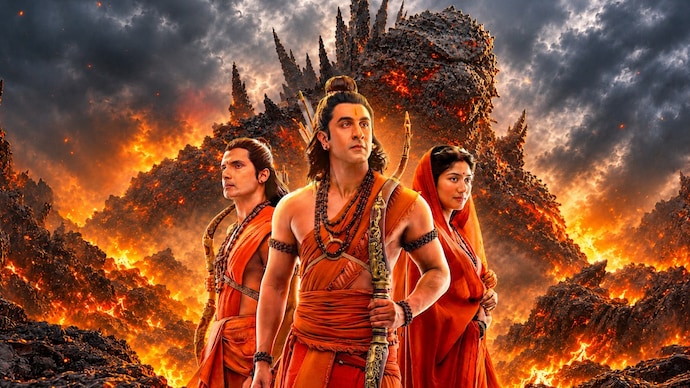
CG, visual effects and world-building have become major selling points for big-screen spectacles, especially films chasing global audiences. The aim is immersive worlds, larger-than-life characters and a theatrical experience that justifies the premium-format ticket. Hollywood long owned this space, but other industries are now stepping up.
Two films tapping into this trend are India's Ramayana, rooted in mythology and cultural heritage, and Japan's Godzilla Minus Zero, the sequel to the Oscar-winning Godzilla Minus One. Both have made their mark at the box office in different markets, and both have their visual effects at the centre of the conversation. So, is there a clear winner?
First, the awkward bit: the two films are difficult to compare. One is a post-war monster movie from Tokyo, made by a relatively small team on a reported budget of $13 million to $20 million. The other is India's most expensive film production, a two-part retelling of an epic older than cinema, reportedly costing around $500 million across both parts and backed by DNEG, the eight-time Academy Award-winning studio behind Dune and Interstellar.
So why compare them? Because the internet already has. Godzilla Minus Zero follows the film that won Japan its first VFX Oscar and is the first Japanese production shot for IMAX. Ramayana: Part 1 is India's attempt to claim a place on the same global stage. With both arriving within days of each other in early November, comparisons of their promotional visuals were inevitable.
The short answer is no, there is no clear winner. The longer answer is that it depends on what you reward.
Round one: models, mass and scale
Godzilla Minus Zero keeps its roster tight, focusing on Godzilla and King Ghidorah, and the execution is excellent. The dinosaur-like anatomy, skin textures and fine detailing are remarkably convincing, especially given the budget. A tight roster is also a safer proposition, though: two creatures are far easier to perfect than dozens.
Director Takashi Yamazaki, who comes from a visual effects background, understands that making a monster feel enormous doesn't necessarily require a bigger model or set pieces. Low camera angles and long lenses compress perspective so that Godzilla looms over his surroundings. The scale comes from composition and from the way the world responds to the creature.
Ramayana is playing a different game. Its roster includes daanavs (demons or asuras), Taraka, Subahu, Kumbhakarna, mythical animals and, most importantly, Jatayu. The variety is impressive, but audiences already carry strong visual expectations of these characters. Kumbhakarna and the Khar-Dushan pair look distractingly artificial, and too many asuras blur into one another. Creating an entire range of mythological beings is no easy task, but the modelling has room to improve.
Jatayu, however, is where Ramayana truly takes flight. The detailing, anatomy, expressions, wing movements and interaction with the environment make it a remarkable CG creation. Cinematographer Pankaj Kumar revealed that Jatayu was entirely CG, with an exact-size physical model used on set to help Yash understand the bird's proportions. Director Nitesh Tiwari says the Ravana-Jatayu sequence took six and a half years from first brief to final shot.
On models, Godzilla surely gets the edge, though Ramayana's creature work isn't distracting in its entirety. But in sheer mass and scale, Ramayana is unmistakably the more ambitious film and outperforms Godzilla by miles.
Round two: CG world building and set extensions
This is where Ramayana comes out swinging. The biggest challenge in mythological cinema is making ancient worlds feel lived-in rather than like elaborate green-screen backdrops. Shot largely on soundstages, the film combines large practical foreground sets with DNEG's digital extensions to recreate Ayodhya, Mithila, Dandakaranya and Lanka. Each has its own colours, textures and atmosphere, and that consistency is central to the world-building.
Ayodhya and Swarna Lanka are breathtaking, but the forest portions are where the film's visual effects feel less convincing, with occasional lighting inconsistencies and environments that lack natural textures. However, these sequences are built around heroes swinging between trees and battling giant monsters, where the emphasis is on spectacle and fantasy rather than realism. The creative intent is clearly to build a heightened fantasy world.
Personally, though, I would still take real locations over digital extensions whenever possible. Natural landscapes have a texture and unpredictability that are difficult to recreate, and the forests here sometimes feel too clean to convey a sense of danger. Even so, when it comes to which film took on the bigger world-building challenge, Ramayana clearly has the edge.
Godzilla Minus Zero works with a more contained world and executes it beautifully. Set largely in devastated post-war Japan, much of it is brought to life through real locations and practical sets, giving it an authenticity that is harder to achieve digitally, and most of its set extensions blend seamlessly into the live-action footage. Godzilla builds on the details of existing environments, whereas Ramayana has to digitally create worlds audiences have never seen before. That is also where its limitation lies: the ravaged-Japan setting feels more like a refinement of the first film than an entirely new visual undertaking.
Ghidorah's opening attack on Matsumoto is a standout example of this hybrid approach. Practical set elements and careful camera movement establish depth and natural lighting, while CGI takes over when the scale of destruction demands it. The result feels grounded rather than like weightless debris.
Round three: simulations
Here the Japanese film is in a league of its own, and the reason has a name: VFX artist Tatsuji Nojima. He won an Oscar at 25 for the water in the first film, and the sequel is another masterclass in fluidity and atmosphere. The churned ocean, the foam peeling off Godzilla's enlarged dorsal plates and the storm clouds charged with lightning as Ghidorah takes flight all stand out. Water and fire are among the hardest elements to recreate in VFX, and the human eye recognises them instinctively. Poorly executed water can look like slow-motion jelly. Nojima's water looks convincingly wet and fluid.
Shirogumi's VFX team grew only from about 35 artists to around 50, yet one fully CG seaplane shot reached two billion simulated water particles, roughly ten times the first film's figure. Nojima also studied high-speed footage of real lightning so that Ghidorah's strikes leave particles behind instead of vanishing like a comic-book flash. The destruction is just as convincing: Ghidorah's gravity beams lift entire wooden buildings before slamming them down in a spray of dust and debris. The best compliment I can pay it is that it reads as physics, not animation.
Ramayana tackles a different simulation problem, and its scale is massive in its own right. DNEG juggled snow, water, land and large crowds alongside intricate simulations such as Jatayu's layered feathers, flowing garments and forest canopies reacting to wind shear. The astras (divine weapons) are handled smartly. Instead of the flat, neon-laser look that tripped up earlier Indian mythological films, they are anchored in elemental forces: compressed air, heat distortion, embers and shockwaves that ruffle costumes, bend foliage and kick up dust. It is a more grounded reading of a divine weapon, and it works.
Both studios excel at what their stories demand, but water, storm and destruction at that level of physical weight remain the toughest benchmark in the business, and Shirogumi cleared it.
Round four: physical interaction and the real world
The real test of VFX is not how convincing a digital creature or environment looks in isolation, but how naturally it interacts with everything around it.
Godzilla Minus Zero handles this especially well in its flight sequences. Aircraft, creatures and environments feel like they share the same physical space. Practical cockpit interiors, combined with physical lighting effects that recreate lightning flashes on the glass and the actors' faces, help the digital storms and creatures blend naturally into the shots. Much of this happens in storms, smoke and sea spray, which forgive a lot, but even in the creature battles the shadows, lighting and interaction are on point.
Ramayana's standout is the introductory battle sequence. Characters, crowds, creatures and the natural environment come together breathtakingly, with dust, snow, sunlight and atmosphere grounding the action. The use of daylight in most of the film makes this especially hard, since digital elements must match the natural lighting, shadows and reflections on live-action characters and sets. When it works, it is striking. However, a few shots with extensive sky replacement show lighting mismatches between physical elements and digital backgrounds, and the effects-heavy forest skirmishes can dissolve into a bright blur.
Round five: compositing, cameras and cohesion
The final test is whether the camera believes in what it is looking at. Godzilla Minus Zero's rule is discipline: the camera never does anything a real camera could not, so the monsters sit inside a recognisable photographic language. The approach is largely basic and leaves little room for experimentation. That restraint, however, comes at a cost. The much-anticipated Ghidorah showdown feels underwhelming, while the title monster itself disappears for long stretches, with the film choosing to give more room to its human drama.
Ramayana's VFX pipeline is the industrial opposite. The film reportedly involved around 9,500 VFX shots across a 600-day post-production schedule, reflecting the sheer scale of its visual ambition. The results, however, are uneven. While the principal environments and larger set pieces often look impressive, secondary crowds and demons appear slightly flat, particularly in wide daylight shots. Scenes such as the Swayamvar and the forest war also expose the limits of digital crowds, which lack the natural movement and variation needed to feel alive.
Finish also varies across sequences: Ravana's portions look sharper than some Ayodhya establishing shots, where lighting and texture occasionally lack consistency. However, the Jatayu sequence and the Pushpak Vimana visuals show what the pipeline can achieve at its best, combining scale, detail and spectacle.
So who wins?
The winner ultimately depends on what viewers value in a VFX spectacle. Godzilla Minus Zero excels in technical execution, with superior creature movement, physical interactions, lighting and compositing. Its restraint makes the effects feel remarkably grounded, especially on a fraction of Ramayana's reported budget. However, its limited monster screen time and greater focus on human drama mean the VFX showcase is relatively contained.
Ramayana, on the other hand, scores higher on ambition and world-building. Creating an entire mythological universe, bringing fantastical creatures to life and staging large-scale battles across digitally constructed environments is a far bigger undertaking. Its execution is inconsistent, but sequences involving Jatayu, Lanka and the astras show the scale of its achievement. Ultimately, Godzilla Minus Zero is the more technically accomplished film, while Ramayana offers the grander visual spectacle. Which one wins comes down to whether one values technical precision or sheer scale and imagination.

