Maa Inti Baangaram and Tollywood's 16-year wait to break Arundhati's record
Samantha Ruth Prabhu's Maa Inti Bangaaram has crossed Arundhati's lifetime worldwide gross within 10 days. The run has renewed focus on how rarely Tollywood backs solo woman-led commercial films.
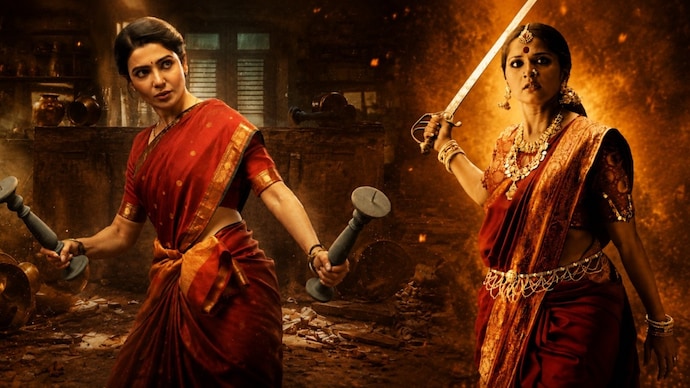
Sixteen years. That is a long time for a box office record to stand in an industry that resets its benchmarks every Friday. Now imagine a woman-led film holding that record for almost two decades. Inspiring, isn't it? In the last 16 years, Telugu cinema has watched male stars rewrite the Rs 100-crore mark, then the Rs 500-crore mark, then the Rs 1000-crore mark, sometimes more than once a year. And yet the record for a solo woman-led commercial film – Anushka Shetty's Arundhati, released in 2009 – sat untouched through all of it. Until now. Samantha Ruth Prabhu's Maa Inti Bangaaram, in just 10 days, has quietly and finally gone past Arundhati's lifetime collection.
The film's worldwide gross has crossed approximately Rs 78.71 crore by its ninth and tenth days, edging past Arundhati's lifetime total of around Rs 70 crore. It hasn't caught up with Mahanati's Rs 84.5 crore – a number that gets invoked in the same breath almost reflexively whenever this conversation comes up. That comparison, though, isn't a fair one to make. But that's a debate for another time.
Arundhati, a horror film that hit theatres in 2009, shattered box office records on release and even performed better than films led by male heroes at the time.
What makes this moment land isn't simply that a record fell – it's how long it took to fall, and what was happening in the industry while it stood. The years since Arundhati have been dominated almost entirely by mass heroes, pan-India spectacle, and a box office discourse organised around male stars and machismo-loaded franchises: Baahubali, KGF, Pushpa, Kalki 2898 AD, Peddi, and the rest of that lineage.
Crore counts in the hundreds, sometimes thousands, have become a routine measure of a hero's stardom, especially since Baahubali happened. It is not that a woman-led film has never released in the past 16-plus years. There were a handful, with some earning critical acclaim and some ending up as damp squibs, but none that could make a big dent at the box office. A solo woman-led film entering that same conversation, without a male co-lead to share billing or box office credit, has been rare enough that each instance gets treated as a novelty rather than a pattern.
That scarcity is itself the point. It isn't that audiences don't want to watch women carry a film – Maa Inti Bangaaram's own trajectory argues against that theory. The film opened to over Rs 43 crore worldwide in its first weekend, then kept building rather than collapsing after the opening rush, a pattern usually associated with films riding on a male star's pre-existing fan base rather than reviews and word of mouth.
By its second Friday, it was still adding meaningfully to its tally instead of falling off the cliff that solo female leads have historically been expected to fall off. That's not how a "special interest" film behaves. That's how a mainstream hit behaves. A film is truly considered a hit when women and family audiences throng theatres. And Maa Inti Bangaaram saw women in hordes enjoying the BV Nandini Reddy-directorial.
Why Mahanati doesn't count the same way
Mahanati, directed by Nag Ashwin, is a biopic on the life of legendary actor Savitri. It is routinely cited as the woman-led film that already outdid Arundhati, and on paper, yes, it earned more – it raked in Rs 85 crore in its lifetime. But one cannot compare Mahanati with either Arundhati or Maa Inti Bangaaram, simply because it has a cushioning that these two films never did.
Mahanati was never a one-woman show in the way Arundhati or Maa Inti Bangaaram are. Keerthy Suresh anchored it and carried its emotional weight, but the film leaned heavily on an ensemble of recognisable names – Dulquer Salmaan, Vijay Devarakonda, Samantha herself in a cameo, among others – layered over a sprawling, multi-era biographical canvas on a huge budget that pulled audiences in for reasons well beyond its lead alone. It was also a film about a beloved real figure, Savitri, which gave it a built-in nostalgia engine that no amount of marketing can manufacture from scratch.
Arundhati and Maa Inti Bangaaram don't have that cushion. Both are entirely original commercial films, built around their heroines with no ensemble to share the load and no real-life legend to lean on. The film succeeds or fails on the audience's appetite for watching one woman alone hold the screen for two-plus hours of a mainstream masala template – action, drama, mass elevation, the works. That is a narrower, harder bar to clear than Mahanati's.
It's the bar Arundhati set in 2009, and it's the bar Samantha has now cleared in 2026.
Maa Inti Bangaaram's true achievement
There's a version of this story where Maa Inti Bangaaram gets filed away as a nice feel-good footnote - Samantha's biggest solo opening, her best comeback film after a three-year gap, a win for her fairly new production banner. All of that is true. But reducing it to a personal milestone misses what it represents at the industry level: proof, sixteen years overdue, that a solo female lead commercial film can still compete in a marketplace that has spent a decade and a half telling itself, through sheer repetition, that only men can open and sustain a theatrical run on star power alone.
The discomfort worth sitting with is this – an industry that releases hundreds of films every year took sixteen years to produce another one confident enough to bet on a woman alone, that too in a conventional commercial template, with a woman in a saree fighting for her family, without diluting that bet with an ensemble or a real-life legend to fall back on. That's not a comment on what audiences will or won't watch. Maa Inti Bangaaram has already disproved that theory at the box office. It's a comment on what the industry was willing to greenlight, budget, and back in the years in between. And the fact that Samantha was the actor and producer, with her writer-husband Raj Nidimoru behind the story and as co-producer, makes it even more special.
Samantha didn't need flashy budgets or an ensemble cast to get to the magic number. She relied on a solid story, worked on strict budgets, fronted her own story, and took that bet. It took sixteen years. Whether it takes another sixteen for the next one is the question this film leaves hanging over Tollywood – and the answer, this time, is in Telugu cinema's hands, not the audience's.
Sixteen years. That is a long time for a box office record to stand in an industry that resets its benchmarks every Friday. Now imagine a woman-led film holding that record for almost two decades. Inspiring, isn't it? In the last 16 years, Telugu cinema has watched male stars rewrite the Rs 100-crore mark, then the Rs 500-crore mark, then the Rs 1000-crore mark, sometimes more than once a year. And yet the record for a solo woman-led commercial film – Anushka Shetty's Arundhati, released in 2009 – sat untouched through all of it. Until now. Samantha Ruth Prabhu's Maa Inti Bangaaram, in just 10 days, has quietly and finally gone past Arundhati's lifetime collection.
The film's worldwide gross has crossed approximately Rs 78.71 crore by its ninth and tenth days, edging past Arundhati's lifetime total of around Rs 70 crore. It hasn't caught up with Mahanati's Rs 84.5 crore – a number that gets invoked in the same breath almost reflexively whenever this conversation comes up. That comparison, though, isn't a fair one to make. But that's a debate for another time.
Arundhati, a horror film that hit theatres in 2009, shattered box office records on release and even performed better than films led by male heroes at the time.
What makes this moment land isn't simply that a record fell – it's how long it took to fall, and what was happening in the industry while it stood. The years since Arundhati have been dominated almost entirely by mass heroes, pan-India spectacle, and a box office discourse organised around male stars and machismo-loaded franchises: Baahubali, KGF, Pushpa, Kalki 2898 AD, Peddi, and the rest of that lineage.
Crore counts in the hundreds, sometimes thousands, have become a routine measure of a hero's stardom, especially since Baahubali happened. It is not that a woman-led film has never released in the past 16-plus years. There were a handful, with some earning critical acclaim and some ending up as damp squibs, but none that could make a big dent at the box office. A solo woman-led film entering that same conversation, without a male co-lead to share billing or box office credit, has been rare enough that each instance gets treated as a novelty rather than a pattern.
That scarcity is itself the point. It isn't that audiences don't want to watch women carry a film – Maa Inti Bangaaram's own trajectory argues against that theory. The film opened to over Rs 43 crore worldwide in its first weekend, then kept building rather than collapsing after the opening rush, a pattern usually associated with films riding on a male star's pre-existing fan base rather than reviews and word of mouth.
By its second Friday, it was still adding meaningfully to its tally instead of falling off the cliff that solo female leads have historically been expected to fall off. That's not how a "special interest" film behaves. That's how a mainstream hit behaves. A film is truly considered a hit when women and family audiences throng theatres. And Maa Inti Bangaaram saw women in hordes enjoying the BV Nandini Reddy-directorial.
Why Mahanati doesn't count the same way
Mahanati, directed by Nag Ashwin, is a biopic on the life of legendary actor Savitri. It is routinely cited as the woman-led film that already outdid Arundhati, and on paper, yes, it earned more – it raked in Rs 85 crore in its lifetime. But one cannot compare Mahanati with either Arundhati or Maa Inti Bangaaram, simply because it has a cushioning that these two films never did.
Mahanati was never a one-woman show in the way Arundhati or Maa Inti Bangaaram are. Keerthy Suresh anchored it and carried its emotional weight, but the film leaned heavily on an ensemble of recognisable names – Dulquer Salmaan, Vijay Devarakonda, Samantha herself in a cameo, among others – layered over a sprawling, multi-era biographical canvas on a huge budget that pulled audiences in for reasons well beyond its lead alone. It was also a film about a beloved real figure, Savitri, which gave it a built-in nostalgia engine that no amount of marketing can manufacture from scratch.
Arundhati and Maa Inti Bangaaram don't have that cushion. Both are entirely original commercial films, built around their heroines with no ensemble to share the load and no real-life legend to lean on. The film succeeds or fails on the audience's appetite for watching one woman alone hold the screen for two-plus hours of a mainstream masala template – action, drama, mass elevation, the works. That is a narrower, harder bar to clear than Mahanati's.
It's the bar Arundhati set in 2009, and it's the bar Samantha has now cleared in 2026.
Maa Inti Bangaaram's true achievement
There's a version of this story where Maa Inti Bangaaram gets filed away as a nice feel-good footnote - Samantha's biggest solo opening, her best comeback film after a three-year gap, a win for her fairly new production banner. All of that is true. But reducing it to a personal milestone misses what it represents at the industry level: proof, sixteen years overdue, that a solo female lead commercial film can still compete in a marketplace that has spent a decade and a half telling itself, through sheer repetition, that only men can open and sustain a theatrical run on star power alone.
The discomfort worth sitting with is this – an industry that releases hundreds of films every year took sixteen years to produce another one confident enough to bet on a woman alone, that too in a conventional commercial template, with a woman in a saree fighting for her family, without diluting that bet with an ensemble or a real-life legend to fall back on. That's not a comment on what audiences will or won't watch. Maa Inti Bangaaram has already disproved that theory at the box office. It's a comment on what the industry was willing to greenlight, budget, and back in the years in between. And the fact that Samantha was the actor and producer, with her writer-husband Raj Nidimoru behind the story and as co-producer, makes it even more special.
Samantha didn't need flashy budgets or an ensemble cast to get to the magic number. She relied on a solid story, worked on strict budgets, fronted her own story, and took that bet. It took sixteen years. Whether it takes another sixteen for the next one is the question this film leaves hanging over Tollywood – and the answer, this time, is in Telugu cinema's hands, not the audience's.

