Consent empowerment: Rhetoric is elevating, reality can be sobering
India has made significant progress in recognising that "No means no," but a wide gap persists between awareness and lived experience. Young, low-income, semi-urban, divorced and economically dependent women remain especially vulnerable, highlighting that true empowerment depends not just on education, but on economic agency and social change.
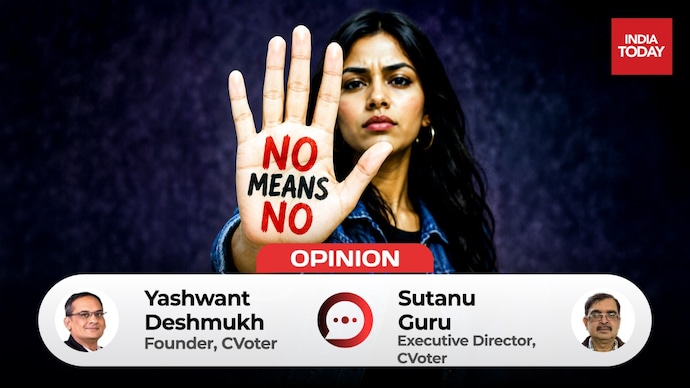


No means no has been a battle cry for gender justice across societies across age groups, and across all kinds of boundaries. Yet, when it comes to real life experiences, no means no often becomes a mirage.
No doubt there has been a dramatic improvement in gender justice as defined by consent empowerment of females. No doubt, no means no is now respected by a significantly higher proportion of males. And yet, there is that gap between perception and reality that should be troubling for Indian society.
An exclusive survey conducted for India Today on consent reveals both significant changes in societal norms in India and the persistence of societal pressures on women to conform, to accept and submit to pressures.
Overall, if you look at the results of the survey conducted across India, in all the states, across all social groups, age groups, gender, and education, plus income thresholds. It is heartening to see that close to 60 % of Indians now say that no means no is something that should be respected.
This is holding true across all geographical boundaries. There are variations, of course. For instance, North and West report higher awareness of consent empowerment, while South and East do lag behind, but not by a significant margin.
Now for reality and lived experience. The consent perception score is nearly 60 out of 100. But consent experience score drops to 44 out of 100.
Dig deeper into the data, one sees clear patterns that should be disturbing for Indian society, particularly when it comes to this day and age when there is a need for increasing female participation at the workplace, and for their freedom of movement, and most importantly, for the freedom they need to enjoy to have relationships with their own consent.
While the gap between perception and reality holds true across all geographical boundaries, the significance of the gap becomes even more disturbing if you look at the age categories. For instance, the difference between perception and reality for females in the age group 18 to 25 is a staggering 21%.
While 59 % of the respondents say that they are aware of the notion that no means no should be respected, only 38% say that they have experienced no means no in real life. Isn’t it ironical: Gen Z seems to be the most vulnerable? The same holds true even for categories of employment. For those who are employed within low-income activities the experience perception gap is again more than 20% and it declines significantly to just about 10% when the income category is very high. This is understandable because low-income females have traditionally faced more exploitation and harassment.
There are other variables too, as subsequent reports and stories in this special issue of India Today will indicate. But one more troubling aspect is the status of females in semi-urban India.
In urban India and rural India, there is not much difference between perception and reality when it comes to no means no, but in semi-urban India there is a significant difference, and it seems that females in semi-urban India are more vulnerable than even their rural counterparts. What does this say for autonomy?
Education without economic freedom is something which kind of nullifies the concept of empowerment, regardless of the location of respondent. The Consent Empowerment Index numbers are a proof of that.
Just think on the stereotypes of 3 layers of locations: Urban, Semi Urban and Rural demographics along with the 3 layers of education: Low, Middle and Higher ranges of school/college education.
Among these 3x3, nine layers of probabilities, one would argue that on the Empowerment Index, one end of the spectrum would be covered by highly educated females living in Urban areas while the other end would be fixed with low education marked with rural setting and the semi-urban with middle education would be stationed somewhere in the middle. If we look at only these two dimensions, then these observations would fit in exactly with those pre-conceived notions.
However, the moment you throw in the Occupation levels and 3 layers of low, medium and high economic agency in this equation, these 9 layers automatically evolve in 27 layers of demographics to study the Empowerment Index. And this is where the stereotypes of empowerments come crashing down.
The data reveals that a Low Education Female living in Rural areas, but High level of economic agency is multiple times more empowered than her high education counterpart living in Urban area but with low economic agency.
So the education on its own is only driving the perception part of the Index, while it is the Occupation/Economic independence which drives the living experience part of the Index in a significantly different way.
And the irony of being the middle layer of semi-urban females with a middle layer of education and middle layer of occupation is living the worst of both dimensions. In terms of empowerment scales, she is neither here, nor there.
And this pattern is further highlighted on the question of Marital Rape. There is a serious debate over consent even in marriage or live in relationships that point towards agency, or the lack of it.
A big majority of respondents on this exclusive survey for India Today say that marital rape does happen, but the contrast of an urban, high educated with low economic independence female facing that situation is way higher than a rural, less educated female with high degree of economic independence.
A majority also wants marital rape to be criminalised but with a caveat: laws must come with checks and balances to prevent misuse. While rape remains a challenge and trauma for survivors is acute even now; there also have been observations and verdicts by the higher judiciary lamenting the misuse of sexual assault laws by some women.
If you look at it from a broad perspective, India in the third decade of the 21st century is dramatically different from India a few decades ago, when India Today magazine was conducting similar kinds of surveys. There is no doubt that empowerment of women has significantly improved. There is also no doubt that women now have agency. This was visible, particularly about a decade ago, when the Me-Too movement that hit the world travelled across to India and exploded across all sectors and all professions.
It was a kind of cathartic moment for tens of thousands, if not hundreds of thousands, of women in India who had experienced sexual harassment and worse at the hands of colleagues, peers, seniors, and people in positions of authority. There is no doubt that the MeToo movement played a very significant role in increasing awareness that a woman's consent is sacrosanct.
However, social pressures, entrenched norms, and the stigma attached to women in certain circumstances continue to make them highly vulnerable. For instance, married women are generally perceived to be, and often are, safer when it comes to issues of consent. In contrast, divorced and separated women remain significantly more vulnerable. That is perhaps because society continues to judge divorced and separated women differently, leading to distorted perceptions of their autonomy and consent.
These are the issues which need serious debate and a serious cross-gender dialog because detailed data will clearly reveal that consent perception and consent reality are both improving. But in this day and age of artificial intelligence and digital discourse, consent and safety of women acquire an altogether new dimension. Digital harassment has become one of the key factors, which is of concern in this day and age.
To sum up, it would be safe to say that the movement towards gender empowerment, when it comes to ‘no means no’ being respected, is positive and healthy.
At the same time, for a large category of women like those in the lower age groups, those in the lower income groups, those residing in semi-urban India, those who are separated or divorced, or those who have to work in office environments where female empowerment and gender harassment guidelines are not widely practiced, agency, consent and recourse remain a challenge. The difference between perception and reality remains stark.
The challenge for Indian society is to move towards a day when "No means no" ceases to be merely a slogan and truly translates into reality.
No means no has been a battle cry for gender justice across societies across age groups, and across all kinds of boundaries. Yet, when it comes to real life experiences, no means no often becomes a mirage.
No doubt there has been a dramatic improvement in gender justice as defined by consent empowerment of females. No doubt, no means no is now respected by a significantly higher proportion of males. And yet, there is that gap between perception and reality that should be troubling for Indian society.
An exclusive survey conducted for India Today on consent reveals both significant changes in societal norms in India and the persistence of societal pressures on women to conform, to accept and submit to pressures.
Overall, if you look at the results of the survey conducted across India, in all the states, across all social groups, age groups, gender, and education, plus income thresholds. It is heartening to see that close to 60 % of Indians now say that no means no is something that should be respected.
This is holding true across all geographical boundaries. There are variations, of course. For instance, North and West report higher awareness of consent empowerment, while South and East do lag behind, but not by a significant margin.
Now for reality and lived experience. The consent perception score is nearly 60 out of 100. But consent experience score drops to 44 out of 100.
Dig deeper into the data, one sees clear patterns that should be disturbing for Indian society, particularly when it comes to this day and age when there is a need for increasing female participation at the workplace, and for their freedom of movement, and most importantly, for the freedom they need to enjoy to have relationships with their own consent.
While the gap between perception and reality holds true across all geographical boundaries, the significance of the gap becomes even more disturbing if you look at the age categories. For instance, the difference between perception and reality for females in the age group 18 to 25 is a staggering 21%.
While 59 % of the respondents say that they are aware of the notion that no means no should be respected, only 38% say that they have experienced no means no in real life. Isn’t it ironical: Gen Z seems to be the most vulnerable? The same holds true even for categories of employment. For those who are employed within low-income activities the experience perception gap is again more than 20% and it declines significantly to just about 10% when the income category is very high. This is understandable because low-income females have traditionally faced more exploitation and harassment.
There are other variables too, as subsequent reports and stories in this special issue of India Today will indicate. But one more troubling aspect is the status of females in semi-urban India.
In urban India and rural India, there is not much difference between perception and reality when it comes to no means no, but in semi-urban India there is a significant difference, and it seems that females in semi-urban India are more vulnerable than even their rural counterparts. What does this say for autonomy?
Education without economic freedom is something which kind of nullifies the concept of empowerment, regardless of the location of respondent. The Consent Empowerment Index numbers are a proof of that.
Just think on the stereotypes of 3 layers of locations: Urban, Semi Urban and Rural demographics along with the 3 layers of education: Low, Middle and Higher ranges of school/college education.
Among these 3x3, nine layers of probabilities, one would argue that on the Empowerment Index, one end of the spectrum would be covered by highly educated females living in Urban areas while the other end would be fixed with low education marked with rural setting and the semi-urban with middle education would be stationed somewhere in the middle. If we look at only these two dimensions, then these observations would fit in exactly with those pre-conceived notions.
However, the moment you throw in the Occupation levels and 3 layers of low, medium and high economic agency in this equation, these 9 layers automatically evolve in 27 layers of demographics to study the Empowerment Index. And this is where the stereotypes of empowerments come crashing down.
The data reveals that a Low Education Female living in Rural areas, but High level of economic agency is multiple times more empowered than her high education counterpart living in Urban area but with low economic agency.
So the education on its own is only driving the perception part of the Index, while it is the Occupation/Economic independence which drives the living experience part of the Index in a significantly different way.
And the irony of being the middle layer of semi-urban females with a middle layer of education and middle layer of occupation is living the worst of both dimensions. In terms of empowerment scales, she is neither here, nor there.
And this pattern is further highlighted on the question of Marital Rape. There is a serious debate over consent even in marriage or live in relationships that point towards agency, or the lack of it.
A big majority of respondents on this exclusive survey for India Today say that marital rape does happen, but the contrast of an urban, high educated with low economic independence female facing that situation is way higher than a rural, less educated female with high degree of economic independence.
A majority also wants marital rape to be criminalised but with a caveat: laws must come with checks and balances to prevent misuse. While rape remains a challenge and trauma for survivors is acute even now; there also have been observations and verdicts by the higher judiciary lamenting the misuse of sexual assault laws by some women.
If you look at it from a broad perspective, India in the third decade of the 21st century is dramatically different from India a few decades ago, when India Today magazine was conducting similar kinds of surveys. There is no doubt that empowerment of women has significantly improved. There is also no doubt that women now have agency. This was visible, particularly about a decade ago, when the Me-Too movement that hit the world travelled across to India and exploded across all sectors and all professions.
It was a kind of cathartic moment for tens of thousands, if not hundreds of thousands, of women in India who had experienced sexual harassment and worse at the hands of colleagues, peers, seniors, and people in positions of authority. There is no doubt that the MeToo movement played a very significant role in increasing awareness that a woman's consent is sacrosanct.
However, social pressures, entrenched norms, and the stigma attached to women in certain circumstances continue to make them highly vulnerable. For instance, married women are generally perceived to be, and often are, safer when it comes to issues of consent. In contrast, divorced and separated women remain significantly more vulnerable. That is perhaps because society continues to judge divorced and separated women differently, leading to distorted perceptions of their autonomy and consent.
These are the issues which need serious debate and a serious cross-gender dialog because detailed data will clearly reveal that consent perception and consent reality are both improving. But in this day and age of artificial intelligence and digital discourse, consent and safety of women acquire an altogether new dimension. Digital harassment has become one of the key factors, which is of concern in this day and age.
To sum up, it would be safe to say that the movement towards gender empowerment, when it comes to ‘no means no’ being respected, is positive and healthy.
At the same time, for a large category of women like those in the lower age groups, those in the lower income groups, those residing in semi-urban India, those who are separated or divorced, or those who have to work in office environments where female empowerment and gender harassment guidelines are not widely practiced, agency, consent and recourse remain a challenge. The difference between perception and reality remains stark.
The challenge for Indian society is to move towards a day when "No means no" ceases to be merely a slogan and truly translates into reality.
No means no has been a battle cry for gender justice across societies across age groups, and across all kinds of boundaries. Yet, when it comes to real life experiences, no means no often becomes a mirage.
No doubt there has been a dramatic improvement in gender justice as defined by consent empowerment of females. No doubt, no means no is now respected by a significantly higher proportion of males. And yet, there is that gap between perception and reality that should be troubling for Indian society.
An exclusive survey conducted for India Today on consent reveals both significant changes in societal norms in India and the persistence of societal pressures on women to conform, to accept and submit to pressures.
Overall, if you look at the results of the survey conducted across India, in all the states, across all social groups, age groups, gender, and education, plus income thresholds. It is heartening to see that close to 60 % of Indians now say that no means no is something that should be respected.
This is holding true across all geographical boundaries. There are variations, of course. For instance, North and West report higher awareness of consent empowerment, while South and East do lag behind, but not by a significant margin.
Now for reality and lived experience. The consent perception score is nearly 60 out of 100. But consent experience score drops to 44 out of 100.
Dig deeper into the data, one sees clear patterns that should be disturbing for Indian society, particularly when it comes to this day and age when there is a need for increasing female participation at the workplace, and for their freedom of movement, and most importantly, for the freedom they need to enjoy to have relationships with their own consent.
While the gap between perception and reality holds true across all geographical boundaries, the significance of the gap becomes even more disturbing if you look at the age categories. For instance, the difference between perception and reality for females in the age group 18 to 25 is a staggering 21%.
While 59 % of the respondents say that they are aware of the notion that no means no should be respected, only 38% say that they have experienced no means no in real life. Isn’t it ironical: Gen Z seems to be the most vulnerable? The same holds true even for categories of employment. For those who are employed within low-income activities the experience perception gap is again more than 20% and it declines significantly to just about 10% when the income category is very high. This is understandable because low-income females have traditionally faced more exploitation and harassment.
There are other variables too, as subsequent reports and stories in this special issue of India Today will indicate. But one more troubling aspect is the status of females in semi-urban India.
In urban India and rural India, there is not much difference between perception and reality when it comes to no means no, but in semi-urban India there is a significant difference, and it seems that females in semi-urban India are more vulnerable than even their rural counterparts. What does this say for autonomy?
Education without economic freedom is something which kind of nullifies the concept of empowerment, regardless of the location of respondent. The Consent Empowerment Index numbers are a proof of that.
Just think on the stereotypes of 3 layers of locations: Urban, Semi Urban and Rural demographics along with the 3 layers of education: Low, Middle and Higher ranges of school/college education.
Among these 3x3, nine layers of probabilities, one would argue that on the Empowerment Index, one end of the spectrum would be covered by highly educated females living in Urban areas while the other end would be fixed with low education marked with rural setting and the semi-urban with middle education would be stationed somewhere in the middle. If we look at only these two dimensions, then these observations would fit in exactly with those pre-conceived notions.
However, the moment you throw in the Occupation levels and 3 layers of low, medium and high economic agency in this equation, these 9 layers automatically evolve in 27 layers of demographics to study the Empowerment Index. And this is where the stereotypes of empowerments come crashing down.
The data reveals that a Low Education Female living in Rural areas, but High level of economic agency is multiple times more empowered than her high education counterpart living in Urban area but with low economic agency.
So the education on its own is only driving the perception part of the Index, while it is the Occupation/Economic independence which drives the living experience part of the Index in a significantly different way.
And the irony of being the middle layer of semi-urban females with a middle layer of education and middle layer of occupation is living the worst of both dimensions. In terms of empowerment scales, she is neither here, nor there.
And this pattern is further highlighted on the question of Marital Rape. There is a serious debate over consent even in marriage or live in relationships that point towards agency, or the lack of it.
A big majority of respondents on this exclusive survey for India Today say that marital rape does happen, but the contrast of an urban, high educated with low economic independence female facing that situation is way higher than a rural, less educated female with high degree of economic independence.
A majority also wants marital rape to be criminalised but with a caveat: laws must come with checks and balances to prevent misuse. While rape remains a challenge and trauma for survivors is acute even now; there also have been observations and verdicts by the higher judiciary lamenting the misuse of sexual assault laws by some women.
If you look at it from a broad perspective, India in the third decade of the 21st century is dramatically different from India a few decades ago, when India Today magazine was conducting similar kinds of surveys. There is no doubt that empowerment of women has significantly improved. There is also no doubt that women now have agency. This was visible, particularly about a decade ago, when the Me-Too movement that hit the world travelled across to India and exploded across all sectors and all professions.
It was a kind of cathartic moment for tens of thousands, if not hundreds of thousands, of women in India who had experienced sexual harassment and worse at the hands of colleagues, peers, seniors, and people in positions of authority. There is no doubt that the MeToo movement played a very significant role in increasing awareness that a woman's consent is sacrosanct.
However, social pressures, entrenched norms, and the stigma attached to women in certain circumstances continue to make them highly vulnerable. For instance, married women are generally perceived to be, and often are, safer when it comes to issues of consent. In contrast, divorced and separated women remain significantly more vulnerable. That is perhaps because society continues to judge divorced and separated women differently, leading to distorted perceptions of their autonomy and consent.
These are the issues which need serious debate and a serious cross-gender dialog because detailed data will clearly reveal that consent perception and consent reality are both improving. But in this day and age of artificial intelligence and digital discourse, consent and safety of women acquire an altogether new dimension. Digital harassment has become one of the key factors, which is of concern in this day and age.
To sum up, it would be safe to say that the movement towards gender empowerment, when it comes to ‘no means no’ being respected, is positive and healthy.
At the same time, for a large category of women like those in the lower age groups, those in the lower income groups, those residing in semi-urban India, those who are separated or divorced, or those who have to work in office environments where female empowerment and gender harassment guidelines are not widely practiced, agency, consent and recourse remain a challenge. The difference between perception and reality remains stark.
The challenge for Indian society is to move towards a day when "No means no" ceases to be merely a slogan and truly translates into reality.

