Is that rainbow on fire? We now know what triggered the rare optical mystery
A striking photograph from West Virginia shows a rare fire rainbow stretching beneath cirrus clouds. The image highlights the unusual conditions needed for a circum horizontal arc to form.
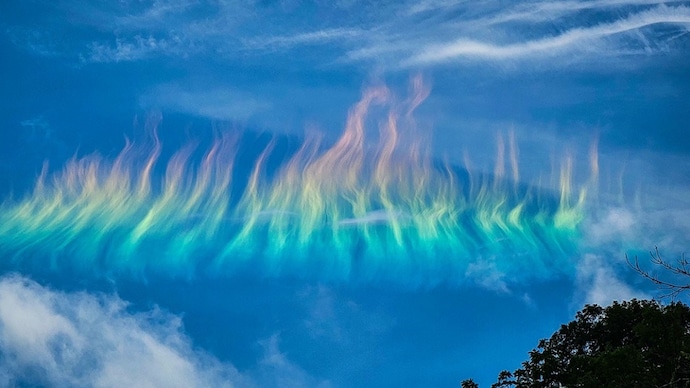
A spectacular "fire rainbow" streaking across the skies of West Virginia has captivated skywatchers, with its flame-like bands of vibrant green, blue and orange creating the illusion of fire dancing through the clouds.
While the phenomenon looks extraordinary, it has nothing to do with flames or rainbows produced by rain.
The rare display is known scientifically as a circum horizontal arc, an optical phenomenon formed when sunlight passes through millions of tiny ice crystals suspended in high-altitude cirrus clouds.
The striking image, captured near North Fork Mountain in West Virginia in 2021, shows colourful, flame-shaped streaks stretching parallel to the horizon beneath wispy cirrus clouds.
The shimmering colours are produced as sunlight is refracted by flat, hexagonal ice crystals that behave like countless floating prisms in the sky.
For a circum horizontal arc to appear, several atmospheric conditions must align perfectly. The Sun must be positioned at least 58 degrees above the horizon, ensuring that sunlight enters the ice crystals at the correct angle.
In addition, thin cirrus fibratus clouds must be present, with their microscopic hexagonal ice crystals aligned horizontally. Only when these crystals maintain a similar orientation can they collectively bend sunlight into the brilliant spectrum of colours visible from the ground.
Because these precise conditions rarely occur simultaneously, circum horizontal arcs are considered one of the more unusual optical displays in Earth's atmosphere.
Despite its popular nickname, a fire rainbow is neither a rainbow nor related to fire. Traditional rainbows are formed when sunlight is refracted and reflected inside water droplets after rainfall.
A circum horizontal arc, by contrast, is produced entirely by ice crystals high in the atmosphere.
Scientists say the phenomenon shows how ordinary atmospheric ingredients like sunlight, ice crystals and high clouds, can combine to create one of nature's most breathtaking spectacles, transforming an otherwise clear summer sky into a canvas of shimmering colours.
A spectacular "fire rainbow" streaking across the skies of West Virginia has captivated skywatchers, with its flame-like bands of vibrant green, blue and orange creating the illusion of fire dancing through the clouds.
While the phenomenon looks extraordinary, it has nothing to do with flames or rainbows produced by rain.
The rare display is known scientifically as a circum horizontal arc, an optical phenomenon formed when sunlight passes through millions of tiny ice crystals suspended in high-altitude cirrus clouds.
The striking image, captured near North Fork Mountain in West Virginia in 2021, shows colourful, flame-shaped streaks stretching parallel to the horizon beneath wispy cirrus clouds.
The shimmering colours are produced as sunlight is refracted by flat, hexagonal ice crystals that behave like countless floating prisms in the sky.
For a circum horizontal arc to appear, several atmospheric conditions must align perfectly. The Sun must be positioned at least 58 degrees above the horizon, ensuring that sunlight enters the ice crystals at the correct angle.
In addition, thin cirrus fibratus clouds must be present, with their microscopic hexagonal ice crystals aligned horizontally. Only when these crystals maintain a similar orientation can they collectively bend sunlight into the brilliant spectrum of colours visible from the ground.
Because these precise conditions rarely occur simultaneously, circum horizontal arcs are considered one of the more unusual optical displays in Earth's atmosphere.
Despite its popular nickname, a fire rainbow is neither a rainbow nor related to fire. Traditional rainbows are formed when sunlight is refracted and reflected inside water droplets after rainfall.
A circum horizontal arc, by contrast, is produced entirely by ice crystals high in the atmosphere.
Scientists say the phenomenon shows how ordinary atmospheric ingredients like sunlight, ice crystals and high clouds, can combine to create one of nature's most breathtaking spectacles, transforming an otherwise clear summer sky into a canvas of shimmering colours.
A spectacular "fire rainbow" streaking across the skies of West Virginia has captivated skywatchers, with its flame-like bands of vibrant green, blue and orange creating the illusion of fire dancing through the clouds.
While the phenomenon looks extraordinary, it has nothing to do with flames or rainbows produced by rain.
The rare display is known scientifically as a circum horizontal arc, an optical phenomenon formed when sunlight passes through millions of tiny ice crystals suspended in high-altitude cirrus clouds.
The striking image, captured near North Fork Mountain in West Virginia in 2021, shows colourful, flame-shaped streaks stretching parallel to the horizon beneath wispy cirrus clouds.
The shimmering colours are produced as sunlight is refracted by flat, hexagonal ice crystals that behave like countless floating prisms in the sky.
For a circum horizontal arc to appear, several atmospheric conditions must align perfectly. The Sun must be positioned at least 58 degrees above the horizon, ensuring that sunlight enters the ice crystals at the correct angle.
In addition, thin cirrus fibratus clouds must be present, with their microscopic hexagonal ice crystals aligned horizontally. Only when these crystals maintain a similar orientation can they collectively bend sunlight into the brilliant spectrum of colours visible from the ground.
Because these precise conditions rarely occur simultaneously, circum horizontal arcs are considered one of the more unusual optical displays in Earth's atmosphere.
Despite its popular nickname, a fire rainbow is neither a rainbow nor related to fire. Traditional rainbows are formed when sunlight is refracted and reflected inside water droplets after rainfall.
A circum horizontal arc, by contrast, is produced entirely by ice crystals high in the atmosphere.
Scientists say the phenomenon shows how ordinary atmospheric ingredients like sunlight, ice crystals and high clouds, can combine to create one of nature's most breathtaking spectacles, transforming an otherwise clear summer sky into a canvas of shimmering colours.

