Monsoon rain intensity in July depends on two oceans separated by 10,000 km
IMD has forecast below-normal rainfall in July as El Nino strengthens. Can the Indian Ocean save India's monsoon or will the Pacific Ocean break records and wreak havoc?
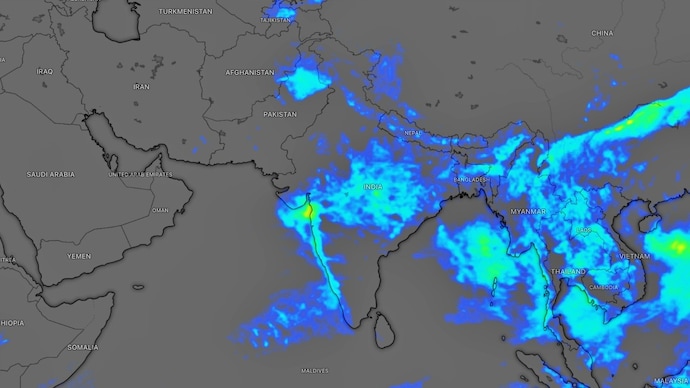
India's monsoon has entered July with a far-from-ideal forecast.
The Indian Meteorological Agency (IMD) has predicted below-normal rainfall during the country's wettest month, which will follow the fifth-driest June since records began in 1901.
After June ended with a 39.8% rainfall deficit, meteorologists have admitted that the fate of the rest of the season could now hinge on a battle between two oceans nearly 10,000 kilometres apart.
IMD has forecast that rainfall across the country in July is likely to be below 94% of the Long Period Average (LPA) of 280.4 mm.
The forecast, however, will largely come into play later in the month as July's first week is expected to bring widespread showers that could temporarily reduce the rainfall deficit.
The key question now is whether the warming Pacific Ocean or the Indian Ocean will have the bigger influence on India's weather.
HOW CAN THE PACIFIC OCEAN INFLUENCE JULY RAIN INTENSITY?
The biggest concern is El Nino, a naturally occurring climate pattern marked by unusually warm waters in the central and eastern equatorial Pacific Ocean.
Even though it develops thousands of kilometres away from India, El Nino disrupts global wind circulation.
Historically, strong El Nino years have often coincided with below-normal monsoon rainfall and drought conditions across parts of India.
That is the worrying part.
According to the IMD and the World Meteorological Organisation (WMO), El Nino has now developed and is expected to strengthen further during the monsoon season, with many global climate models indicating it could become moderate to strong later this year.
HOW CAN THE INDIAN OCEAN SAVE THE MONSOON?
The only major climate signal that could offset El Nino's impact is the Indian Ocean Dipole (IOD), a climate pattern that develops much closer to India.
A positive IOD occurs when sea surface temperatures in the western Indian Ocean, near eastern Africa, become warmer than those near Indonesia.
This difference strengthens moisture-bearing winds towards India, often enhancing monsoon rainfall and partially cancelling out El Nino's effects.
At present, however, the IMD says neutral IOD conditions prevail, with forecasts suggesting they are likely to persist through much of the southwest monsoon season.
At the same time, Australia's Bureau of Meteorology (BOM) has said that a positive IOD could develop during the second half of the monsoon, usually between August and September, which could help boost the monsoon's strength.
Keeping both scenarios in mind, July's rainfall is expected to remain under the influence of the Pacific Ocean unless the Indian Ocean begins behaving differently later in the season.
In other words, the intensity of India's monsoon over the coming weeks may depend on which of these two distant oceans ultimately exerts the stronger pull.
India's monsoon has entered July with a far-from-ideal forecast.
The Indian Meteorological Agency (IMD) has predicted below-normal rainfall during the country's wettest month, which will follow the fifth-driest June since records began in 1901.
After June ended with a 39.8% rainfall deficit, meteorologists have admitted that the fate of the rest of the season could now hinge on a battle between two oceans nearly 10,000 kilometres apart.
IMD has forecast that rainfall across the country in July is likely to be below 94% of the Long Period Average (LPA) of 280.4 mm.
The forecast, however, will largely come into play later in the month as July's first week is expected to bring widespread showers that could temporarily reduce the rainfall deficit.
The key question now is whether the warming Pacific Ocean or the Indian Ocean will have the bigger influence on India's weather.
HOW CAN THE PACIFIC OCEAN INFLUENCE JULY RAIN INTENSITY?
The biggest concern is El Nino, a naturally occurring climate pattern marked by unusually warm waters in the central and eastern equatorial Pacific Ocean.
Even though it develops thousands of kilometres away from India, El Nino disrupts global wind circulation.
Historically, strong El Nino years have often coincided with below-normal monsoon rainfall and drought conditions across parts of India.
That is the worrying part.
According to the IMD and the World Meteorological Organisation (WMO), El Nino has now developed and is expected to strengthen further during the monsoon season, with many global climate models indicating it could become moderate to strong later this year.
HOW CAN THE INDIAN OCEAN SAVE THE MONSOON?
The only major climate signal that could offset El Nino's impact is the Indian Ocean Dipole (IOD), a climate pattern that develops much closer to India.
A positive IOD occurs when sea surface temperatures in the western Indian Ocean, near eastern Africa, become warmer than those near Indonesia.
This difference strengthens moisture-bearing winds towards India, often enhancing monsoon rainfall and partially cancelling out El Nino's effects.
At present, however, the IMD says neutral IOD conditions prevail, with forecasts suggesting they are likely to persist through much of the southwest monsoon season.
At the same time, Australia's Bureau of Meteorology (BOM) has said that a positive IOD could develop during the second half of the monsoon, usually between August and September, which could help boost the monsoon's strength.
Keeping both scenarios in mind, July's rainfall is expected to remain under the influence of the Pacific Ocean unless the Indian Ocean begins behaving differently later in the season.
In other words, the intensity of India's monsoon over the coming weeks may depend on which of these two distant oceans ultimately exerts the stronger pull.

