Nasa sets late-August launch date for Nancy Grace Roman Space Telescope
The telescope is designed to survey the universe on an unprecedented scale and the mission could help answer some of astronomy's biggest unanswered questions.
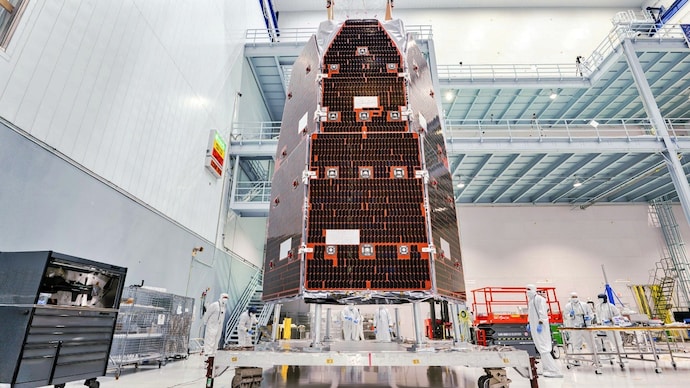
Nasa has officially set Sunday, August 30, 2026, as the launch date for its highly anticipated Nancy Grace Roman Space Telescope, the space agency's next major space observatory after the James Webb Space Telescope.
The spacecraft is scheduled to lift off aboard a SpaceX Falcon Heavy rocket from Launch Complex 39A at Nasa's Kennedy Space Center in Florida at around 4:56 pm IST.
The mission is launching nearly nine months ahead of its original schedule.
Named after Nancy Grace Roman, Nasa's first chief of astronomy, the telescope is expected to transform scientists' understanding of the universe by tackling some of astronomy's biggest mysteries, including dark matter, dark energy and planets beyond our solar system.
TO SEE A BIGGER PICTURE
Unlike the James Webb Space Telescope, which focusses on small regions of the universe in extraordinary detail, Roman is designed to scan vast areas of the sky quickly.
Nasa said that its primary instrument can capture images with Hubble-like clarity but over an area at least 100 times larger, allowing astronomers to survey billions of galaxies and hundreds of millions of stars far more efficiently.
After launch, Roman will travel to the Sun-Earth Lagrange Point 2 (L2), around 1.5 million kilometres from Earth, where it will operate alongside Webb.
From this stable location, the telescope will have an uninterrupted view of deep space while remaining shielded from much of the Sun's and Earth's heat.
WHY IS THE NANCY GRACE SPACE TELESCOPE A BIG DEAL?
Roman's wide-field surveys are expected to help scientists investigate why the universe's expansion is accelerating, a phenomenon linked to the mysterious force known as dark energy.
The observatory will also map the distribution of dark matter, discover thousands of exoplanets using multiple techniques, and observe exploding stars, black holes and distant galaxies.
Nasa recently completed fuelling the spacecraft with hydrazine, clearing one of the final major milestones before launch.
Engineers will now integrate the observatory with its launch vehicle and encapsulate it inside the Falcon Heavy payload fairing ahead of liftoff.
Once operational, the Nancy Grace Roman Space Telescope is expected to generate an unprecedented volume of astronomical data, complementing discoveries made by Hubble and Webb while opening a new chapter in humanity's exploration of the cosmos.
Nasa has officially set Sunday, August 30, 2026, as the launch date for its highly anticipated Nancy Grace Roman Space Telescope, the space agency's next major space observatory after the James Webb Space Telescope.
The spacecraft is scheduled to lift off aboard a SpaceX Falcon Heavy rocket from Launch Complex 39A at Nasa's Kennedy Space Center in Florida at around 4:56 pm IST.
The mission is launching nearly nine months ahead of its original schedule.
Named after Nancy Grace Roman, Nasa's first chief of astronomy, the telescope is expected to transform scientists' understanding of the universe by tackling some of astronomy's biggest mysteries, including dark matter, dark energy and planets beyond our solar system.
TO SEE A BIGGER PICTURE
Unlike the James Webb Space Telescope, which focusses on small regions of the universe in extraordinary detail, Roman is designed to scan vast areas of the sky quickly.
Nasa said that its primary instrument can capture images with Hubble-like clarity but over an area at least 100 times larger, allowing astronomers to survey billions of galaxies and hundreds of millions of stars far more efficiently.
After launch, Roman will travel to the Sun-Earth Lagrange Point 2 (L2), around 1.5 million kilometres from Earth, where it will operate alongside Webb.
From this stable location, the telescope will have an uninterrupted view of deep space while remaining shielded from much of the Sun's and Earth's heat.
WHY IS THE NANCY GRACE SPACE TELESCOPE A BIG DEAL?
Roman's wide-field surveys are expected to help scientists investigate why the universe's expansion is accelerating, a phenomenon linked to the mysterious force known as dark energy.
The observatory will also map the distribution of dark matter, discover thousands of exoplanets using multiple techniques, and observe exploding stars, black holes and distant galaxies.
Nasa recently completed fuelling the spacecraft with hydrazine, clearing one of the final major milestones before launch.
Engineers will now integrate the observatory with its launch vehicle and encapsulate it inside the Falcon Heavy payload fairing ahead of liftoff.
Once operational, the Nancy Grace Roman Space Telescope is expected to generate an unprecedented volume of astronomical data, complementing discoveries made by Hubble and Webb while opening a new chapter in humanity's exploration of the cosmos.
Nasa has officially set Sunday, August 30, 2026, as the launch date for its highly anticipated Nancy Grace Roman Space Telescope, the space agency's next major space observatory after the James Webb Space Telescope.
The spacecraft is scheduled to lift off aboard a SpaceX Falcon Heavy rocket from Launch Complex 39A at Nasa's Kennedy Space Center in Florida at around 4:56 pm IST.
The mission is launching nearly nine months ahead of its original schedule.
Named after Nancy Grace Roman, Nasa's first chief of astronomy, the telescope is expected to transform scientists' understanding of the universe by tackling some of astronomy's biggest mysteries, including dark matter, dark energy and planets beyond our solar system.
TO SEE A BIGGER PICTURE
Unlike the James Webb Space Telescope, which focusses on small regions of the universe in extraordinary detail, Roman is designed to scan vast areas of the sky quickly.
Nasa said that its primary instrument can capture images with Hubble-like clarity but over an area at least 100 times larger, allowing astronomers to survey billions of galaxies and hundreds of millions of stars far more efficiently.
After launch, Roman will travel to the Sun-Earth Lagrange Point 2 (L2), around 1.5 million kilometres from Earth, where it will operate alongside Webb.
From this stable location, the telescope will have an uninterrupted view of deep space while remaining shielded from much of the Sun's and Earth's heat.
WHY IS THE NANCY GRACE SPACE TELESCOPE A BIG DEAL?
Roman's wide-field surveys are expected to help scientists investigate why the universe's expansion is accelerating, a phenomenon linked to the mysterious force known as dark energy.
The observatory will also map the distribution of dark matter, discover thousands of exoplanets using multiple techniques, and observe exploding stars, black holes and distant galaxies.
Nasa recently completed fuelling the spacecraft with hydrazine, clearing one of the final major milestones before launch.
Engineers will now integrate the observatory with its launch vehicle and encapsulate it inside the Falcon Heavy payload fairing ahead of liftoff.
Once operational, the Nancy Grace Roman Space Telescope is expected to generate an unprecedented volume of astronomical data, complementing discoveries made by Hubble and Webb while opening a new chapter in humanity's exploration of the cosmos.

