Voyager 1 is one light-day from Earth: Humanity's bravest traveller refuses to stop
Voyager 1 has travelled farther than any human-made object. Find out how its 1970s technology, nuclear power source and ageing systems keep it going.

The National Aeronautics and Space Administration (NASA) is an agency of the U.S. government responsible for the civilian space programme, as well as aeronautics and space research.
NASA was established in 1958, succeeding the National Advisory Committee for Aeronautics (NACA). Since its inception, NASA has led most of America's space exploration efforts, including the Apollo Moon landing missions, the Skylab space station, and the Space Shuttle program. NASA also supports the International Space Station and oversees the development of the Orion spacecraft, the Space Launch System, Commercial Crew Vehicles, and the Lunar Gateway space station.
NASA's research focuses on better understanding Earth through the Earth Observing System, advancing heliophysics via the Science Mission Directorate's Heliophysics Research Programme, exploring celestial bodies across the solar system with advanced robotic spacecraft like New Horizons, and conducting astrophysics research on topics such as the Big Bang, through initiatives like the Great Observatories and related programs.
NASA has worked on numerous space projects, with notable ones including the X-15 programme, Project Mercury, Project Gemini, and Project Apollo.
Delhi NCR's air quality has worsened, crossing severe levels due to pollution from vehicles, crackers, and stubble burning in neighbouring states.
This special episode of 5ive Live covers major developments across environmental policy, business, public health, and state politics.
Post Diwali, North India faced increased air pollution, multiple fire occurrences, and ongoing fuel quality checks focusing on ethanol blending levels.
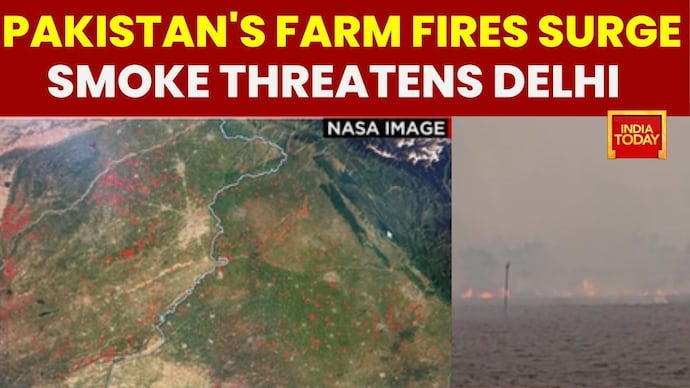
NASA satellite images and Pakistani media reports reveal a surge in farm fires across the border in Pakistan, recording 4.2 times more crop fire detections. Till the end of October, over 30,000 farm fires were reported in Pakistan, compared to just over 1,600 cases in Indian Punjab, where border districts like Tarn Taran and Amritsar lead the tally. Northwestern winds and western disturbances are expected to carry heavy smoke across Punjab, Haryana, and the Indo-Gangetic Plains towards Delhi NCR, exacerbating air quality during the festive season. Despite measures by state governments in Punjab and Haryana, including red entries, FIRs, and equipment distribution, stubble burning on both sides of the border continues to affect Delhi NCR's Air Quality Index.
The big talking point of this episode of News Today is the escalating tension in West Asia. Geopolitical tensions between the United States and Iran have escalated following missile strikes and blockades around the Strait of Hormuz, driving global oil prices past eighty-four dollars per barrel.
Indian-origin astronaut Anil Menon has shared his first message from the International Space Station following his successful launch as part of NASA's latest mission.
An Iranian missile strike on UAE vessels in the Strait of Hormuz killed Indian seafarer Rohan Kumar and injured nine others, prompting India's Ministry of External Affairs to summon the Iranian Deputy Chief of Mission.
In this episode of Tech Today, we dive deep into the biggest stories that are shaping the future of technology, from the new space race to the latest consumer hardware! BIG TECH STORY: The Artemis II Deep Dive We go behind the scenes of the successful moon mission to explore the massive tech upgrade since Apollo. Discover the secrets of the new "Glass Cockpit," the world's first Deep Space Laser Internet (260 Mbps), AI-driven Optical Navigation, and the surprising role of the iPhone 17 Pro Max in space. Plus, how all this influences India’s Gaganyaan mission. TECH REVIEW: OnePlus Nord 6: Is this a mid-range phone or a cheat code? We review the Nord 6 with its 9000mAh power-bank battery, 165Hz display, and Snapdragon 8s Gen 4 chipset. Does it blur the line between flagship and budget? TECH & YOU: Smart Toothbrush: Are electric toothbrushes worth the ₹10,000+ price tag? We test the Oral-B iO Series 9 to see how features like the real-time pressure sensor and AI-powered 3D tracking can teach you to brush better, backed by science. Don't forget to like, share, and subscribe for more tech deep dives!
In this episode of News Today, the focus is on the high-stakes peace negotiations between the United States and Iran, which will be held in Islamabad on Saturday.
US President Donald Trump has warned Iran against charging fees on ships passing through the Strait of Hormuz.
Astronauts aboard Nasa’s Artemis II mission captured striking views of the Moon as the Orion spacecraft flew around its far side on April 6, offering a rare glimpse of the rugged, cratered terrain that remains hidden from Earth. The images, taken during the spacecraft’s lunar flyby, showcase the stark contrast between the Moon’s shadowed far side and the sunlit horizon. The Artemis II mission, Nasa's first crewed journey to the Moon in over five decades, marks a significant milestone in preparations for future lunar landings under the Artemis programme. As Orion completed its trajectory around the Moon, astronauts documented the journey through high-resolution imagery, providing valuable scientific and visual data.
In this edition of To The Point, the focus is on the escalating tensions between the United States and Iran and the showdown over deletion of voter's names in Bengal during the SIR exercise ahead of assembly polls.
Speaking on India Today podcast UnPolitics, Nasa astronaut Sunita Williams reflects on her 27-year career and recent retirement announcement during a broadcast from a literature festival in India. Williams addressed media speculation regarding her health during her extended stay on the International Space Station, clarifying that she returned in good health despite the physical challenges of zero gravity.
This report examines NASA's comprehensive strategy to address the hazards of lunar dust, a substance described as 'sharp, like broken glass' that poses significant risks to astronauts and equipment. The speaker highlights the historical challenges faced during Apollo missions, including 'lunar hay fever' experienced by Harrison Schmitt in 1972. To combat this, researchers like Ian Wells have developed innovative solutions, such as using liquid nitrogen to remove 98% of dust, a method famously tested on a Barbie doll. The programme also details the Electrodynamic Dust Shield (EDS) technology, which uses electric waves to clean surfaces like helmet visors and solar panels. Beyond protection, the transcript notes that lunar dust could be repurposed to create oxygen and building materials for future moon shelters. These advancements are critical for the upcoming Artemis II mission and NASA's goal of establishing a nuclear reactor on the moon by 2030, bringing humanity closer to long-term lunar habitation.
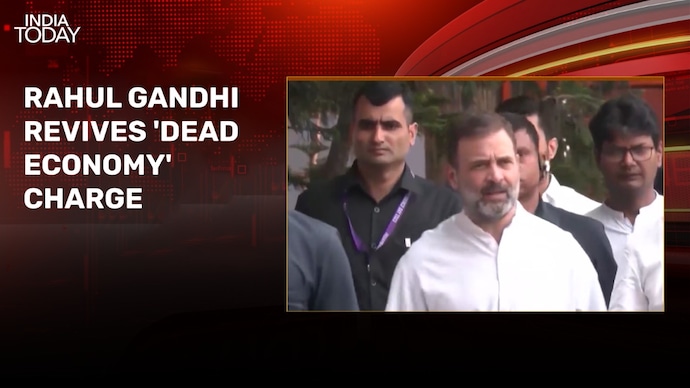
The top focus of this episode of To The Point is on Congress leader Rahul Gandhi’s 'dead economy' jibe.
In an exclusive interview with India Today's Preeti Choudhry, space icon Sunita Williams spoke on life beyond active space flight, her love for animals, her bond with Kalpana Chawla and much more.
This special report anchored by Akshita Nandagopal examines the political friction surrounding Congress leader Rahul Gandhi’s remarks on the Indian economy. Gandhi characterizes the current fiscal state as a dead economy, citing the impact of 50% US tariffs on Indian textiles under the Trump administration. The program features a debate between BJP’s RP Singh and Congress spokesperson Anshul Avijit regarding infrastructure spending, private investment, and poverty alleviation. Insights from the World Economic Forum in Davos include perspectives from economists like Geeta Gopinath on India’s growth trajectory and data transparency. Additionally, the report features NASA astronaut Sunita Williams reflecting on her 27-year career, her bond with Kalpana Chawla’s family, and the future of lunar exploration. The broadcast also covers the impact of heavy snowfall in Jammu, Kashmir, and Himachal Pradesh, which has disrupted flights and road connectivity. This comprehensive coverage bridges domestic economic policy, international trade relations with the United States, scientific milestones, and the logistical challenges posed by winter weather in northern India.
In this Special Report, we focus on the retirement of veteran NASA astronaut Sunita Williams after an illustrious 27-year career. Speaking in New Delhi, Williams described her visit to India as a 'homecoming', reflecting on her deep personal ties to the country where her father was born. During an interactive session, she shared profound life lessons from her time aboard the International Space Station, noting, 'Every person I know is there. Every animal, every plant, everything we know is there, and we're all on this one planet.' Williams, who completed three missions and set multiple human spaceflight records, emphasized how viewing Earth from orbit changes one's perception of global differences. The retired astronaut also met with the family of late fellow astronaut Kalpana Chawla during her stay in the national capital. The programme highlights her historic contributions to space exploration and her reflections on humanity's shared home.
On this Special Report, India Today covers a historic and unusual development in space flight as NASA's Crew-11 begins an early return to Earth. NASA Administrator Gerard Isaacman confirmed the decision, stating, 'It's in the best interest of our astronauts to return Crew 11 ahead of their planned departure' following a medical issue involving a single crew member. This marks the first planned medical evacuation in the International Space Station's 25-year history. While the affected astronaut is reported to be stable, the agency prioritised Earth-based medical care over microgravity limitations. The report also addresses viral internet speculation regarding the nature of the medical concern, which NASA has not confirmed, citing privacy. The transition of command from NASA's Mike Fink to Russian cosmonaut Sergei Kuznetsov ensured continued station operations. This rare return provides critical data for future long-duration missions, including the Artemis program and upcoming lunar explorations.