Nasa's Psyche spacecraft photographs Mars as a glowing crescent. See pic
Nasa's Psyche spacecraft captured a stunning crescent image of Mars from nearly 5 million kilometres away on May 3, 2026. The spacecraft is using Mars's gravity as a slingshot before heading to a metal-rich asteroid in 2029.
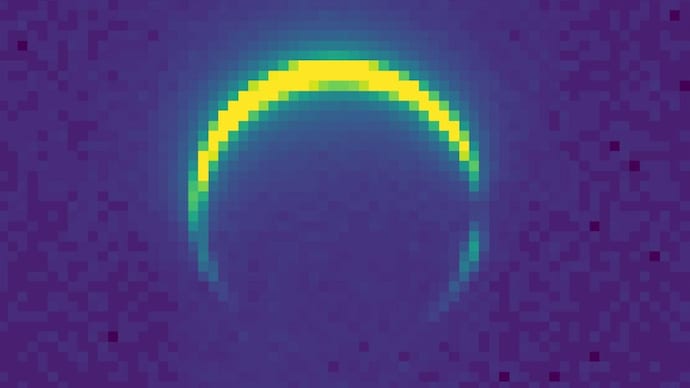
Nasa’s Psyche spacecraft has done something rather poetic on its long journey through space. On May 3, 2026, it turned its cameras toward Mars and captured the planet as a thin, glowing crescent, something like the crescent Moon we see from Earth on certain nights.
The spacecraft was about 4.8 million kilometres away from Mars at the time.
WHY IS PSYCHE FLYING PAST MARS?
The spacecraft is not visiting Mars. It is using the planet's gravity as a slingshot, a technique called a gravity assist. Think of it as borrowing speed from Mars's gravitational pull to travel faster without burning extra fuel.
The close approach happens on May 15, 2026, after which Psyche will continue toward its actual destination: a metal-rich asteroid also called Psyche, located in the asteroid belt between Mars and Jupiter. It is expected to arrive in 2029.
WHAT DOES THE IMAGE ACTUALLY SHOW?
The crescent appears because Psyche is approaching Mars from what scientists call a high-phase angle. This means the Sun is positioned behind and above both the planet and the spacecraft, so only a sliver of the sunlit side of Mars is visible.
The image was taken using the spacecraft's multispectral imager, which is a powerful camera that captures different wavelengths of light. The exposure lasted just 2 milliseconds.
Even so, parts of the image are oversaturated, or are too bright, because sunlight reflecting off Mars was stronger than expected.
Dust in the Martian atmosphere scatters sunlight, making the crescent appear to wrap further around the planet. Interestingly, a small gap appears on the right side of the crescent.
Scientists believe this coincides with Mars's north polar ice cap, where seasonal clouds and haze may be blocking the scattered light.
The images are primarily for calibrating the cameras before Psyche reaches the asteroid in 2029.
Nasa’s Psyche spacecraft has done something rather poetic on its long journey through space. On May 3, 2026, it turned its cameras toward Mars and captured the planet as a thin, glowing crescent, something like the crescent Moon we see from Earth on certain nights.
The spacecraft was about 4.8 million kilometres away from Mars at the time.
WHY IS PSYCHE FLYING PAST MARS?
The spacecraft is not visiting Mars. It is using the planet's gravity as a slingshot, a technique called a gravity assist. Think of it as borrowing speed from Mars's gravitational pull to travel faster without burning extra fuel.
The close approach happens on May 15, 2026, after which Psyche will continue toward its actual destination: a metal-rich asteroid also called Psyche, located in the asteroid belt between Mars and Jupiter. It is expected to arrive in 2029.
WHAT DOES THE IMAGE ACTUALLY SHOW?
The crescent appears because Psyche is approaching Mars from what scientists call a high-phase angle. This means the Sun is positioned behind and above both the planet and the spacecraft, so only a sliver of the sunlit side of Mars is visible.
The image was taken using the spacecraft's multispectral imager, which is a powerful camera that captures different wavelengths of light. The exposure lasted just 2 milliseconds.
Even so, parts of the image are oversaturated, or are too bright, because sunlight reflecting off Mars was stronger than expected.
Dust in the Martian atmosphere scatters sunlight, making the crescent appear to wrap further around the planet. Interestingly, a small gap appears on the right side of the crescent.
Scientists believe this coincides with Mars's north polar ice cap, where seasonal clouds and haze may be blocking the scattered light.
The images are primarily for calibrating the cameras before Psyche reaches the asteroid in 2029.

