Is IIT Madras Director just a cow urine expert as Priyanka Gandhi labelled him?
Congress leader Priyanka Gandhi has called IIT Madras Director V Kamakoti a gau mutra expert, months after his cow urine remarks. Here is a look at his academic record, awards and his role on the NTA exam reform task force.
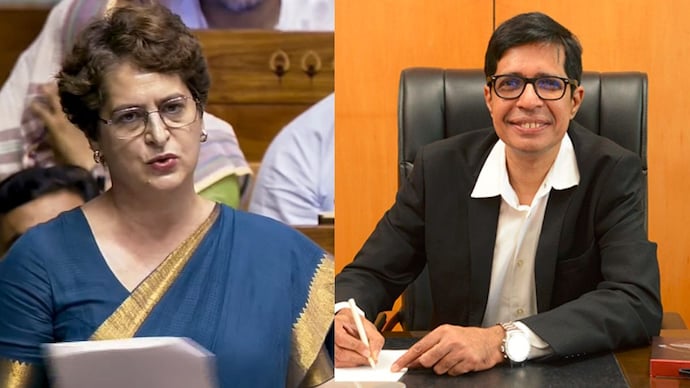
Congress leader Priyanka Gandhi Vadra has found an unlikely target in the Centre's newest expert panel: a scientist known for his work on microprocessors, not medicine. Questioning the composition of the government's newly constituted task force to reform India's examination system, she said its members included "a former IB chief, the owner of an IT company, and even an expert on gau mutra."
The remark, offered without elaboration, was unmistakably aimed at IIT Madras Director V Kamakoti, one of several names on the high-powered panel headed by Infosys co-founder Nandan Nilekani. It revived a controversy that first surfaced in 2025, when Kamakoti claimed cow urine had antibacterial and digestive properties, a comment that drew swift criticism from scientists and opposition leaders alike.
The panel itself has a far more prosaic mandate: recommending reforms to the National Testing Agency (NTA) after a string of paper leak scandals rattled public trust in India's examination system.
WHO IS V KAMAKOTI, AND WHAT ARE HIS CREDENTIALS?
Kamakoti Veezhinathan earned his MS and PhD in computer science and engineering from IIT Madras, joined its faculty in 2001 and took over as Director in January 2022.
He specialises in computer architecture, information security and VLSI design, which is the process of packing millions of tiny electronic switches called transistors onto a single silicon chip. He heads the institute's Microprocessor Development Programme and its Information Security Education and Awareness Programme.
He led the team behind SHAKTI, India's first indigenous industrial grade microprocessor, a homegrown chip meant to reduce the country's reliance on imported processors in areas such as defence and communications.
His other roles include membership of the National Security Advisory Board and, earlier, chairmanship of the Artificial Intelligence Task Force set up by the Ministry of Commerce and Industry.
At IIT Madras, he has served as Chairman of the JEE and as Associate Dean for industrial consultancy and sponsored research, and he sits on the technology committees of the Reserve Bank of India and the National Stock Exchange.
He has more than 150 papers in international journals and conferences, has guided numerous doctoral and research scholars, and has delivered close to 50 industry and government projects.
His awards include the Padma Shri in 2026, the DRDO Academic Excellence Award, the Abdul Kalam Technology Innovation National Fellowship, the IBM Faculty Award and the VASVIK Industrial Research Award.
WHAT DID KAMAKOTI SAY ABOUT COW URINE?
The gau mutra reference goes back to January 2025. Speaking at a Maatu Pongal event at a cow shelter in Chennai, Kamakoti spoke about indigenous cattle and organic farming and said cow urine had antibacterial, antifungal and digestive properties.
He also shared an anecdote about an ascetic whose fever, he said, subsided after consuming it.
The remarks drew criticism from opposition leaders and sections of the scientific community, who argued the claims lacked clinical evidence for use in humans.
Kamakoti later said he was pointing to published research, and his supporters said the comments reflected traditional knowledge and his interest in native cattle rather than institutional advice.
WHAT IS KAMAKOTI'S ROLE ON THE NTA TASK FORCE?
On the panel, Kamakoti's focus is the technology and structure of examinations.
He has spoken about the need for transparency in how scores are calculated and for a system in which everyone in the exam chain is accountable, arguing that safeguards must keep pace as the number of candidates runs into millions.
Congress leader Priyanka Gandhi Vadra has found an unlikely target in the Centre's newest expert panel: a scientist known for his work on microprocessors, not medicine. Questioning the composition of the government's newly constituted task force to reform India's examination system, she said its members included "a former IB chief, the owner of an IT company, and even an expert on gau mutra."
The remark, offered without elaboration, was unmistakably aimed at IIT Madras Director V Kamakoti, one of several names on the high-powered panel headed by Infosys co-founder Nandan Nilekani. It revived a controversy that first surfaced in 2025, when Kamakoti claimed cow urine had antibacterial and digestive properties, a comment that drew swift criticism from scientists and opposition leaders alike.
The panel itself has a far more prosaic mandate: recommending reforms to the National Testing Agency (NTA) after a string of paper leak scandals rattled public trust in India's examination system.
WHO IS V KAMAKOTI, AND WHAT ARE HIS CREDENTIALS?
Kamakoti Veezhinathan earned his MS and PhD in computer science and engineering from IIT Madras, joined its faculty in 2001 and took over as Director in January 2022.
He specialises in computer architecture, information security and VLSI design, which is the process of packing millions of tiny electronic switches called transistors onto a single silicon chip. He heads the institute's Microprocessor Development Programme and its Information Security Education and Awareness Programme.
He led the team behind SHAKTI, India's first indigenous industrial grade microprocessor, a homegrown chip meant to reduce the country's reliance on imported processors in areas such as defence and communications.
His other roles include membership of the National Security Advisory Board and, earlier, chairmanship of the Artificial Intelligence Task Force set up by the Ministry of Commerce and Industry.
At IIT Madras, he has served as Chairman of the JEE and as Associate Dean for industrial consultancy and sponsored research, and he sits on the technology committees of the Reserve Bank of India and the National Stock Exchange.
He has more than 150 papers in international journals and conferences, has guided numerous doctoral and research scholars, and has delivered close to 50 industry and government projects.
His awards include the Padma Shri in 2026, the DRDO Academic Excellence Award, the Abdul Kalam Technology Innovation National Fellowship, the IBM Faculty Award and the VASVIK Industrial Research Award.
WHAT DID KAMAKOTI SAY ABOUT COW URINE?
The gau mutra reference goes back to January 2025. Speaking at a Maatu Pongal event at a cow shelter in Chennai, Kamakoti spoke about indigenous cattle and organic farming and said cow urine had antibacterial, antifungal and digestive properties.
He also shared an anecdote about an ascetic whose fever, he said, subsided after consuming it.
The remarks drew criticism from opposition leaders and sections of the scientific community, who argued the claims lacked clinical evidence for use in humans.
Kamakoti later said he was pointing to published research, and his supporters said the comments reflected traditional knowledge and his interest in native cattle rather than institutional advice.
WHAT IS KAMAKOTI'S ROLE ON THE NTA TASK FORCE?
On the panel, Kamakoti's focus is the technology and structure of examinations.
He has spoken about the need for transparency in how scores are calculated and for a system in which everyone in the exam chain is accountable, arguing that safeguards must keep pace as the number of candidates runs into millions.
Congress leader Priyanka Gandhi Vadra has found an unlikely target in the Centre's newest expert panel: a scientist known for his work on microprocessors, not medicine. Questioning the composition of the government's newly constituted task force to reform India's examination system, she said its members included "a former IB chief, the owner of an IT company, and even an expert on gau mutra."
The remark, offered without elaboration, was unmistakably aimed at IIT Madras Director V Kamakoti, one of several names on the high-powered panel headed by Infosys co-founder Nandan Nilekani. It revived a controversy that first surfaced in 2025, when Kamakoti claimed cow urine had antibacterial and digestive properties, a comment that drew swift criticism from scientists and opposition leaders alike.
The panel itself has a far more prosaic mandate: recommending reforms to the National Testing Agency (NTA) after a string of paper leak scandals rattled public trust in India's examination system.
WHO IS V KAMAKOTI, AND WHAT ARE HIS CREDENTIALS?
Kamakoti Veezhinathan earned his MS and PhD in computer science and engineering from IIT Madras, joined its faculty in 2001 and took over as Director in January 2022.
He specialises in computer architecture, information security and VLSI design, which is the process of packing millions of tiny electronic switches called transistors onto a single silicon chip. He heads the institute's Microprocessor Development Programme and its Information Security Education and Awareness Programme.
He led the team behind SHAKTI, India's first indigenous industrial grade microprocessor, a homegrown chip meant to reduce the country's reliance on imported processors in areas such as defence and communications.
His other roles include membership of the National Security Advisory Board and, earlier, chairmanship of the Artificial Intelligence Task Force set up by the Ministry of Commerce and Industry.
At IIT Madras, he has served as Chairman of the JEE and as Associate Dean for industrial consultancy and sponsored research, and he sits on the technology committees of the Reserve Bank of India and the National Stock Exchange.
He has more than 150 papers in international journals and conferences, has guided numerous doctoral and research scholars, and has delivered close to 50 industry and government projects.
His awards include the Padma Shri in 2026, the DRDO Academic Excellence Award, the Abdul Kalam Technology Innovation National Fellowship, the IBM Faculty Award and the VASVIK Industrial Research Award.
WHAT DID KAMAKOTI SAY ABOUT COW URINE?
The gau mutra reference goes back to January 2025. Speaking at a Maatu Pongal event at a cow shelter in Chennai, Kamakoti spoke about indigenous cattle and organic farming and said cow urine had antibacterial, antifungal and digestive properties.
He also shared an anecdote about an ascetic whose fever, he said, subsided after consuming it.
The remarks drew criticism from opposition leaders and sections of the scientific community, who argued the claims lacked clinical evidence for use in humans.
Kamakoti later said he was pointing to published research, and his supporters said the comments reflected traditional knowledge and his interest in native cattle rather than institutional advice.
WHAT IS KAMAKOTI'S ROLE ON THE NTA TASK FORCE?
On the panel, Kamakoti's focus is the technology and structure of examinations.
He has spoken about the need for transparency in how scores are calculated and for a system in which everyone in the exam chain is accountable, arguing that safeguards must keep pace as the number of candidates runs into millions.

