SpaceX stacks first Starship V3: The world's tallest rocket is ready for launch
SpaceX has assembled the first full Starship V3 stack at Starbase, Texas, marking a historic milestone in its mission to reach Mars. Here is what the powerful new Raptor 3 engines and V3 upgrades mean for the future of space travel.
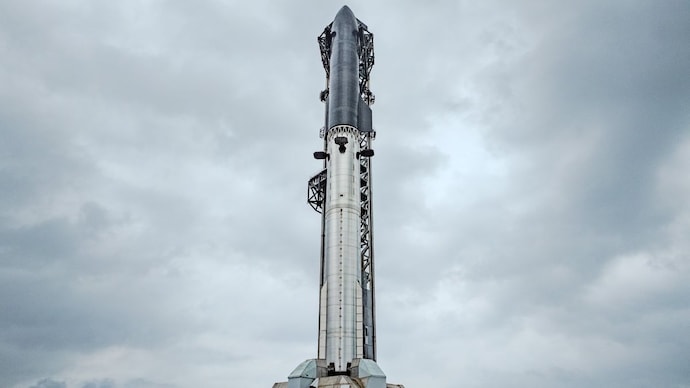
Something made space enthusiasts stop scrolling on Saturday, May 9. Three photographs of the tallest rocket ever built, fully stacked and gleaming silver under overcast Texas skies, appeared on SpaceX’s official X account. For the first time, the complete Starship V3 stood assembled on the launch pad, and the caption said it all: First full stack of Starship V3.
At 124 metres tall, Starship is not just the world's largest rocket. It is SpaceX's grandest bet on humanity's future beyond Earth.
WHAT IS STARSHIP V3?
Starship is a fully reusable two-stage rocket designed to carry humans and cargo to the Moon, Mars, and beyond.
Think of it as two giant tubes stacked atop each other: the lower section is the Super Heavy booster, a powerful first stage that lifts the rocket off the ground; the upper section is the Starship spacecraft itself, the part that carries crew or cargo into space.
The V3, or Block 3, is the most advanced version yet. It brings a range of upgrades that make the rocket lighter, more powerful, and far simpler to operate than its predecessors.
WHAT MAKES THE RAPTOR 3 ENGINE SO SPECIAL?
The biggest change lies in the engine. Both stages of V3 use the new Raptor 3 engine, which produces roughly 280 tonnes of thrust, about 22 per cent more than its predecessor, the Raptor 2.
More thrust simply means more lifting power.
What truly sets Raptor 3 apart, though, is its elegant simplicity. Earlier engines were wrapped in a tangle of external plumbing, sensors, and fire-suppression systems. Raptor 3 has all of that built inside, making it lighter and far easier to maintain.
The Super Heavy booster carries 33 of these engines; the Starship spacecraft carries six.
V3 also features stretched propellant tanks holding about 12 per cent more fuel, alongside improved heat-shield tiles on the spacecraft.
These tiles protect the vehicle during re-entry, the fiery plunge back through Earth's atmosphere.
WHAT HAPPENS NEXT FOR STARSHIP?
This stacking of Ship 39 atop Booster 19 at Starbase, Texas sets the stage for Flight Test 12, the debut orbital flight of the full V3 architecture, targeted for no earlier than May 12.
Before launch, engineers will conduct a wet dress rehearsal, essentially a full fuelling test without an actual liftoff, to verify every system.
If all goes to plan, V3 could eventually deliver up to 150 metric tonnes to low-Earth orbit per flight, repeatedly, with minimal refurbishment between launches.
That is the dream. And right now, it is standing tall in Texas.
Something made space enthusiasts stop scrolling on Saturday, May 9. Three photographs of the tallest rocket ever built, fully stacked and gleaming silver under overcast Texas skies, appeared on SpaceX’s official X account. For the first time, the complete Starship V3 stood assembled on the launch pad, and the caption said it all: First full stack of Starship V3.
At 124 metres tall, Starship is not just the world's largest rocket. It is SpaceX's grandest bet on humanity's future beyond Earth.
WHAT IS STARSHIP V3?
Starship is a fully reusable two-stage rocket designed to carry humans and cargo to the Moon, Mars, and beyond.
Think of it as two giant tubes stacked atop each other: the lower section is the Super Heavy booster, a powerful first stage that lifts the rocket off the ground; the upper section is the Starship spacecraft itself, the part that carries crew or cargo into space.
The V3, or Block 3, is the most advanced version yet. It brings a range of upgrades that make the rocket lighter, more powerful, and far simpler to operate than its predecessors.
WHAT MAKES THE RAPTOR 3 ENGINE SO SPECIAL?
The biggest change lies in the engine. Both stages of V3 use the new Raptor 3 engine, which produces roughly 280 tonnes of thrust, about 22 per cent more than its predecessor, the Raptor 2.
More thrust simply means more lifting power.
What truly sets Raptor 3 apart, though, is its elegant simplicity. Earlier engines were wrapped in a tangle of external plumbing, sensors, and fire-suppression systems. Raptor 3 has all of that built inside, making it lighter and far easier to maintain.
The Super Heavy booster carries 33 of these engines; the Starship spacecraft carries six.
V3 also features stretched propellant tanks holding about 12 per cent more fuel, alongside improved heat-shield tiles on the spacecraft.
These tiles protect the vehicle during re-entry, the fiery plunge back through Earth's atmosphere.
WHAT HAPPENS NEXT FOR STARSHIP?
This stacking of Ship 39 atop Booster 19 at Starbase, Texas sets the stage for Flight Test 12, the debut orbital flight of the full V3 architecture, targeted for no earlier than May 12.
Before launch, engineers will conduct a wet dress rehearsal, essentially a full fuelling test without an actual liftoff, to verify every system.
If all goes to plan, V3 could eventually deliver up to 150 metric tonnes to low-Earth orbit per flight, repeatedly, with minimal refurbishment between launches.
That is the dream. And right now, it is standing tall in Texas.

